

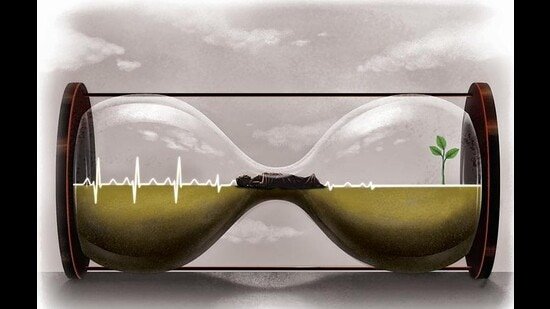
The machine was a rhythmic intruder in a room where the only other sounds were of hushed whispers and people breathing.
I was in the ICU after a sudden respiratory incident hauled me into surgery. It turned out my interior geography, specifically the plumbing of certain blood vessels, had to be rearranged. Dr Aniruddha Bhuiyan, a stellar vascular surgeon and among a few of his kind in India, was thankfully at hand.
During the procedure, conducted under local anaesthesia, I told the doctor I would like to chat with him to keep pace with how it was all going. He spoke with a certain detached intimacy. Dr Bhuiyan had a job to do: ensure I got back to the safety of the bed. That bed is where this dispatch started to take shape.
Lying in the ICU, I thought back to my time on the operating table, watching the monitors; seeing the arteries that carried blood, and the mechanics of my existence, rendered in flickering grayscale. I asked questions because that is what I am trained to do.
Dr Bhuiyan’s craft is a fascinating one. He works on some of the structures that house the human spirit. He found me equally rare, a man more curious about the catheters than the prognosis of pain.
His job is done. I am back home, putting the finishing touches to these words. But I cannot shake the memory of the intensive-care ward. To my left, a man lay trapped in the wreckage of a broken hip. “Mela re, mela,” he would cry every once a while. “I have died. I have died.” In Marathi, the lament sounded raw and primal. To my right, a woman sat in a silence so heavy it felt like a physical presence. She was praying, lips moving in a frantic code, as if trying to negotiate a settlement with God. I learnt she was dealing with stage four cancer.
Straight ahead was the nurses’ bay. There were no Grey’s Anatomy histrionics there. These were efficient professionals who moved with composure. I spent my hours talking to them, sometimes about the endings they had seen, and what that was like.
Confronted with prolonged pain and definitive death, what would they choose: as much time as they could secure, or an early release, I asked. Because this is something that has been on my mind for years, more so lately, amid India’s new approaches. (Our laws on passive euthanasia and living wills have been evolving since 2018.)
The nurses and resident doctors, almost without exception, expressed the opinion I lean towards: “Let me go.”
They have seen the absolute limits of medicine. They know we can keep a body warm and monitors dancing far beyond points of no return.
They also know it is almost never the patient who refuses to let go; it is the family, clutching at the hem of science, desperate to keep loss and grief at bay.
***
I thought a lot, in the ICU, about Harish Rana and his parents.
Rana died on March 24, at the All India Institute of Medical Sciences (AIIMS) in Delhi, in India’s first recognised case of passive euthanasia, after the Supreme Court permitted the withdrawal of life support. He had spent over 13 years in a vegetative state, following a fall at the age of 18. After his death, his family ensured that multiple organs were donated, extending his life into the bodies of others.
This detail haunts me. His parents, Ashok Rana and Nirmala Devi, didn’t just bury their 31-year-old son; they dismantled a monolith, with their plea. Then, in the midst of their grief, they furthered life. Rana’s heart now beats in someone else’s chest. His lungs draw in air for a stranger. His kidneys keep another human healthy.
***
What does it take to be rational in the face of the infinite? It takes the realisation that “sanctity of life” is a hollow phrase if all it indicates is the beeping of a mechanical heartbeat.
This is the realisation I hope will guide my last days, when my time comes — and lying in the ICU, I had a stark sense of just how suddenly such a moment may arrive.
When my time comes, I want to be harvested, my vital organs given away to those who still have a story to write.
Let all the rest go to science. Let a 20-year-old medical student, the age my elder daughter is now, trace the nerves of my arm with a scalpel. Let me be a lesson, and a memory.
A conflict emerges, on thinking of the living. My wife is a woman of deep faith. For her, the grave is a bridge to the divine. Would my decision cheat her of her right to mourn as she sees fit? I think of my daughters. Would they find closure if their father was distributed across five different zip codes and a handful of laboratories? Will the one who knows the landscape of my mind consider it an act of betrayal if the vessel is snatched away while the conversation was still midway?
Years ago, when my father was dying, my brother and I chose logic. When the doctors told us his body had done all it could, we wanted for him what he would have chosen: a dignified, peaceful end. My mother, a deeply religious person, saw it too. Her love eclipsed any confusion, fear or dogma. “Let him go in peace,” she said.
Back then, I lacked the courage to ask the follow-up question. I couldn’t bring myself to broach, with her, the idea of donating his body to research.
It moves me to think that Harish Rana’s parents found the strength to choose radical honesty over ritual.
So, a voice in my head says: Let science have the meat. Let love be the legacy. And let more of us have the courage to follow Harish into the light, leaving nothing behind but the lives we saved.
(Charles Assisi is co-founder of Founding Fuel and author of the Life Hacks column in HT Wknd)
