

“…There once lived a woman, /
Khona, whose incandescent words outlived /
her deafening silence and outshone /
those earthly stars, the powers that rule the world. /
For her severed tongue bled and bled, and the blood spread, /
Sweeping others into the flood… becoming /
a rising tide of women, speaking, speaking, speaking out, /
in many tongues.”
That’s from Radha Chakaravarthy’s poem, Severed Tongue (2023), which draws on the tale of Khona, a 6th-century poet and scholar of astronomy in Bengal.
Her prophecies were so accurate, they inspired jealousy in her father-in-law, Varahamihira, an astrologer in the court of Chandragupta II. Varahamihira ordered her tongue to be severed, to silence her.
Her story lives on, in poems, songs and folktales. “The same cannot be said of Varahamihira,” says Lopamudra Basu, a professor of English at University of Wisconsin-Stout.
Basu is co-editor, with New Mexico-based scholar and poet Feroza Jussawala, of Sing, Slivered Tongue, an anthology of South Asian women’s poetry. Among the poems featured is Chakaravarthy’s Severed Tongue.
The volume contains 67 other poems, by as many women, aged 30 to 70, from India, Pakistan, Sri Lanka Nepal, Bangladesh, and from the South Asian diaspora in the UK, US, Canada, Australia and Sweden. Notable among these are Tishani Doshi from India, Shelly Naz from Bangladesh and Anuja Ghimire from Nepal, the writers ranging in age from 30 to 70.
The collection was two years in the making, Basu says, and she knew from the start who she would reach out to for help co-editing it. She had wanted to work with Jussawala ever since she reviewed her first book of poems, Chiffon Saris (2004), she adds.
Trauma was chosen as the theme of Sing, Slivered Tongue, since it encompasses experiences typically relegated to silence. And yet trauma has, through history, been a persistent element of the female experience, Basu adds.
Take the severed tongue itself. The image appears over and over, across cultures and through centuries, in tales told about women. In Greek mythology, the Athenian princess Philomel was raped by her brother-in-law, who then cut her tongue out to hide his crime. In 2020, during the assault and gangrape of a 19-year-old Dalit woman in Hathras, Uttar Pradesh, her tongue was gashed. She would die two weeks later from her injuries.
In their introduction, the editors write that they are cognisant that “we are still distanced from the traumas of the most-disenfranchised”. The volume, they add, nonetheless seeks to represent a range of voices and experiences.
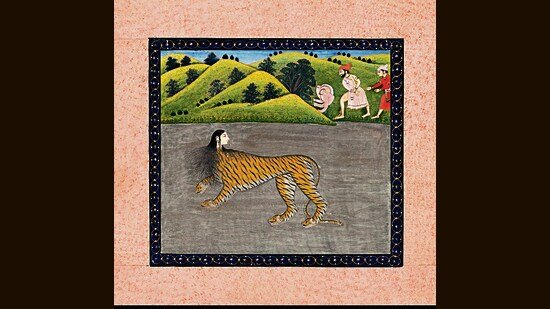
Tishani Doshi’s Tiger Woman (2020), for instance, is a response to a 19th-century Mughal painting that depicts two men in pursuit of a woman with the body of a tiger.
“Lean in and he will tell you /
how the summer hunts are so frequent, /
even the heap of muslin on the bank is overcome with sweat. /
Even the cicadas who are sawing the afternoon in half /
Seem to be signalling a threat. /
On this occasion, the tiger woman escapes, but the sidekick knows, /
eventually the body fails…”
POETIC JUSTICE
“The purpose of this volume is to give the pain a place to exist and to be articulated,” says Jussawala. “That’s the only way to heal a wound; expose it to the air.”
This is important because history focuses on wars and genocides, Basu adds, ignoring the personal wars fought everyday, in ordinary times.
So, in Sounding Brass and Tinkling Cymbals Without Love (2023), Zilka Joseph, the US-based Bene Israeli poet, writes:
“…even now I hear her tinny bangles jingle /
see the fake gold earrings shimmer /
was it her father or husband or brother or uncle /
who tricked her /
who sold her… /
how much did they pay the police /
our landlord the local thugs… /
we see no evil hear no evil speak no evil /
we saved ourselves… /
and did nothing to save the girl.”
While many of the poems address violence and abuse, there are other kinds of trauma explored too, including the death of a parent, the burdens of the caregiver, and the distinct fears inherent in ageing as a woman.
The South Asian female perspective of trauma and pain is hard to come by in mainstream studies, Basu points out. “Our anthology attempts to collect and memorialise a small section of what is thus lost, to give such pain a place to exist. In this way,” she adds, “the volume also ultimately represents hope.”
