

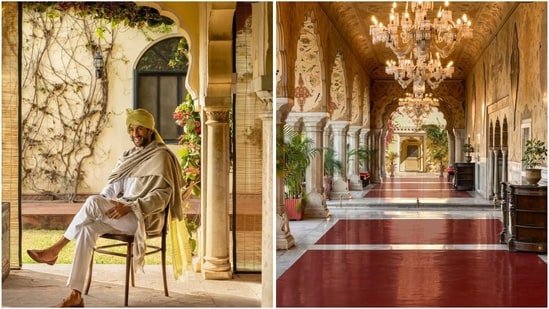
The Jaipur City Palace, a historic symbol of Rajasthan’s royal architecture, is home to several lesser-seen sections that have remained largely hidden from public view. In a conversation with Architectural Digest India, Sawai Padmanabh Singh spoke about these unseen parts of the palace, including private courtyards, stepwells, and restored chambers that reflect its layered architectural heritage. (Also read: Step inside Gautam Gambhir’s beautifully curated ivory-toned New Delhi home that gives him ‘space to think and breathe’ )
A legacy shaped by art and royal patronage
The palace’s artistic legacy dates back to the early 20th century, when German artist Archibald Herman Müller was commissioned by Maharaja Sawai Man Singh II to paint royal portraits.
His works, especially the cartouche-style portraits displayed in the Chandra Mahal veranda, were inspired by Mughal design sensibilities and remain an integral part of the palace’s visual identity. This deep-rooted connection to art continues today, with Padmanabh Singh carrying forward the family’s long tradition of cultural patronage.
Often seen in the tranquil surroundings of the Jai Niwas gardens, Padmanabh, dressed simply yet elegantly, speaks passionately about his vision for the palace. For him, the City Palace is more than just a residence; it is a living museum of craftsmanship and history. He describes it as a space filled with artistic expression, shaped by generations of artisans and built as a centre for community and creativity.
Restoring hidden spaces and sustaining living heritage
One of the most remarkable spaces under restoration is the historic stepwell or baoli, originally designed as a retreat during Jaipur’s harsh summers. Featuring elegant columns, marble slides, and Indo-Rajput architectural detailing, it once served as a recreational space for royal women.
Beyond architecture, Padmanabh also emphasises the importance of sustaining the artisan communities connected to the palace. He believes that Jaipur’s identity is inseparable from its traditional crafts, many of which are at risk of fading. By supporting these craftsmen, he aims to keep the cultural ecosystem of the city alive.
Another notable area within the palace complex is a series of interconnected courtyards and passageways that reveal the scale and complexity of its original design. These spaces, layered with faded frescoes, carved arches, and period detailing, offer a glimpse into how the palace once functioned as a fully lived-in royal residence, with each section serving a distinct social and cultural purpose.
