

20th Century Studios’ The Devil Wears Prada 2 has arrived in theatres to strong responses from both audiences and critics, bringing with it a striking evolution in visual storytelling. Where the original The Devil Wears Prada defined aspirational workplace glamour, the sequel expands that vision into something more layered and expansive—mirroring the modern fashion industry itself. Central to this transformation is production designer Jess Gonchor, who returns to reimagine the world of Runway with a balance of nostalgia and scale, intimacy and opulence.
New York: Where legacy meets scale
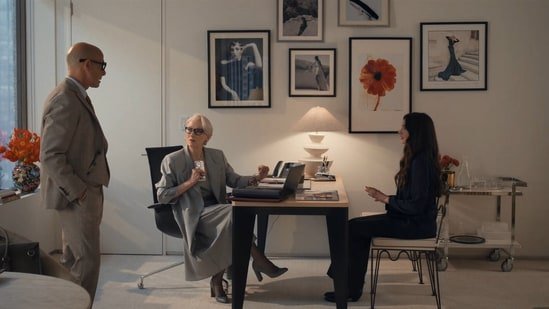
In New York, the film’s core setting is redefined with greater depth and dimension. Miranda Priestly’s office—one of the most recognisable spaces from the original film—has been rebuilt almost entirely from scratch. Gonchor introduces a tactile metaphor for Miranda’s enduring authority, drawing inspiration from stacks of National Geographic magazines to evoke a sense of physical and symbolic weight. The result is a space that feels grounded and imposing, reflecting both the character’s legacy and the shifting dynamics of print media.
“I grew up in a house where my dad had a bunch of National Geographic magazines in the basement, and my mother would joke about them affecting the gravitational pull of the Earth. So, I just wanted to recreate that weight, kind of like Miranda’s holding on to that print media physically and metaphorically,” Jess Gonchor says.
The Runway offices, too, have undergone a dramatic transformation. Now nearly eight times larger than before, the redesigned newsroom embraces scale and movement, featuring elongated communal desks inspired by real-world magazine bullpens, including those at Vogue. The expanded layout captures the frenetic pace and collaborative energy of contemporary publishing.
“We had the luxury this time of building something bigger. So, we played around with having big, long common desks in the bullpen that we modelled after the bullpen at Vogue, though ours is more exaggerated.”
Beyond Manhattan, the production extends into carefully selected locations that enhance authenticity. A Vermont-set estate is realised through Billy Joel’s 26-acre mansion in Oyster Bay, Long Island, while Miranda’s Hamptons residence is filmed in nearby Centre Island. These real-world locations lend the narrative a tangible sense of luxury.
Several iconic landmarks also return, reinforcing continuity with the original film. The American Museum of Natural History serves as the backdrop for the Runway gala, while familiar Upper East Side settings reappear, seamlessly bridging past and present.
Milan: Craft, couture, and cinematic illusion
In Milan, the film leans into spectacle, blending fashion, art, and cinema. Among the most ambitious undertakings is the recreation of the refectory housing The Last Supper by Leonardo da Vinci. Unable to film in the original location, the production team constructed a three-quarter-scale replica on a soundstage, meticulously painted by Italian scenic artists to preserve the integrity of the historic space.
Runway’s fashion show unfolds at the Accademia di Brera, chosen over more public landmarks for greater creative control. The runway itself was built over five days by a local crew experienced in producing Milan’s real-world fashion shows, lending authenticity while maintaining secrecy around key sequences.
The grandeur of Lake Como is captured through Villa Balbiano, transformed into a character’s lavish estate with newly installed gardens and sculptural elements. Meanwhile, Palazzo Parigi provides an elegant backdrop for hotel exteriors and lobby scenes, paired with interiors filmed at the Woolworth mansion in Long Island.
Additional Milan locations—including Villa Arconati, Santa Maria delle Grazie, Palazzo Clerici, and Galleria Vittorio Emanuele II—add further texture, reinforcing the film’s global scale and visual richness.
Rebuilding an icon
What ultimately distinguishes The Devil Wears Prada 2 is not just the scale of its production design, but its intent. Each space—whether reconstructed or real—reflects a world in transition. Through precise detailing and grounded storytelling, Gonchor revisits Runway not as a static icon, but as an evolving entity shaped by time and industry shifts.
The result is a visual landscape that feels both nostalgic and forward-looking, underscoring a central idea: while fashion evolves, enduring style—and thoughtful design—remain timeless.
