

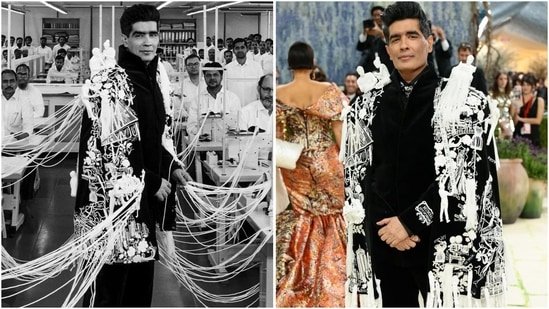
Manish Malhotra transformed the Met Gala 2026 red carpet into a tribute to Indian craftsmanship, arriving in a striking bandhgala and embroidered cape that carried the names and signatures of the artisans behind his atelier.
For his second consecutive Met appearance, the designer moved beyond fashion spectacle to spotlight the often-unseen hands that bring couture to life, turning his ensemble into a powerful celebration of Mumbai, memory, and collective artistry. (Also read: Heidi Klum’s living marble statue look at Met Gala 2026 reminds fans of Hrithik Roshan’s iconic Dhoom 2 museum disguise )
Manish Malhotra celebrates Indian craftsmanship at Met Gala
Dressed in a classic Indian bandhgala layered with a dramatic embroidered cape, the designer used fashion’s biggest stage to honour the hands that have helped shape his couture legacy over the decades.
The cape featured the names and signatures of artisans from his atelier, many of whom have worked alongside him for years, transforming the ensemble into not just couture but a deeply personal tribute to craftsmanship and collaboration.
Taking to Instagram, Manish shared a series of photographs from the Met Gala red carpet along with a heartfelt note about the inspiration behind the look. He wrote, “Fashion is Art/ Artisan. Our atelier at The Met.”
‘Over 960 hours by more than 50 artisans’
Explaining the vision behind the ensemble, he added, “For my appearance at the Met Gala, I wanted to create something deeply personal, a reflection of Mumbai, the city that has shaped my journey, my cinema, and my sense of design, along with the atelier that brings my vision to life every day, my work family.”
The designer further revealed that the architectural cape was brought to life over 960 hours by more than 50 artisans across Mumbai and Delhi. “For me, this is more than a garment; it is a story of craft, memory, and collaboration,” he shared.
Traditional Indian embroidery takes centre stage
The intricate piece combined traditional Indian embroidery techniques, including dori, zardozi, chikankari, and kasab work, all woven together as a visual narrative. The cape also carried references to Mumbai’s cinematic and cultural landmarks, while three-dimensional sculptural details celebrated the artisans themselves.
“Woven into the piece are the names and signatures of the artisans themselves, a tribute to every hand and every moment that shaped it,” Manish wrote, highlighting the often-unseen labour behind couture craftsmanship.
He concluded the note by reflecting on the larger meaning behind the ensemble, writing, “This look is both a celebration and a reminder of where we come from, and how Indian craftsmanship continues to find its place on a global stage.”
