

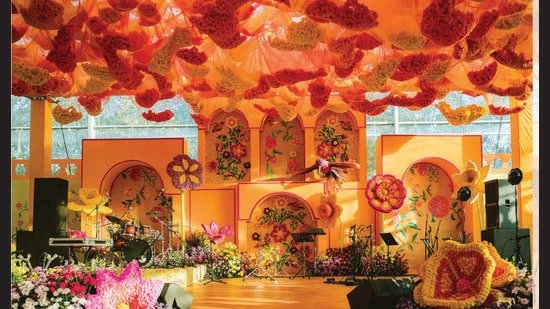
We’re at that point of human evolution when a wedding reception with an oxygen bar for the guests seems old fashioned. When walking through a replica of Hogwarts or the Morarka Haveli to greet the bride and groom seems déclassé. The trends of the moment are more ambitious: A Renaissance-themed reception, a mehendi set in a crochet carnival, a roka party featuring Squid Game competitions (minus the dying, relax).
“In the past decade, there’s been a major shift in the way we view weddings,” says Shweta Mehta, co-founder of Delhi-based event planning company The Wedding Square. Couples now try to make guests feel like it’s their special day too. Prep can start as much as a year in advance and planners consult with art curators, game-show creators, exhibition organisers and digital artists when they draw up their moodboards. See what it takes to wow guests as the couple take their vows.

Say yes to the excess
Aashna Saran, founder of Aash Studio, has been in the wedding planning business since 2011. Over the years, she says weddings and sangeets have moved on from an “awards-show vibe” to an interactive event. “You don’t just want bigger and fancier celebrations – you want bigger and different.”
In February last year, they worked on a mehendi in Ahmedabad that was designed to feel like a carnival. They got artisans to crochet a gigantic crochet blanket for the ceiling decor, and had large kinetic sola flower installations and birds that could flap their wings. There were stalls where guests could make their own potli bags, try tie-dyeing, or put together their own pot pourri. “We worked with glassblowers from Firozabad and sola (hand-carved wood flowers) vendors from Kolkata, plus cane weavers and embroiderers,” recalls Saran. “Our prep started almost eight months in advance.”
The new obsession: Personalisation, both for the guest and each individual host. This could mean building a playlist for each guest’s pick-up vehicle at a destination wedding; air fresheners in the car that tie into the wedding’s themed fragrance. “The experience doesn’t just start at the venue – it means taking into account everything that the guest will see, hear and touch,” says Nidhi Sahi, founder of Enjay Events. Don’t be surprised if there’s a live counter at the wedding – not for chaat or pasta, but for guests to customise their own bag charm, keychain or tote bags.

I do… want it all
The lexicon has changed too. Planners now use terms such as dreamscape, experiential design, and sensory celebration, instead of theme colour and signature scent. “It’s mostly planners who are pushing couples to go beyond their comfort zones,” says Prerika Puri, the founder and creative head of wedding design company To The Aisle. Puri, along with Kavneet Sethi of The Wedding Galore, came up with a bioluminescent-inspired sangeet at Thailand’s Anantara Koh Yao Yai in November 2024. “We’d heard that the island the hotel was located on had bioluminescent beaches, so we went kayaking in the night to experience it. It was magical,” says Puri. But how do you capture that same feeling on a screen? The only way was through 360° LED screens, much like the immersive Van Gogh art exhibits that everyone’s obsessed with. “We had 550 square metres of LED screens that displayed visuals of glowing blue waves crashing onto the shore. It was the highlight of the evening.”
It was a lot of work. The hotel didn’t have a ballroom, so they set up a 1,000 square metre marquee outdoors. It had to be air-conditioned, which was when they realised that the ACs available in Thailand were boxy units that would interrupt the placement of the LED screens. So, they had to figure out a way to pull in the cool air from below the screens. They timed every sangeet performance and choreographed the lighting and LED projections to change accordingly. “Everything was planned down to the smallest detail,” says Puri.
It got them to think beyond their own skills too. “Because you’re designing an experience and not just planning a celebration, you have to be an expert in everything,” says Sethi. “You’re thinking like a lighting technician, a set producer, a sound engineer and a projectionist too.”

Near, far, wherever you are
Destination weddings used to be one large holiday – everyone parachuted into the resort, did the Indian shaadi, and popped out. Now, couples want themselves and their guests to feel like they’re all on a parallel Eras tour, with a quick tour of the country’s culture. “We did a destination wedding in Japan at which we had each of the 125 guests experience a snapshot of life in Kyoto,” says Mehta of The Wedding Square. They organised a traditional tea ceremony and a geisha performance, and gave guests kimonos embroidered with their names for them to relax in their rooms. “Today, people are well-travelled and have already seen everything – either in person or online. So, you try to take something familiar and make it seem new and unique.”
The planning involved multiple trips to Kyoto to understand the culture better. “We went out, interacted with locals, and got a feel of everyday life in Kyoto,” says Mehta. “That helped us design the wedding with a local touch.”

RSVP to the drama
How big can you really go with an interactive celebration? Planners say guest lists have shrunk to accommodate celebrations that feel personal, even as the scale of the event is amped up. “Last April, we worked with a couple who had just 120 of their close friends and family at their roka ceremony. But they wanted them to actually participate in the celebration, not just sit around,” says Vikram Chaudhary, co-founder of Mumbai-based event design company Taxi Design Studio. So, they simulated a Squid Game experience, with over 50 LED screens with visuals that simulated the feel of the show. “We mapped guests’ faces using AI, so you could see, in live time, who was disqualified and who was moving to the next level,” Chaudhary says.
What’s keeping more weddings from being truly immersive, Chaudhary says, is that “we’re still not thinking about technology as an element of design”. This isn’t about video drones hovering above the couple. “Now you can use AI to detect people’s movements on the stage, and change the visuals accordingly. You can cover the venue in screens and create a whole mini-universe within it.” Think of it like the otherworldly visuals that the electronic music producer Anyma does for his concerts. “When you exit the venue, you should feel like you’ve just returned from another dimension.”
From HT Brunch, April 25, 2026
Follow us on www.instagram.com/htbrunch
