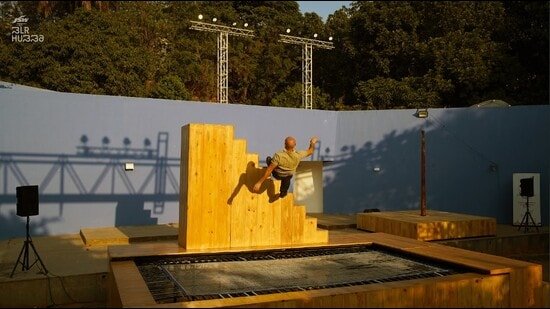
Organised by UnboxingBLR, the BLR Hubba was labelled the FOMO Festival – audiences actually complained that the rich programming made it hard for them to choose between events. And truly, during its course, Bengaluru glut-feasted on diverse art forms and performances across many cultural spaces in the city. Even the streets were included through Rasthe Hubbas. There was theatre of many kinds, music concerts, workshops, art installations, a crafts bazaar, exhibitions, a film festival, heritage walks. Of course, all of it posed a stiff challenge to the infamous traffic jams – the only force known to slow Bangaloreans in search of a lively evening.
The Elevation event at BLR Hubba (UnboxingBLR)
Every chosen Hubba venue was a character in the festival plot. At Freedom Park, once Bangalore’s Central Jail, people watched films and interacted with video exhibits inside what once were cells. There, I watched a memorable short film, Purple Muslin by Erkan Ozgen, that showed the struggles of women displaced by violence from northern Iraq. The events presented at Freedom Park explored the ideas of freedom and confinement, expression and censorship. Some empty cells were even used as frames for selfies taken behind bars!
How can food not be at the core of any Bengaluru-focused celebration? Freedom Park was also the venue for Thindi Hubba, the food festival. I attended a zine workshop facilitated by Nidhi Dhingra near the food stalls. Artistes, professionals, students and others sat with paper and colours to explore memories of their favourite foods while making zines. The Makkala Hubba was a huge draw with parents and children enjoying customised events and workshops. Hush Hour by Songs of Sleep, facilitated by Akash Narendran and Deepthi Bhaskar, offset the frenetic pace by offering festival goers a space to rest and listen to lullabies for an hour every day.The Strangers’ Choir, created and expertly facilitated by Medha Sahi, saw a packed hall of participants, who had just met, suddenly transforming into a choir that comfortably sang in harmony.
The Indian Institute of World Culture, Basavanagudi, is famous for its old and well-stocked library. This is where I attended the first BLR Hubba concert on my list, The Karnataka Raga Trail by Chitra Srikrishna. It uniquely showcased the contributions of Karnataka-based composers and musicians (male and female) to Carnatic music from the times of Vyasathirtha, guru of saint composer Purandara Dasa. Padmini Chettur and her group of dancers presented Varnam at Sabha, a relatively new and popular cultural hub in the city. Shorn of show yet spectacular, Varnam invited the audience to observe movement closely rather than to imagine storylines suggested by it.
I also watched The RE: Moving Project by Miti Desai at Sabha. Using the language of Mohiniattam, Desai described the journey of exiting a pause and moving again. At the same venue, I witnessed the audience falling asleep to lullabies sung by Vedanth Bhardwaj and Gurupriya Atreya in a concert specially designed towards that end.Storiculture’s Blood Moon Over Bengaluru was an immersive theatre performance that transformed its audience into sorcerers for the afternoon – and how willingly did the freshly-minted “sorcerers” participate!
At Bangalore International Centre (BIC), that hosted many events, I found Indri Pickle Lab – a riveting video installation in which a friendly-neighbourhood grandma applies science to the art of pickle making. Created by Jasmeen Patheja and her grandmother Inderjit Kaur, the installation invited audiences to share pickle memories and recipes in specially provided sheets. I left the recipe of my favourite turmeric rhizome pickle for their records which will be shared with pickle enthusiasts over the world through the Pickle Lab’s website.
Speaking about the making of a festival of this scale, Ravichandar V, Chief Facilitator, BLR Hubba, said the effort involved a team of 45 people and 12 curators but “no office or permanent staff.” In true Bangalore spirit, the organisers used “technology and innovation” to their advantage. The festival, budgeted at ₹12 crores was funded through private sources, with the government enabling permissions, support and awareness. “The intent was something for everyone and something near you. Through this Hubba, we wish to foster the community coming together to celebrate the city,” he said. The third edition of the festival has been “the largest yet at 378 events over 30 venues; with 800 plus artistes from 42 countries including Japan, Canada, US, Singapore, Thailand, UK and Norway, among others.”
Sub-festivals were designed to further increase choice. The children’s festival, Makkala Hubba, he adds, “has been a great hit and more than 300 government school children attended every day” using specially provided transport facilities.
For every event I chose to attend at BLR Hubba, I missed at least six others on my wish list. Community music, all women groups, rural collectives, gender-bending performances and fresh voices all featured.
Sa Ma Ra Sa, a women’s classical music ensemble led by Manasi Prasad, for instance, featured Bhagyalakshmi Krishna on morsing and Rajani Venkatesh on the mridangam. Rajani Venkatesh also wowed audiences in her concert with violinist-vocalist Ila Diliip, who opened for the Sirat Trio led by Palestinian violinist, Akram Abdulfattah. In Queen, directed by Daniel Dsouza, we saw a feisty woman fighting for herself and her kingdom under challenging circumstances. In Pebet, the 60-year-old play by Manipur’s Kalakshetra Theatre, a children’s fable played out as a political metaphor. New soundscapes were opened by two remarkable concerts, Anektara: A String Ensemble by Vasu Dixit Collective and East Marries West presented by Shubhendra Rao and Saskia Rao-de Haas, who celebrated the confluence of the sitar and the cello through Hindustani music.
There was more but as I mentioned earlier, BLR Hubba wasn’t called the FOMO festival for nothing.
Charumathi Supraja is a writer, poet and journalist based in Bengaluru.
सिद्धभूमि के लेखक एक प्रमुख समाचार लेखक हैं, जिन्होंने समाज और राजनीति के महत्वपूर्ण मुद्दों पर गहरी जानकारी और विश्लेषण प्रदान किया है। उनकी लेखनी न केवल तथ्यात्मक होती है, बल्कि समाज की जटिलताओं को समझने और उजागर करने की क्षमता रखती है। उनके लेखों में तात्कालिक घटनाओं के विस्तृत विश्लेषण और विचारशील दृष्टिकोण की झलक मिलती है, जो पाठकों को समाज के विभिन्न पहलुओं पर सोचने के लिए प्रेरित करते हैं।
एक ऐसे समय में जब प्रिंट एवं मुद्रण अपनी प्रारंभिक अवस्था में था ,समाचार पत्र अपने संसाधनो के बूते निकाल पाना बेहद दुष्कर कार्य था ,लेकिन इसे चुनौती के रूप में स्वीकार करते हुए स्वर्गीय श्री शयाम सुन्दर मिश्र “प्रान ” ने 12 मार्च 1978 को पडरौना (कुशीनगर ) उत्तर प्रदेश से सिद्ध भूमि हिंदी साप्ताहिक का प्रकाशन आरम्भ किया | स्वर्गीय श्री शयाम सुन्दर मिश्र “प्रान ” सीमित साधनों व अभावों के बीच पत्रकारिता को मिशन के रूप में लेकर चलने वाले पत्रकार थे । उनका मानना था कि पत्रकारिता राष्ट्रीय लोक चेतना को उद्वीप्त करने का सबसे सशक्त माध्यम है । इसके द्वारा ही जनपक्षीय सरोकारो को जिन्दा रखा जा सकता है । किसी भी संस्था के लिए चार दशक से अधिक का सफ़र कम नही है ,सिद्ध भूमि ने इस लम्बी यात्रा में जनपक्षीय सरोकारो को जिन्दा रखते हुए कर्मपथ पर अपने कदम बढ़ाएं हैं और भविष्य के लिए भी नयी आशाएं और उम्मीदें जगाई हैं । ऑनलाइन माध्यम की उपयोगिता को समझते हुए सिद्ध भूमि न्यूज़ पोर्टल की शुरुवात जुलाई 2013 में किया गया |
हमसे संपर्क करने और जुड़ने के लिए मेल करें -
siddhbhoomi@gmail.com
Subscribe to Updates
Get the latest creative news from FooBar about art, design and business.