

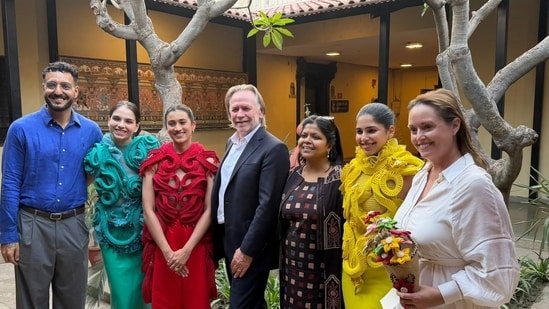
A dance performance accompanying the exhibition ‘The Guardians Across Mountains and Sea’ at the National Crafts Museum & Hastkala Academy in New Delhi brought movement and ritual into dialogue with contemporary fibre sculptures by Australian First Nations artist Grace Lillian Lee.
The performance was choreographed by Shohini Dutta, who said the intention was to animate the artworks and allow audiences to experience them beyond the display.
“The idea was to translate the essence of the artworks into movement and bring them alive through dance,” Dutta said.
The exhibition, curated by Divjyot Singh of the Australian High Commission, presents Lee’s hand-woven sculptures alongside Indian weaving traditions using siki grass and hand-carved wooden masks from tribal communities in Nagaland and Himachal Pradesh from the museum’s collection.
Choreography inspired by the sculptures
Performed by dancers Manvie Kochhar, Nargis Garg and Shreyasi Gopinath, the choreography responded to the woven sculptural forms in the exhibition, translating their themes of wind, cosmology and ancestral memory into movement.
Dancers moved among the sculptural works, responding to their shapes, curves and spirals through fluid choreography that echoed the themes of wind and movement embedded in Lee’s practice.
Sculptures inspired by winds and cosmology
Lee’s sculptural series – North Winds, South Winds, East Winds and West Winds – draws on Indigenous cosmologies where winds guide journeys, carry stories and signal seasonal change.
During the performance, dancers mirrored these ideas through circular movements and directional choreography that evoked currents of air and tidal motion.
The sculptures themselves function as directional markers, referencing navigation systems across oceanic cultures where wind, stars and sea are read as living guides.
The symbolism resonates with traditions in the Indian subcontinent as well, where the cardinal directions are often associated with deities and protective guardians.
Blending dance traditions
The performance brought together dancers trained in diverse traditions.
Manvie Kochhar and Nargis Garg, both trained in jazz and ballet, contributed fluid contemporary movements that echoed the sculptural forms.
They were joined by Shreyasi Gopinath, a Bharatanatyam dancer, a mix that mirrored the exhibition’s theme.
Craft traditions as living knowledge
Lee’s practice emerges from Torres Strait Islander weaving traditions, where fibre work has historically been used to create baskets, bags and functional objects that also carried stories and cultural knowledge.
The exhibition places these traditions in conversation with Indian fibre practices, where weaving has similarly functioned as a living system of knowledge passed down across generations.
Australian High Commissioner to India Phillip Green said Lee’s work highlights how ancestral knowledge continues to shape contemporary artistic expression.
“Australian artist Grace Lillian Lee’s presentation foregrounds First Nations knowledge as living practice. Rooted in tradition yet unmistakably present, her work reminds us that ancestral knowledge moves, adapts and continues to shape contemporary art,” Green said.
By combining sculpture, craft and performance, the presentation offered audiences a multisensory experience of how weaving traditions across Australia and India continue to evolve while maintaining deep connections to ancestry and place.
