

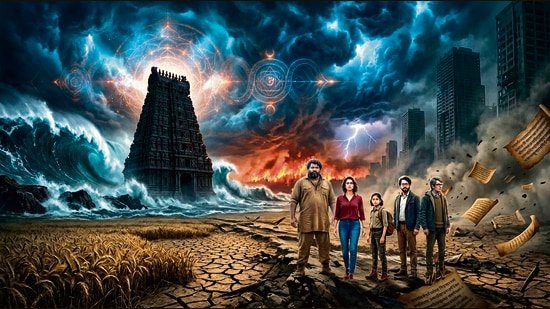
The winds had changed. The oceans were warming. The forests were burning. A monstrous El Niño was coming.
Amid it all, in a wooden cupboard in the basement of a temple in a small town in southern Tamil Nadu, a prophecy was waiting to be uncovered. A prophecy of pralaya or dissolution, handed down from generation to generation, within a family of priests. A prophecy, and a solution.
The Pralaya Prophecy (2026; Hachette India) is Wknd columnist, climate researcher and climate-tech investor Mridula Ramesh’s first work of fiction.
It is rooted in the idea of a planet in peril; but rooted also in the sense of hope, agency and action that underpin Ramesh’s works of non-fiction, The Climate Solution: India’s Climate-Change Crisis and What We Can Do about It (2018) and Watershed: How We Destroyed India’s Water and How We Can Save It (2021).
Like the earlier works, this one is set in the Indian context.
“When I wrote The Climate Solution, the goal was a book that was purely about India,” says Ramesh, 51. She has known for 12 years that she would use the same principle for her first work of fiction (which, incidentally, is designed as a trilogy). “I wanted a work of climate fiction that would have very Indian themes running through it,” she says.
In The Pralaya Prophecy, then, temples, faith and forests have a key role to play.
What did it take to merge myth and data, research and lore? It was an experiment, the author says. “The story weaves together the places and temples I have visited, the science I work with, and the stories I grew up with.”
There is science underpinning it all. Why does faith play a role, for instance? For one thing, a message is rendered more potent when it is delivered by a spiritual leader. Read more on this theme, from a recent Wknd column,here.
In the book, clues hidden in ancient temples, holding the promise of a way forward for the world, serve as a counterbalance to the machinations of a powerful cabal, and the looming potential of AI.
The tale’s incidental heroes are drawn from the general populace: Rajan, born into a priestly family but not a practising priest, battling grief, alcoholism and the disappointment of his father; his brilliant preteen daughter Lakshmi; an immensely capable local schoolteacher named Swati; her cousin, a genteel lout named Arjun; and their family retainer, confidante and protector, Thangam (the true hero of part one).
In their epic quest, this motley crew are up against an axis that is infinitely more powerful, with almost-unlimited resources, whose key agenda is chaos for profit. “The cabal in the book is fiction,” says Ramesh. “But the idea that a greener future and competitive free-market capitalism are poison for some is a very real thing.”
ROOTS AND WINGS
Ramesh has spent much of her career researching, experimenting with and writing about climate-change solutions. She grew up and lives in Madurai, studied chemistry and biology at Cornell University, has an MBA from the Kellogg School of Management at Northwestern University, and worked as a business consultant at McKinsey & Company in Silicon Valley.
She returned to India in 2003, and continued working with McKinsey.
By 2015, she had set off on a different path, founding the Sundaram Climate Institute with a focus on waste and water solutions, and climate education. She is executive director of Sundaram Textiles, which has won the coveted TPM Excellence Award conferred by the Japanese Institute of Plant Maintenance.
After her first two books, cli-fi was a natural next step, she says. “For real climate action, you need to get more people converted than those already in the arena. And you’re not going to get them by writing more non-fiction.”
The idea to infuse some magic into the novel came from her daughter. As soon as she suggested it, Ramesh says, she knew what direction the book could take.
The author grew up around stories of the Siddhars of southern Tamil Nadu, sages and healers who have spent centuries studying the life force represented by the ancient Hindu concept of the kundalini. From their systems of belief, she draws much of the philosophy that runs through the book, of how body, mind, earth and universe are connected. And how, when one is tipped out of balance, chaos can follow.
“I think all religions have something to say about balance,” Ramesh says. “Even the idea of treating others as you would like to be treated yourself is about not overstepping bounds.”
FIRST PERSON, SINGULAR
In the book, then, ordinary people — although it could be argued there is no such thing — dig deep, to find the power and energy that will carry them through a seemingly impossible mission.
In the real world, Ramesh says, the magic could be as simple as a shift in perspective. “Then, everything changes.”
Ramesh has lived this shift. “I knew nothing about the climate crisis 13 years ago,” she says.
Then, amid a drought in Madurai, the borewell that she, her husband and their two children relied on ran dry. The idea of the water simply running out seemed so outlandish that “at first we thought it was a technical issue”. They soon realised that the water was in fact gone.
Ramesh decided to investigate, and use lessons she had learnt at the textile factory, to address this issue in her home. The family installed water meters, started composting and decided to monitor and slash waste in all its forms.
“The magic is the shift in perspective: to think that this was my problem and I had to be part of the solution” Ramesh says.
What matters, of course, is a shift of this kind at the community, district, national and global levels. It can help to put a price on environmental resources, particularly on water and carbon, as a way of signalling value or respect, the researcher says. “It’s because we don’t price pollution, water, carbon, forests or biodiversity that we need to have this conversation today.”
The Pralaya Prophecy is her way of driving this conversation, and shift. “You have to try different ways of repeating the same message,” Ramesh says. “You can’t keep doing the same thing over and over again, and expect change to come.”
