

It’s not unusual for an artist to use ash, metal dust, industrial lacquer, resin, found objects, digital transfers, even dried blood in their works. Andy Warhol, famously, urinated on canvases primed with copper paints to create his Oxidation series in the 1970s. Abby Leigh flattens her oil and wax paintings to squiggles with a sledgehammer. Lucien Smith uses a fire extinguisher to apply paint to canvas.
It makes the material more than a medium. Art, after all, is the embodiment of an idea, not the application of pigment to a surface. That is why I feel drawn to the surrealist, maximalist art of Raqib Shaw. The Kashmiri artist based in London, shares powerful messages of displacement, desire, and the price of human cruelty – all in unusual ways.
Shaw starts out familiarly enough. His drawings are outlined with acrylic paint much like in stained glass windows. He then fills them with industrial car paint – a choice he made early in his career, when he couldn’t afford more expensive paints. He isn’t just spraying it on. Shaw uses a fine-tipped porcupine quill or needle to achieve precision, adding jewels, glitter and other embellishments as needed. The technique and material has since become his signature.
It’s also given every inch of his canvas a fantastical feel. There are wildly imagined creatures, forces of nature imbued with life, self-portraits depicted in a variety of moods, fully realised dream worlds. They’re beautiful – colours bright, the shapes all tumbling into each other. But they’re deliberately unsettling. The longer you look at them, the more tension emerges.
Look at his monumental piece, Paradise Lost (2009-2025), a 100-foot-wide, 21-panel autobiographical work. Inspired by English poet John Milton’s poem of the same name, it presents a lush forest alive with animals and mythic energy. It feels enchanted, but the sense of innocence is fragile and fleeting, ready to slip away at a moment’s notice. The colour and detailing of the forest scene, garden scene and cityscape is breathtaking, despite its massive scale. It shows that beauty and disturbance coexist.
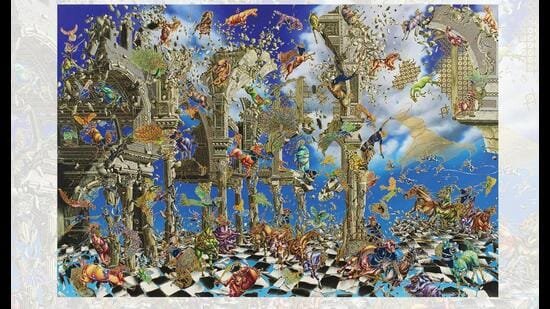
In Horse Catcher (2013), a grand building made in some kind of ancient architectural style, seems to be disintegrating against a luminous blue sky. Horses and other creatures float around, tumbling through space. It’s a magnificent scene depicting the fear of instability. There is a sense of quiet collapse within beauty, chaos hidden within grandeur.
I’m most interested in Shaw’s use of ornamentation. His art works appear decorative, yet contain heavy themes of exile, loss, and hidden tension. They demonstrate how illusion can mask turmoil. Shaw’s family left Kashmir in the ’90s, following the region’s political insurgency. They used to trade in carpets, objets d’art and more. Then, on a business trip to London, he discovered a love of art, and eventually settled there to establish his practice. It’s not surprising that his work reflects his early exposure to beautiful objects, and also laments a lost land. It rewards slow looking. And it’s a great example of why the medium is sometimes the message.
Mukesh Sharma’s e-waste works reflect small-town experiences within metropolitan life, social media-driven isolation, and rapidly changing cities.
From HT Brunch, March 07, 2026
Follow us on www.instagram.com/htbrunch
