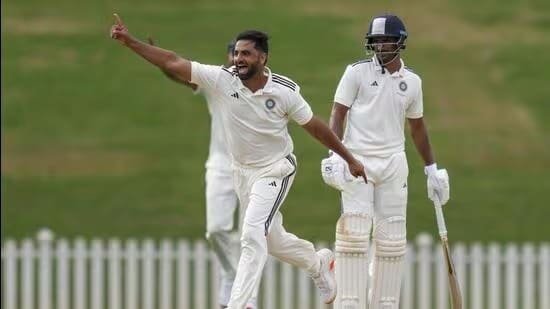
Jammu & Kashmir’s spectacular ascent to their first Ranji Trophy title points to an important aspect of cricket in India: the game has achieved near-perfect saturation in the country’s sporting culture. Even a small but consistent nudge in the right direction can now propel a region or team towards unprecedented success.
Auqib Nabi, the 29-year-old fast-bowler who spearheaded J&K’s Ranji campaign, comes from Baramulla, where he learnt to play cricket on cleared patches of farmland. (PTI)
Every state that is not a cricketing powerhouse yet should sit up and take note of what J&K did right, to get to the pinnacle of the domestic game.
This team has been playing the Ranji for 67 years, yet, for a variety of interconnected reasons — internal strife, political instability, militancy, lack of jobs, a poor economy — has had only the most bare-bones infrastructure. To begin with, there are just two stadiums in the region: Sher-i-Kashmir in Srinagar and Maulana Azad in Jammu. Both lay disused and dysfunctional until repairs began ahead of the 2025-26 Ranji season.
Cricket academies, nets and other facilities are too few, and remain concentrated in the same two cities.
Auqib Nabi, the 29-year-old fast-bowler who spearheaded J&K’s Ranji campaign with a remarkable 60 wickets this season (the highest in the tournament; he is, in fact, one of only a handful of bowlers ever to take 60 or more wickets in Ranji history), comes from Baramulla, where he learnt to play cricket on cleared patches of farmland.
“It’s still hard to find proper pitches, turf or nets in Baramulla,” he said, when we spoke days ahead of the win. When it was apparent that he had the potential to be a really good player, coaches and friends advised him to leave J&K and look for opportunities elsewhere. He joined a club in Bengaluru.
His arc, with small tweaks, can be used to trace the journeys of all his Ranji teammates.
Amid the lack of infrastructure and long decades of being the whipping boys of domestic cricket, J&K’s transformation began with one man’s belief.
When Irfan Pathan joined the state team as player and mentor in 2018, he saw something of himself in the young men’s hunger to succeed. “It’s the same mentality as an up-and-coming Mumbai cricketer,” Pathan has said in interviews. “If you are coming from Jogeshwari or Andheri, you have to go to town on a local train carrying a kit bag. You take two hours just to reach the ground. Then you have to make sure that you have full concentration when you get your chance.”
In this atmosphere, Pathan realised his first task was to encourage a new kind of mindset in J&K’s players, whether beginners or members of the state squad. They had to believe that their game mattered, that they were already in possession of all the raw ingredients they needed in order to succeed.
Pathan spent two years in J&K, but unearthed more than half the players who scripted this season’s Ranji fairytale, from Nabi to the big-hitting Abdul Samad.
Soon after Pathan left, Mithun Manhas, who is now president of the Board of Control for Cricket in India (BCCI), was appointed head of development for J&K cricket.Over a couple of years, he built an elite atmosphere for the state’s senior team, getting the ball rolling by handpicking coaches, including head coach Ajay Sharma from Delhi, bowling coach P Krishnakumar from Bengaluru and fielding coach Dishant Yagnik from Rajasthan. They were then invited to develop the team as they wished, with a long rope in terms of time.
On Krishnakumar’s advice, Manhas had a pacy, bouncy pitch laid at Sher-i-Kashmir, with a view to developing fast-bowling talent. Krishnakumar then spent almost a year there, in relentless training with his core bowling unit.
“The first thing for me was to bring them out of their inferiority complex,” he told me. “And make them understand that they were as good as anybody, and it was just a matter of execution and mental strength. That automatically made them want to develop their skills too. Nabi, for example, must have bowled at least a thousand balls that season just to master his wrist position.”
A change in mentality for players, a dedicated team of coaches planning for success, and an administration that cares. That is (clearly) a recipe for success.
(Email feedback to rudraneil@gmail.com. The views expressed are personal)
सिद्धभूमि के लेखक एक प्रमुख समाचार लेखक हैं, जिन्होंने समाज और राजनीति के महत्वपूर्ण मुद्दों पर गहरी जानकारी और विश्लेषण प्रदान किया है। उनकी लेखनी न केवल तथ्यात्मक होती है, बल्कि समाज की जटिलताओं को समझने और उजागर करने की क्षमता रखती है। उनके लेखों में तात्कालिक घटनाओं के विस्तृत विश्लेषण और विचारशील दृष्टिकोण की झलक मिलती है, जो पाठकों को समाज के विभिन्न पहलुओं पर सोचने के लिए प्रेरित करते हैं।
एक ऐसे समय में जब प्रिंट एवं मुद्रण अपनी प्रारंभिक अवस्था में था ,समाचार पत्र अपने संसाधनो के बूते निकाल पाना बेहद दुष्कर कार्य था ,लेकिन इसे चुनौती के रूप में स्वीकार करते हुए स्वर्गीय श्री शयाम सुन्दर मिश्र “प्रान ” ने 12 मार्च 1978 को पडरौना (कुशीनगर ) उत्तर प्रदेश से सिद्ध भूमि हिंदी साप्ताहिक का प्रकाशन आरम्भ किया | स्वर्गीय श्री शयाम सुन्दर मिश्र “प्रान ” सीमित साधनों व अभावों के बीच पत्रकारिता को मिशन के रूप में लेकर चलने वाले पत्रकार थे । उनका मानना था कि पत्रकारिता राष्ट्रीय लोक चेतना को उद्वीप्त करने का सबसे सशक्त माध्यम है । इसके द्वारा ही जनपक्षीय सरोकारो को जिन्दा रखा जा सकता है । किसी भी संस्था के लिए चार दशक से अधिक का सफ़र कम नही है ,सिद्ध भूमि ने इस लम्बी यात्रा में जनपक्षीय सरोकारो को जिन्दा रखते हुए कर्मपथ पर अपने कदम बढ़ाएं हैं और भविष्य के लिए भी नयी आशाएं और उम्मीदें जगाई हैं । ऑनलाइन माध्यम की उपयोगिता को समझते हुए सिद्ध भूमि न्यूज़ पोर्टल की शुरुवात जुलाई 2013 में किया गया |
हमसे संपर्क करने और जुड़ने के लिए मेल करें -
siddhbhoomi@gmail.com
Subscribe to Updates
Get the latest creative news from FooBar about art, design and business.