

Now that Fargo, the engrossing TV series, exists as a complete five-season work (with Season 6 a distant hope), it felt like the right time to revisit the entire show. So that’s exactly what I did recently, binge-watching all five seasons with my partner, who was watching creator Noah Hawley’s anthology for the first time.
Freed from the anxieties of plot, since I already knew which characters would survive the bloodbath and which schemes would unravel, I found myself paying closer attention to something I’d only half-registered the first time around: the music.
What a good idea that was. Fargo, it turns out, is that rare series that rewards a second viewing not for plot twists one missed, but for the details buried in plain sight. Chief among them: one of television’s most audacious soundtracks.
Inspired by the Coen brothers’ 1996 film of the same name, the series shares more than just the title and Minnesota setting with its cinematic predecessor. It inherits the film’s darkly comic sensibility, its fascination with ordinary people caught in extraordinary violence, and its understanding that songs can be as menacing as a loaded gun. But where the film was a single, contained story, the series has each season set in a different era (from the 1950s to 2019), each with its own cast of characters — and a meticulously curated sonic dimension.
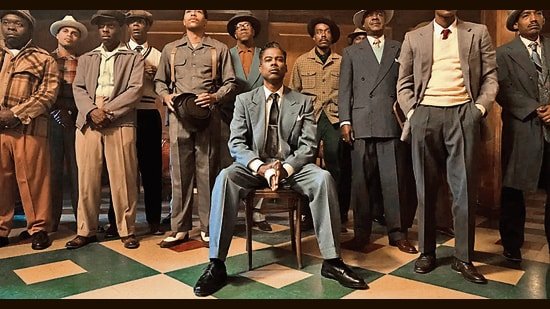
There’s a moment in Season 2 when a cover of Just Dropped In (To See What Condition My Condition Is In) by White Denim crashes into the frame. It’s not the Kenny Rogers original. This is grittier, rougher, stripped of nostalgia and rebuilt to create unease. The choice is characteristic of what makes Fargo such a masterclass in storytelling.
Most crime dramas lean on music as window-dressing. Fargo uses it as a building block. Yes, there’s Jeff Russo’s exquisite original score, with its haunting xylophone motifs and strings that seem to teeter on the brink. But there’s also everything from psychedelic rock to Soviet choir music and obscure Italian gibberish pop to classic British blues rock from the 1960s.
The first season, released in 2014 and set in 2006, reaches immediately for the genuinely strange: the ethereal Full Moon by Eden Ahbez and the raw Crawlin’ Kingsnake by John Lee Hooker, both making the Midwestern bleakness bleaker still. Adriano Celentano’s Piccola adds a bit of Italian rock-and-roll with inflections of swing into snowy Minnesota without seeming the least bit incongruous. The songs are deliberately off-kilter, and they work.
By Season 2, set in 1979, the show’s musical ambition has bloomed. Here, one finds a deep dive into the decade’s sonic contradictions: Jethro Tull’s Locomotive Breath chugs alongside Billy Thorpe’s prog epic Children of the Sun. Bobby Womack reinterprets California Dreamin’ with soul, while Blitzen Trapper’s version of I Am a Man of Constant Sorrow twists traditional folk into something modern and scary. There’s also the Japanese-sounding yell-along Yama Yama by the fictional, studio-created band The Yamasukis, and Shakey Graves paired with Monica Martin for a bone-chilling rendition of O Death.
Season 3 takes the show’s musical eclecticism to absurdist heights. It opens with Celentano’s Prisencolinensinainciusol, an Italian song composed entirely of gibberish meant to sound like English; a perfect metaphor for the season’s themes of post-truth and miscommunication. Later come World Party’s Ship of Fools and Lambert, Hendricks & Ross’s jazz standard, Moanin’. Then, most audaciously, Jeff Russo covers Britney Spears’s Toxic with singer Lisa Hannigan, transforming the pop tune into slow-burn dread. The season also features the Ural Cossacks Choir singing the folk songs Kalinka and Katyusha, a cultural hat-tip to the show’s Russian side-plot and the sinister character, Yuri Gurka.
Season 4 — the one that divided critics — retreats to 1950 Kansas City. Here, the soundtrack functions as a socio-political map, a collision of the sophisticated and raw. We get the elegant jazz Art Blakey version of Moanin’, and the French poise of Edith Piaf’s Le Petit Homme, representing the established order. But the soul of the season lies in the grit: Koko Taylor’s Insane Asylum with its Delta blues influence haunts the rivalry between the Italian and Black crime syndicates. The inclusion of Slim Gaillard’s Yep Roc Heresy adds that quintessential Fargo touch of the bizarre: a bebop tune in a nonsensical “Vout” language (a mix of Arabic food names, hipster slang and nonsense words) that, in a sense, represents the chaotic nature of the American Dream.
Finally, Season 5 returns us to 2019 and delivers perhaps the most playful soundtrack yet. Rush’s Working Man sets the blue-collar tone for main antagonist Roy Tillman’s Montana domain, while Grand Funk Railroad’s fuzzy, frenetic Paranoid injects classic rock swagger into the character Dot’s suburban survivalism. But it is the choice of Danny Elfman’s This Is Halloween, taken straight from The Nightmare Before Christmas (1993), that once again proves Fargo’s willingness to go left when every other show might turn right, twisting a whimsical holiday tune towards gothic darkness.
Meanwhile, Village People’s YMCA echoes through a political fundraiser, somehow feeling both ironic and perfectly sincere in its depiction of Americana. This is topped off by a reprise of the haunting, unsettling Russo-Hannigan cover of Toxic.
Fargo’s music consistently chooses the cover over the original, the obscure over the obvious, and the dissonant over the conforming. The result is a curated playlist as unexpected as the plot of each season.
(To reach out, email sanjoy.narayan@gmail.com. The views expressed are personal)
