There’s a century I particularly favour, when it comes to word histories. Two consecutive ones, actually: the 16th and 17th.
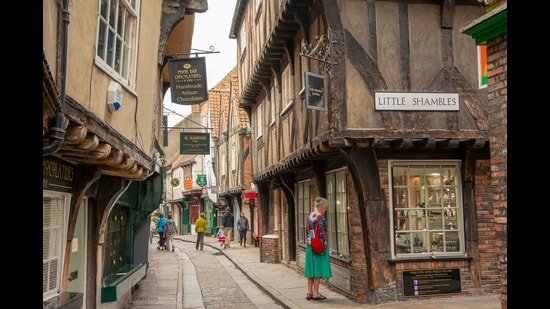
For something to technically be a shambles, it would need to be covered somewhat in slaughtered meat! Even the Shambles aren’t a shambles any more. Above, stores line a street in York where butchers once displayed meat on “fleshammels” or “flesh shelves”, which is where we get the term. (Wikinedia)
So much was happening in urban England at this time. Society was changing; London was growing. This was nothing like the boom the city would see in the 1800s, but new terms were still needed for new customs and business practices. Old words were being redefined. And the English language itself entered a significant phase of formalisation, with the emergence of early dictionaries and standardised spelling.
Because so much of everyday language was now being entered into the written record (via diaries, novels, plays, poems), we can look back and see the Latin, Old French and Old English take new journeys. (That last word, incidentally, comes from the 13th century Old French journée, or the course of travel in “un jour” or “one day”.)
Back to my favourite centuries, take, for instance, round robin. This is the term for a system in which people (or software programs, today) take turns to occupy a position or perform a task. The term doesn’t come from any habit of the birds; they don’t, after all, perch in circles or arrange their chores in this way.
It has roots in the Old French “rond ruban” or “round ribbon”… because petitions sent to kings, or to a ship’s captain, had signatures arranged in a circle, so that no one name stood at the top of the list, and was singled out as a primary instigator. So round, and like a ribbon.
Complexion is another interesting one. It derived from the Latin complexio, for combination. Until the 15th century, one’s complexion was the way in which the four supposed humours of the body had combined within a person. From there, it came to mean “outward aspect” (the humours were thought to play a large role in defining appearance and temperament). It was a short hop from there to the idea of complexion as the state of one’s skin.
From skin to overall appearance, I particularly like the path “handsome” has taken.
It started out having nothing to do with aesthetics whatsoever. In the 15th century, the word indicated that something was “easy to handle”; tools or weapons, for instance. Fast-forward a century, and it had become shorthand for convenient. Convenient became pleasant, and, by the late-16th century, “physically attractive in an aesthetically pleasing manner”.
Now to my three favourites from this era.
The first is “pittance”. In the Middle Ages, this was a word derived from Latin that meant “pious request”. By the 16th century, it was the term for a small sum of money donated to a monastic order, in memory of a deceased loved one. As such sums grew smaller, the term became a byword for payment that simply wasn’t enough. And “paid a pittance” is what we still say.
Nippy, meanwhile, today means nimble; until the 16th century, it indicated a stealthy act of thieving. Which is a rather self-explanatory journey. But nipper today simply means “small child”. How did that happen? The evolution isn’t what you’d think (children were pickpockets and so on; no, that’s not it).
By the 1800s, on London’s bustling streets, little boys were being taken on as assistants by costermongers (fruit and vegetable vendors). Their job was to watch the wares and raise an alert if someone tried to shuffle off without paying. To do this, the boys needed to be nippy; or, quick and clever. Today, cleverness doesn’t really enter into it; a nipper is, simply, a little child.
My absolute favourite is shambles. This comes from the Old English “fleshammels” (or flesh-shelves), for the stools and tables that butchers used to display their wares. Over time, meat markets came to be called shambles. These were chaotic places, often serving as their own slaughterhouses. Shambles, eventually, came to mean “scene of carnage”.
So when you say her place is a shambles, just remember: it really isn’t (or is it)?
(Adam Jacot de Boinod is author of The Meaning of Tingo. The views expressed are personal)
सिद्धभूमि के लेखक एक प्रमुख समाचार लेखक हैं, जिन्होंने समाज और राजनीति के महत्वपूर्ण मुद्दों पर गहरी जानकारी और विश्लेषण प्रदान किया है। उनकी लेखनी न केवल तथ्यात्मक होती है, बल्कि समाज की जटिलताओं को समझने और उजागर करने की क्षमता रखती है। उनके लेखों में तात्कालिक घटनाओं के विस्तृत विश्लेषण और विचारशील दृष्टिकोण की झलक मिलती है, जो पाठकों को समाज के विभिन्न पहलुओं पर सोचने के लिए प्रेरित करते हैं।
एक ऐसे समय में जब प्रिंट एवं मुद्रण अपनी प्रारंभिक अवस्था में था ,समाचार पत्र अपने संसाधनो के बूते निकाल पाना बेहद दुष्कर कार्य था ,लेकिन इसे चुनौती के रूप में स्वीकार करते हुए स्वर्गीय श्री शयाम सुन्दर मिश्र “प्रान ” ने 12 मार्च 1978 को पडरौना (कुशीनगर ) उत्तर प्रदेश से सिद्ध भूमि हिंदी साप्ताहिक का प्रकाशन आरम्भ किया | स्वर्गीय श्री शयाम सुन्दर मिश्र “प्रान ” सीमित साधनों व अभावों के बीच पत्रकारिता को मिशन के रूप में लेकर चलने वाले पत्रकार थे । उनका मानना था कि पत्रकारिता राष्ट्रीय लोक चेतना को उद्वीप्त करने का सबसे सशक्त माध्यम है । इसके द्वारा ही जनपक्षीय सरोकारो को जिन्दा रखा जा सकता है । किसी भी संस्था के लिए चार दशक से अधिक का सफ़र कम नही है ,सिद्ध भूमि ने इस लम्बी यात्रा में जनपक्षीय सरोकारो को जिन्दा रखते हुए कर्मपथ पर अपने कदम बढ़ाएं हैं और भविष्य के लिए भी नयी आशाएं और उम्मीदें जगाई हैं । ऑनलाइन माध्यम की उपयोगिता को समझते हुए सिद्ध भूमि न्यूज़ पोर्टल की शुरुवात जुलाई 2013 में किया गया |
हमसे संपर्क करने और जुड़ने के लिए मेल करें -
siddhbhoomi@gmail.com
Subscribe to Updates
Get the latest creative news from FooBar about art, design and business.