

You expect a lot of things when you enter a bar. Drinks with names you can’t understand. Tipsy friends who are two shots away from deciding to start a podcast. Soggy fries. People seriously listening to a lecture on a weekend? Not so much. People holding a beer in one hand while raising the other to pose questions on Martian rovers, game theory and how plants and bugs talk to each other? Even less so.
The revenge of the nerds is upon us. City bars now host expert-led, visual-heavy chill lectures about subjects that would have otherwise remained inside college classrooms. And the very people who might have spent undergraduate life bunking lectures are now paying to attend them. The discussions cover science, history, poetry, astronomy and art. They’re short; rarely longer than an hour. There’s beer to be sipped alongside, and no exam at the end. Why didn’t anyone think of this earlier?
Notes in the margin
The OG is Canada’s Trampoline Hall barroom lectures, which have been held since 2001 and have covered everything from Taoist philosophy to the fetishisation of tragedy. Lectures on Tap have been held in the US since 2024, with 45-minute expert-led talks that range from alien megastructures to ancient Athens.
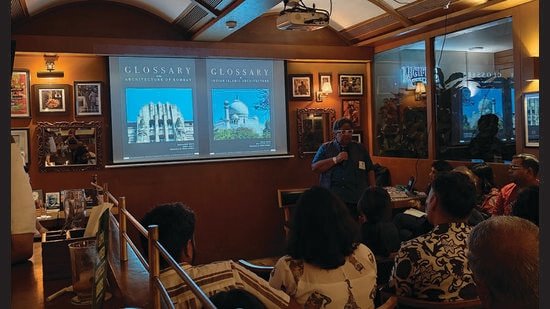
It’s what inspired Shruti Sah and Harsh Snehanshu to start something similar in Bengaluru, and rope in Diya Sengupta and Abhishek Shetty to extend it to Mumbai. They wanted to bring in speakers who talk about subjects that people didn’t learn in school or college, says Sengupta, 39. At last Sunday’s lecture on Mumbai’s older architectural styles, architect Mustansir Dalvi displayed AI-generated renderings of colonial Bombay, and pointed out such diverse influences as Greek columns and the Gol Gumbaz in the city’s buildings.
In Delhi, the unLecture founders are recent graduates, who have fresh memories of how boring classroom sessions can be. Kezia Anna Mammen, 22, says that young people need to “reclaim learning” in an age where information now comes in caption-and-summary Reels. “It feels as if you read something and forget it the next minute,” says Mammen. “People are looking for ways to learn cool things and actually retain that knowledge.”
So, they’ve made their bar lecture titles sound like clickbait: Sex, Death and the Long War of Life (on evolution) and Who Gets to Be A Man? (on violence and masculinity in colonial India). “Politics, urban planning, economic theory, government policy — anything can be interesting if you package and present it well,” says Mishka Lepps, co-founder. The lectures last 20-25 minutes “because that’s how long most people can pay attention without losing focus.”
And the aim is to keep the learning process as chill as the beer. One economics professor they approached seemed excited to talk about what economists really do. “When he first demonstrated his presentation to us, it looked super complex – and I have an economics degree!” Mammen recalls. “This was the stuff that made me doze off when I was in the classroom.” They asked him to drop the jargon, include real-life examples – the actual and imagined causes of Delhi’s pollution, why we’re drinking more coffee – and re-format the lecture as a story. “It was challenging for the lecturer; they’re not used to simplifying these concepts for a lay audience. But it turned out to be an engaging session.”
Lesson plans
Muskan Bhalla, 23, who started Society of Intellectuals in Mumbai and Pune, knows that toning down an expert’s technical details is the key part of the job. “Wherever possible, I ask them to include anecdotes and how the topic applies to them. That’s what gets people to pay attention.” One lecturer sent in yawn-inducing mathematical concepts about quantum physics. Bhalla had him structure the whole lecture as a story – and added animation and memes to the presentation. “We made it seem like we’re time-travelling through different periods of history and viewing the developments that changed the field. That worked much better.”
Pint of View encourages lecturers to go heavy on the visuals and the theatrics. One professor from IIT Bombay showed up with a tennis racket to demonstrate angular momentum. “We don’t expect you to memorise everything, or feel pressured to learn something,” says Shetty. “The hope is that you remember at least a few facts after.”
Attendees tend to show up to the bars with notebooks and sticky notes. Neha Londhe, 24 and Rahil Shah, 24, came to Dalvi’s lecture – their first – because they’re lawyers and work at Bombay High Court, a heritage structure in the older part of the city. “We’re surrounded by these beautiful, heritage structures. It was exciting to hear Mr. Dalvi identify elements of Neo-Classical and Gothic architecture,” says Londhe.
Lecturers love it. K Sridhar, a particle-physics scientist based in Bengaluru, delivered a Pint of View lecture on the theoretical extra dimensions of reality. He’s been trying to get the public interested in scientific knowledge since 1997. “The work we do is difficult to understand, and most scientists take shelter under that pretext.” It’s why most of them talk like they’re “trying to impress a PhD committee”. At the Mumbai lecture, however, it was all plainspeak, and patience. He started with a poem by the Portuguese poet Fernando Pessoa, and found his young audience involved and attentive. Some came up to him, notebook in hand, with questions. “They’d also read up about the subject because they were interested in it.”
No points for guessing
You can’t control for every variable, especially in a bar. Not every lecturer can control an audience the way they do with students. Some ramble. Some veer off course. “Out of every 20 lectures you do, one or two don’t land,” says Bhalla. “By then, it’s too late to stop them.”
The best lecturers, Bhalla says, come prepped to perform, even preen a little bit. One expert who came to talk about the art of storytelling, brought the audience to tears with a sad story that was ostensibly about his own life. He then flipped everything on its head by telling them it was a made-up tale – to prove a point about the power of writing. “Now, I look for that performativeness right from when they make their pitch.”
From HT Brunch, February 07, 2026
Follow us on www.instagram.com/htbrunch
