

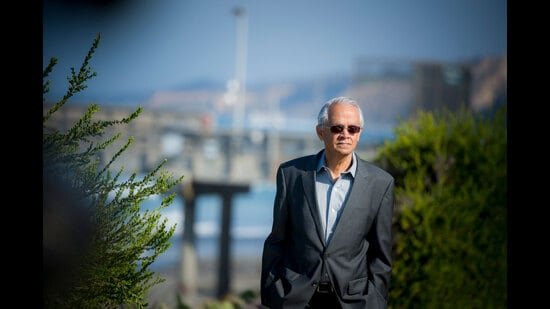
Veerabhadran Ramanathan, 81, has just won the Crafoord Prize (in Geosciences), often considered a precursor to the Nobel.
He discovered that chlorofluorocarbons (CFCs), common refrigerants at that time, were, in fact, potent greenhouse gases. While working at the US National Aeronautics and Space Administration (NASA’s) Langley Research Center in the 1970s, the young man from a village in Tamil Nadu discovered that one tonne of a CFC could have the same warming effect as up to 10,000 tonnes of carbon dioxide. His findings made the front page of The New York Times.
For half a century, his work has added important nuances to our understanding of how climate works. His research has formed the basis of international agreements. He has advised four popes on climate change.
What does he make of where we are today? Excerpts from an interview.
* Your life has been shaped by “productive accidents”: moving to Bangalore to a school where you didn’t speak the language, taking an unfulfilling job in refrigeration, having your PhD advisor radically switch focus. Do you think your breakthroughs came despite these disruptions, or because of them?
My early education was in Trichy and Madurai, in Tamil-medium schools. The Swedish Academy has a photo of me with my teacher, in a tie and shirt — but no footwear. The school provided the shirt and tie. In those days (the 1950s), many parents couldn’t afford shoes for children.
It was unbearably hot during the summers we couldn’t stay inside. There was no fan, no electricity. We couldn’t go outside either. You couldn’t step on the burning ground with bare feet. So the children played in the verandah.
Now imagine what happens in places like that when temperatures rise by five or ten degrees. That, to me, is the core issue of climate change. Wealthy people, like me now, emit heat-trapping pollutants, but the damage is borne by the poor.
In 2014, I related this climate injustice to Pope Francis in the parking lot of St Peter’s Basilica. In his encyclical (or papal letter) published a year later, he described climate change as a moral sin.
A year later, I was on stage with the Dalai Lama in California for his 80th birthday celebrations. After hearing me speak, he said: “Tell me, Dr Ramanathan, how can you clean the outer environment without cleaning the inner environment?” The Pope’s words and the Dalai Lama’s words were ringing in my ears until I included societal transformation as a major component of climate solutions in my own work.
Coming back to education, it was in Tamil until my father was transferred to Bangalore. Suddenly, everything was in English. I couldn’t understand a word. I went from top of the class to the bottom. Somehow — and this is where personality matters — I decided my teachers didn’t know what they were talking about. That’s why I was failing. So, I started learning on my own.
More importantly, I lost my fear of the unknown. That’s what let me move across many fields, from the climates of Mars and Venus to Earth’s climate; from carbon dioxide as the sole warming agent to CFCs, to pollution.
My grades, though, were bad. I didn’t get into an Indian Institute of Technology. I went to Annamalai University. After that I took a job in refrigeration, which I hated. Customers were sending new refrigerators back within weeks because the refrigerant, CFCs, leaked because the machines were not designed for Indian conditions. Those leaking CFCs stayed in my mind.
Once they leak, CFCs remain in the air for 50 to 100 years. Nature eliminates them by transporting them to the stratosphere, where UV light breaks them down, releasing chlorine.
* That’s why the ozone layer was being depleted…
Right. Chlorine is highly reactive; that’s how it kills germs and bleaches clothes.
Anyway, bored, I left to encounter the defining accident in my life. I joined the Indian Institute of Science (IISc) in Bangalore, mainly as my ticket to the US.
The then director assigned me a project to build an advanced instrument to measure temperature fluctuation in turbulent fluids. I built it in three years, and it worked like a charm.
That taught me what I was good at, as well as what my future calling was: original research.
I still remind all young people: Everyone is good at something. Take your time to find out what that is. Once you find it, you have found your career and you will excel.
Within months, I got invited to study for a PhD under the renowned professor Robert Cess at Stony Brook University in New York. I was dreaming of finishing my PhD, getting a job with General Motors, buying a Chevy Impala, and returning to my native Kumbakonam a hero.
* But your advisor switched fields… to the atmospheres of Mars and Venus.
If you ask my friends, they’ll tell you I was depressed for a month, watching my dreams evaporate. That accident… it pulled me into climate.
But when I graduated, no one would hire me. Who wanted an expert in the atmospheres of Mars and Venus? Then NASA was being blamed for destroying the ozone layer, so they hired me to figure out how depletion of stratospheric ozone would impact the climate.
That’s when I read a (1974) paper by two chemists — Mario Molina and F Sherwood Rowland, who later won the Nobel for their work — showing that CFCs destroy the ozone layer. It struck a chord.
Working in the evenings, I calculated that one tonne of CFCs warms the planet as much as 10,000 tonnes of CO2. I didn’t even tell NASA. I just sent the paper out. When it landed on the front page of The New York Times, everything was forgiven.
Until then, CO2 was seen as the main problem. Afterward, a team led by me realised that significant warming comes from non-CO2 gases like methane.
* In 1980, you published a seminal paper on warming…
With NASA engineers, I designed a satellite experiment to measure how the atmospheric blanket of gases traps heat.
People thought there was only one blanket. My CFC discovery catalysed the discovery of a whole set of blankets for different gases, like CFCs, hydrofluorocarbons or HFCs, methane, nitrous oxide, ozone. In 1985, I led an international team and showed that these non-CO2 gases were contributing significantly to the warming, depending on the timeframe. Suddenly, the problem was far more serious than was previously thought.
Working with meteorologist Roland Madden, we predicted, using observations, that by 2000, warming would rise above natural variability. It did.
* Now people are saying, governments included, that cutting emissions is too hard. There are those who argue we should just put aerosols up there and geoengineer our way out of this. Is that a good idea?
No, it’s not.
In an emergency, it could slow warming. But aerosols dramatically reduce sunlight reaching the surface. Think of it as mirrors on a blanket: the mirrors reflect sunlight, but the dark particles absorb sunlight. So, the brown cloud both reflects and traps heat, making what reaches the ground fall by a factor of three to ten.
This hits the monsoon. At the same time, global warming heats the ocean. So, the Indian subcontinent is hit by two opposing forces, which makes prediction hard.
Another problem with the approach is that we keep dumping CO2 and other pollutants into the atmosphere, while drying up the monsoon and making the oceans acidic.
Then, in 2018, working with two colleagues, I made a prediction which is unfortunately coming true: Warming would cross 1.5 degrees Celsius (over pre-industrial levels) by 2030.
At the time, UN said: Not until 2045. People said: There goes Ramanathan crying wolf.
But the planet has crossed 1.5 degrees Celsius. By 2030, when it’s permanent, extreme events will intensify.
* You have briefed four Popes. Some say you were a primary architect of the science behind Laudato si’, Pope Francis’s letter subtitled: On care for our common home. Is faith more effective at bending the curve than science alone?
Faith is key. I see that as the main — perhaps the only — hope.
* Why?
Climate resilience rests on three pillars: Mitigation to reduce pollution. Adaptation to unavoidable changes. And societal transformation so we can survive and thrive.
For societal transformation, the science-faith alliance is essential. I also work with Amma, the “hugging mother” in Kerala, and the Amma in Vellore, one of whom has built a sustainable village and a school dedicated to educating girls in rural areas.
One tested way is to reach people is through leaders of their faith.
Many people think that climate change is happening somewhere else. It’s not touching them yet. We are backpedalling on mitigation. I worry that in about five years, maybe sooner, we will have our ozone-hole moment on climate.
Going back to CFCs, the chemists published their papers in 1974-75. Industry viciously attacked them. Ten years later, in 1985, the ozone hole appeared. Two years after that, we had the Montreal Protocol.
I think the climate’s ozone hole moment will come soon. Only then we will act.
In the next 10 years and beyond, climate change will move into our living rooms, worldwide.
* I ran out of water at home. That’s how I got into this.
That says it all. For India, water and food would be my first focus. Over the next five to fifteen years, India must focus on rural women and the urban poor.
On the positive side, we can still fix this.
But we can’t rely on mitigation alone. We need adaptation now.
(Mridula Ramesh is a climate-tech investor and author. She can be reached on tradeoffs@climaction.net. To read more from this interview, click here)
