Some days ago, Zara Murao, my editor at HT Wknd, and I got into an animated conversation over WhatsApp: Why does it feel like the first quarter of the year just evaporated? Wasn’t it just yesterday that we were scribbling vows to the gods about productivity and fitness?
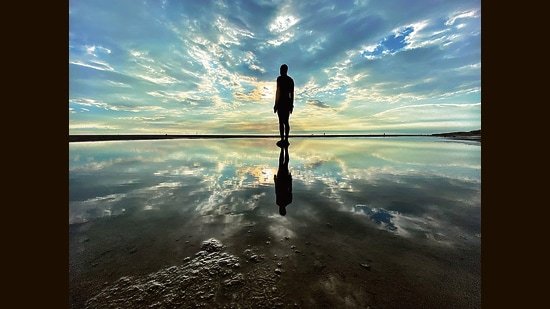
One of British artist Antony Gormley’s life-sized sculptures on Crosby Beach, England. What is the passage of time but a mirror image of what we’re doing with it? (Wikimedia)
Yet here we are, in April, staring at a to-do list that had outgrown the ecosystem it started life in. Time isn’t just flying; it’s evaporating. This feeling has intensified in recent years, we agreed. It ought to be investigated.
I’ve done some digging since then, into some of the theories that attempt to answer the question of what alters our perception of time.
Science points to the Proportional Theory. This one is simple enough: to a five-year-old, a year is 20% of all they have ever known. To those of us with more miles on the odometer, a year is a fraction in our ledger of life. We are victims of our own longevity.
Still, why? Why isn’t a minute experienced identically by us all?
There’s a somewhat poetic answer to that, emerging from contemporary neuroscience.
Our brains are efficiency junkies. When everything is new, they work overtime to lay down pipes that connect dense memories. Time feels thick, almost slow. There is discovery. Learning. First love. First failure. Early experiences of rain, snow, pain; that first feel of the fresh grass under bare feet. Time appears to stretch forever, as details are absorbed and encoded in the brain.
Then, as routine sets in — long commutes, endless cups of tea, mind-numbing spreadsheets — the brain stops recording the details. This, the Proportional Theory posits, is when time begins to “disappear”. We aren’t really losing it so much as losing our memory of it.
This happens as we grow up into creatures who stop doing anything memorable.
Philosophers, for their part, have wrestled with the sly beast called Time. The Greek stoics cut through the fog with grumpy clarity. Seneca, writing in On the Shortness of Life in the 1st century CE, argued that the problem wasn’t that life was too short; it was that we waste most of it. We live as if immortal only to discover, abruptly, that the vault of time is empty. And then we say: oh, where did the time go?
Physics has sought to redefine the dimension itself. The theory of the Block Universe posits that the past, present and future coexist. In some speculative models, scientists argue it might be possible to move through time, almost as one would move along the shelves of a library.
It’s an elegant idea, but a little cold. It robs us of the right to panic. And what good is a Sunday evening without the pangs over the impending Monday?
Perhaps this is the problem with New Year’s Eve. We treat it like a portal. We believe it guarantees us a reset. We overestimate what a single day can wreak or wrest from us, in conviction and creativity. And we underestimate what we can do in a year, simply because we don’t embrace reality as a series of infinite nows.
Good students of physics will know that “now” is a block of time three seconds long. We may be one quarter through the year, but there are millions of “nows” left.
Tomorrow may not be New Year’s Day, but every morning we wake up to is a fresh start. Every hour offers another chance. Why wait for the fireworks to work harder, read that book or finally make that call?
After all, the beauty of time isn’t just that it is transient, but that it is here. In its stubborn persistence, it keeps offering more; until, one day, it doesn’t.
As the ancient proverb goes (sometimes attributed to Africa and sometimes to China): “The best time to plant a tree was 20 years ago. The second-best time is now.”
How else can we hope to look back on a life that is rich in memories and meaning; a life in which we sought out surprise and delight, and let nothing slip by unnoticed?
In this way, as the years accumulate behind us, through small, defiant acts, may we pack our slice of time more densely.
(Charles Assisi is co-founder of Founding Fuel. He can be reached on assisi@foundingfuel.com. The views expressed are personal)
सिद्धभूमि के लेखक एक प्रमुख समाचार लेखक हैं, जिन्होंने समाज और राजनीति के महत्वपूर्ण मुद्दों पर गहरी जानकारी और विश्लेषण प्रदान किया है। उनकी लेखनी न केवल तथ्यात्मक होती है, बल्कि समाज की जटिलताओं को समझने और उजागर करने की क्षमता रखती है। उनके लेखों में तात्कालिक घटनाओं के विस्तृत विश्लेषण और विचारशील दृष्टिकोण की झलक मिलती है, जो पाठकों को समाज के विभिन्न पहलुओं पर सोचने के लिए प्रेरित करते हैं।
एक ऐसे समय में जब प्रिंट एवं मुद्रण अपनी प्रारंभिक अवस्था में था ,समाचार पत्र अपने संसाधनो के बूते निकाल पाना बेहद दुष्कर कार्य था ,लेकिन इसे चुनौती के रूप में स्वीकार करते हुए स्वर्गीय श्री शयाम सुन्दर मिश्र “प्रान ” ने 12 मार्च 1978 को पडरौना (कुशीनगर ) उत्तर प्रदेश से सिद्ध भूमि हिंदी साप्ताहिक का प्रकाशन आरम्भ किया | स्वर्गीय श्री शयाम सुन्दर मिश्र “प्रान ” सीमित साधनों व अभावों के बीच पत्रकारिता को मिशन के रूप में लेकर चलने वाले पत्रकार थे । उनका मानना था कि पत्रकारिता राष्ट्रीय लोक चेतना को उद्वीप्त करने का सबसे सशक्त माध्यम है । इसके द्वारा ही जनपक्षीय सरोकारो को जिन्दा रखा जा सकता है । किसी भी संस्था के लिए चार दशक से अधिक का सफ़र कम नही है ,सिद्ध भूमि ने इस लम्बी यात्रा में जनपक्षीय सरोकारो को जिन्दा रखते हुए कर्मपथ पर अपने कदम बढ़ाएं हैं और भविष्य के लिए भी नयी आशाएं और उम्मीदें जगाई हैं । ऑनलाइन माध्यम की उपयोगिता को समझते हुए सिद्ध भूमि न्यूज़ पोर्टल की शुरुवात जुलाई 2013 में किया गया |
हमसे संपर्क करने और जुड़ने के लिए मेल करें -
siddhbhoomi@gmail.com
Subscribe to Updates
Get the latest creative news from FooBar about art, design and business.