

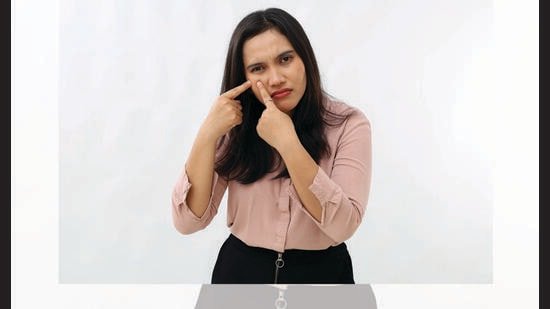
Look in the mirror. The imperfections you see today are not the same ones women of previous generations did. Our grandmothers worried about crow’s feet and laugh lines. Our mums noticed life-ruining dark circles and free radicals. Our older sisters went to college with tubes of Fair & Lovely in their backpacks. Every generation has its own beauty demon, one that can only be vanquished by the trending creams or serums of the time. Even ads have a new script. Honey-dipped voiceovers used to warn us about dry skin. Now they drop terms such as hyperpigmentation, microbiome, collagen and glutathione.
We’re no prettier or uglier than our ancestors. The old beauty problems didn’t die – we just got used to them. So manufacturers just found new things for us to feel terrible about. “Initially, women had concerns over hairfall and ageing,” says Dr. Mahnaz Jahan, a dermatologist for 13 years and the founder of KeraDerm Clinics. Now, patients come to her to get rid of their dark underarms or because they think their face pores are too large. “Problems such as crow’s feet and wrinkles haven’t disappeared – the focus has just shifted to other things. The industry narrative has moved on from solving problems to promising beautification – and skincare is now a form of consumption rather than self-care.”
There’s a curly-girl method for frizzy hair; 10% ascorbic acid night serum for glow (don’t skip sunscreen in the day); star-shaped hydrocolloid stickers for breakouts. There’s cream for butt cellulite, and a different cream for the chicken-skin bumps on your arms. Oh, and something for hyperpigmentation, the beauty industry’s new way of saying “You’re dark, that’s a problem”.
Psychologists now talk about beauty anxiety – the pressure of putting your best face forward all the time. “Back in the day, we’d go to college without makeup, acne-studded skin and all, but girls today are expected to look flawless,” says Jhanvi Bhatia, beauty content creator (@JhanviiBhatiaa). She has shot with brands who ask if she’s menstruating because her skin is too sweaty, or if they can fix the shape of her nose with makeup. “Today’s beauty standards really pick you apart. They highlight problems that you wouldn’t have noticed otherwise.”
As with most content creators, Bhatia gets more free samples than she can reasonably use. Many of them, she says, feel like they’re attacking one’s self-worth on new levels. “Collagen creams and DNA repair serums just feel like they’re creating a problem and then selling a solution,” she says. “I was shopping for skincare with friends recently, and one of them said, ‘If Instagram didn’t exist, I probably wouldn’t shop this much.’” It’s hard not to feel overwhelmed when little potions urge us to “reclaim your skin barrier” or “boost your cellular radiance” or if that one popular influencer didn’t squeal “Omg guys, I’m obsessed!”
Some insecurities persist across generations. Dark skin is one of them, says Dr. Jahan. “Patients usually show me a picture of a celebrity who’s become noticeably fairer and ask if they can also look that way.” Clogged pores and sunspots are no longer points of discussion, which means our microbiome might one day no longer be a concern too.
Dermatologists say you don’t need to panic over every little issue that social media decrees you probably have. Don’t let the internet make you insecure about yourself. Beauty parlour didis are doing that already.
From HT Brunch, February 28, 2026
Follow us on www.instagram.com/htbrunch
