

* Pride goeth before a fall.
* A stitch in time saves nine.
* Know thyself.
* Hustle and flow.
* I am enough.
We have always looked for words to live by.
As much as 3,000 years ago, the Chinese were poring over I Ching (Book of Changes) and drawing from its brief, poetic advice. It is still in print; now available, in fact, in dozens of languages.
Similarly, notes from the Old Testament, sermons of the Buddha (563-483 BCE) and writings of the Stoics (c. 300 BCE) on virtue, fate and how to live this life are still being re-read and spoken. Their clarity and relevance can feel uncanny.
“Pride goeth before a fall” is from the Bible. “Know thyself” is carved into the 4th-century-BCE Temple of Apollo at Delphi. “Patience is half of faith,” has roots in Islam, and versions of it can be traced to the 11th century CE.
A number of our most common aphorisms, meanwhile, are anonymous and rather grandmotherly, but hold such deep truths that they live on too. “A stitch in time saves nine”, for instance, entered the written record in the 1730s but likely began life far earlier.
What are today’s equivalents, and what does the arc of these tiny missives reveal?
“The form and content of the aphorism has changed, but the instinct to find something to live by amid life’s upheavals remains universal,” says James Geary, adjunct professor of public policy at the Harvard Kennedy School at Harvard University and author of The World in A Phrase: A Brief History of the Aphorism (2025).
“Aphorisms are literature’s hand luggage,” he writes, in the book. “Light and compact, they fit easily into the overhead compartment of your brain and contain everything you need to get through a rough day.”
SEE SOMETHING, SAY SOMETHING
* Empty vessels make most noise.
* Still waters run deep.
If it is often hard to tell where an aphorism comes from, that’s because most represent an idea so universal, that it has been expressed over and over, across millennia. The two above, for instance, have been dated variously to 15th-century CE England and Plato in 5th century BCE Greece.
What such phrases also tend to have in common is that they are brief, definitive, and confront and challenge the reader; containing enough words to be easily remembered and yet hold swift insight that represents the wisdom of the age.
A lot has changed in the social-media era (and we’ll get to the downsides of that), but, to start at the surface, a key addition has been imagery.
Visual aphorists such as meme-makers and digital strategists combine text with art and hashtags to create phrases that are designed for virality. Think of the murals that appeared across the US after the 2020 murder of George Floyd by a policeman. They paired street art and imagery of the slain Black man with the words: “I can’t breathe.”
More recently, in 2024, amid Russian attacks on Ukraine, the country’s official X account posted images of President Volodymyr Zelenskyy stooping to greet a veteran at the D-Day memorial in France, with the caption: “We kneel before heroes, not invaders.”
If they seem more rooted in the present than crafted to live forever, that is in part because they are designed for a world that is uniquely connected in real time.
What still makes them aphorisms, rather than, say, slogans? They remain a “manifesto in miniature,” Geary says. They fulfil the mission of “inconvenient truths over comfortable lies”.
LINES OF DUTY
“No snowflake in an avalanche ever feels responsible,” wrote the Polish poet Stanislaw Jerzy Lec (1909-66).
“I shop therefore I am,” declares a provocative artwork created by Barbara Kruger in 1990.
Dark times have always yielded dark beauties.
“They provoke you to take charge of your own life, accept responsibility, and have the courage to face the risk that comes with that responsibility,” says Geary.
In the social-media age, this has changed, somewhat. Terse missives are generated to harvest clicks and, as such, do not challenge, or drive greater action. In fact, because they seek the approval of the reader, they do the opposite: they reaffirm an idea that is comforting, easy to embrace or obvious.
“I am enough” is a far cry from the challenging and existential “Know thyself.” “Hustle and flow” is vague enough to induce one to hit Like and keep scrolling; it is not the call to action of “a stitch in time”.
How does one tell the difference? Geary suggests asking: Does this challenge me? Does it lay emphasis on individuality? Do I feel provoked to make a change on some level? (If the answer is no, it is likely a form of disguised marketing.)
What does a good modern-day aphorism look like? Here are three from Geary’s collection.
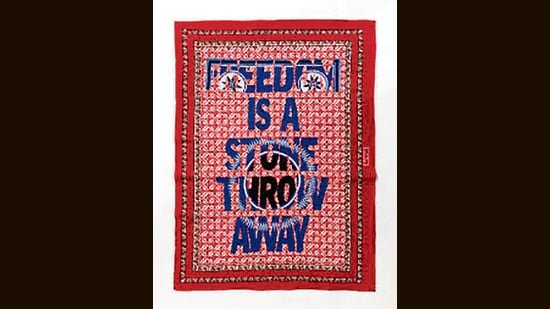
“Freedom is a stone throw away.”
These are words South African visual artist Lawrence Lemaoana, 44, embroidered onto Kanga cotton in 2017. Lemaoana’s use of kanga as a medium for aphorisms draws from Swahili culture, which has a rich tradition of proverbs as storehouses of wit and wisdom, and of women embroidering on fabric as a way to exchange such ideas.
Lemaoana’s phrase references the fight against apartheid and for freedom from colonial rule, and stands as a rallying cry against the corruption, inequity and injustice in his country today.
“Intelligence isolates; stupidity congregates.”
That’s the Colombian philosopher Nicolás Gómez Dávila (1913-1994). Raised in Paris, he returned to Colombia at 23, spent his life reading and writing, and expressed disdain for elements of mass culture. He believed intelligence and wisdom required a certain degree of solitude and independence. Humans lost too much, including much of their capacity for critical thinking, he said, when they consigned themselves to being part of a large group.
“To believe one knows is to err.”
In seven words, the American musician and writer David Byrne, 73 (frontman of the rock band Talking Heads) appears to challenge 18th-century poet Alexander Pope’s “To err is human…”. What are the errors we ought to be avoiding? What errors are we paying too high a price for? Calling into question our commitments to Left, Right, religion, custom, conformity, he elaborates on this and other elements of his philosophy in his collection of essays, The New Sins (2001).
