

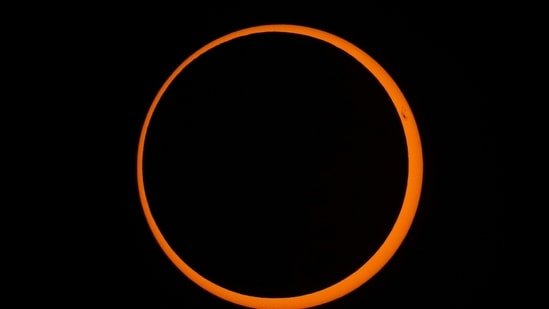
On February 17, a much-anticipated celestial event, a solar eclipse or the Surya Grahan, will take over the skies. However, when it comes to spotting such events, location plays a crucial role in determining how clearly the phenomenon can be seen in the sky. As the first solar eclipse of 2026, it is expected to draw interest, with spectators hoping to tune in to watch it unfold live, wear eclipse glasses, and gather at viewing spots.Let’s check if you can catch the first solar eclipse of 2026 live or not.
Can you see the solar eclipse?
Looks like this time, there will be a very different kind of skywatcher: penguins. The solar eclipse will be visible primarily over Antarctica. According to Earth Sky, the eclipse will begin at 09:56 UTC (Coordinated Universal Time), with maximum eclipse happening at 12:12 UTC.
The eclipse will also be partially visible in regions close to Antarctica, parts of the Southern Hemisphere, including Southern Africa, such as Cape Town, Durban, as well as Zimbabwe and Tanzania, will catch glimpses of the event. The southern tips of Argentina and Chile may also briefly witness the eclipse.
Can you see solar eclipse from India?
The solar eclipse will not be visible from India, as it is primarily happening over the Southern Hemisphere. The path of visibility is exclusively in Antarctica and the nearby southern regions. India falls entirely outside the shadow track of the eclipse. The visibility of any eclipse depends on the location, too. However, there are many live streams by space agencies which one can tune in to and see the eclipse happen virtually. Almost everyone will miss this one out!
Which type of solar eclipse will this be?
As per NASA, it will be an annual solar eclipse.Solar eclipses are magnificient visual spectacle as when the Moon passes between the Sun and Earth, blocking the Sun’s light and casting a shadow on the planet.
This temporarily darkens the sky, and in the case of an annular eclipse, which is set to happen in 3 days, when the Moon covers the Sun’s centre, leaving the Sun’s visible outer edges to form a ‘ring of fire.’
