

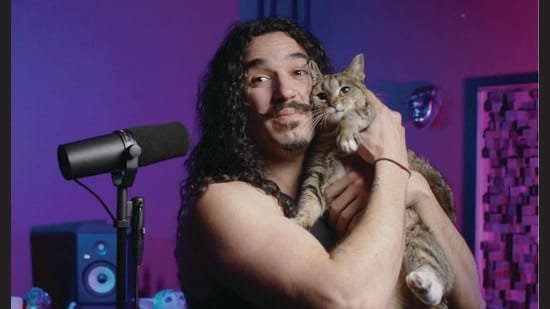
There is a specific kind of Instagram Reel you can’t have missed in the last year. It’s man with cat… in a kitchen, out on the patio, at the work desk, on a solo motorcycle ride, along for the bingewatch. Or a man-cat chat in which the mews get hilarious English subtitles. The cat looks deeply unimpressed with… everything, really. But the man? He’s the internet’s newest soft-masculinity icon.
Aditya Kakodkar (@The.Brewkenstein) has a Marathi-speaking Mau for a sidekick. Aditya Saran (@Adt.Saran) has Hindi-fluent Simba. Other influencers play up their manliness, with their love for cats presented as their one unfortunate weakness. But they’re building armies of followers and getting on the brand-collab radar.
Kakodkar, 35, a food-technology consultant from Pune, admits he considered himself a dog person until a cat entered his life. Still, he sees cats as “a gateway pet; they show you whether you are ready for the commitment of a dog”. Dogs need walks, training, stimulation, grooming, and someone who will reliably come home on time. Man’s best friend requires effort, and man don’t often got time for that.
It’s probably why cats are the more popular pet now. They roughly need food, water and the litter tray cleaned. Hand them a cardboard box, and they’ll leave you alone. They suit small apartments and busy lifestyles well. What makes cats endlessly meme-able is everything that follows: The hissing, the aggressive self-grooming, the things knocked off counters, the vacant staring, the unapologetic sprawl, and the sudden flash of toe beans. This is exactly the behaviour the internet rewards.
As more men realise this, it’s being viewed as a triumph. A woman with a cat? She’s lonely, obsessive, possibly crazy. A man with a cat? Patient, caring husband material. Show us the furbaby!
This wasn’t always the vibe. In ancient Egypt, the cat goddess Bastet was revered as the protector of homes, women, children, and the pharaoh. Norse mythology had Freyja riding a chariot pulled by cats. But by the 1450s, Europe started to get deeply stressed by the idea of older unmarried women, wanting nothing, minding their own business. Those who lived alone were branded as witches. Their feline companions demoted to satanic assistants – sad little stand-ins for husbands and babies the woman was supposedly denied.
Close to 50,000 women have been burned alive on suspicion of being witches. And the stereotype persists. By the early 20th century, suffragettes were mocked as shrill, un-marriageable. All this while men drank too much, fought wars, crashed economies, and still got called providers and visionaries.
Reels are the 2026 avatar of that same double standard. Kakodkar amassed over 3 million views over just nine videos. Saran regularly gets 1 million to 3 million views per video and says he makes ₹2.5 to ₹3 lakh a month from sponsorships. “Even though my wife features in the reels, brands do not ask for her. They want me with the cats.” Companies with no connection to pets are eager to jump on the cat wagon, as long as a man is front and centre. Saran calls it patriarchy with a ring light.
But Shruti Gotarkar, 35, a cat furniture business owner from Navi Mumbai, who has been creating content for almost seven years as @PurrlyCats, has managed only about 200K views. Cat owning women tend to be asked about hygiene, fertility and their own mental health. “The idea that cleaning a litter box leads to female infertility or mental illness is absurd,” Gotarkar says.
She adds that women are still expected to choose between marriage and the cats they’ve raised, and many women end up rehoming their pets rather than taking them along to the marital home. These aren’t demands made of men, Saran notes. So, when you see a Reel about a dude who’s smitten with his kitten, remember that Cat Ladies walked (and tripped and wept and burned) so that Cat Lads could run.
