

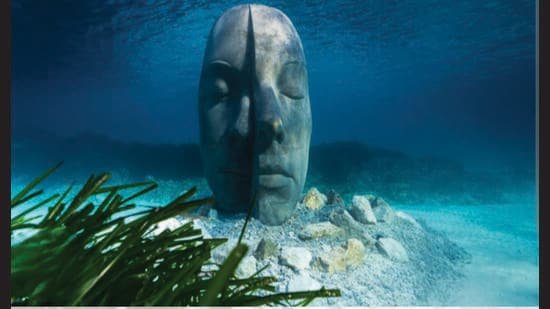
Submerged sculptures. British sculptor, environmentalist and underwater photographer Jason deCaires Taylor literally breathes life into his installations. Over time, hundreds of his undersea sculptures have turned into reefs that serve as habitats for marine biodiversity. The works explore ecological themes and focus on the regenerative power of nature. See them at Museo Atlantico, Lanzarote (Spain), Molinere Bay (Grenada, West Indies) and Musa in Cancun (Mexico).
Prada Marfa (2005). Scandinavian artists Michael Elmgreen and Ingar Dragset hoped to ridicule consumerism by setting up a Prada store in the remote Chihuahua desert near Texas in 2005, displaying luxury in one of the poorest areas of the US. The work was a sealed fake outlet for high-end shoes and handbags, meant to decompose eventually into its surroundings. Surprise, surprise. It was looted the night it was installed. You can still see the spot it was set up in.
Carhenge (1987). Nebraska, US, has a quirky replica of Stonehenge. But instead of stone structures, it’s an installation made of 38 vintage automobiles. The cars are painted grey and arranged like pillars, with some cars doing a balancing act atop just like in the OG English site. Created by Jim Reinders, it also houses other sculptures made from car parts.
Tape Vienna Project (2010). The Viennese art collective Numen/For Use wove giant amorphous cocoon-like structures at the Odeon Theatre in 2010. They used 45 kg (530 rolls) of multi-layered packing and adhesive tapes, and long hollow tubes to resemble spiderwebs. Visitors could walk straight into them. Not fun if you hate spiders, even fake ones.
Mind Your Step (2011). Useful title. But not necessary. What most pedestrians thought was a deep hole that had opened up right in the middle of a public square in Stockholm, was merely Swedish photographer Erik Johansson’s 3D chalk painting. The optical illusion was temporary, but convincing enough for people to do a double take when they passed the busy intersection.
Antarctic Lenin statue (1958). The Soviets beat the West to Earth’s Southern Pole of Inaccessibility – the point in Antarctica that is the farthest to reach from the coast. Average temperatures were -50 degrees Celsius. Even penguins stayed away. But they set up a hut, an airstrip and a gigantic plastic bust of USSR founder Vladimir Lenin, oriented so he’d be facing Moscow. No one visits this place. Snow has been piling higher and may have covered the bust. Maybe he’s still looking at Moscow.
The sunken Vandenberg. The US WWII ship Gen. Hoyt S Vandenberg was deliberately sunk near Florida’s Key West in 2009 to create one of the world’s largest artificial reefs. It’s 50 feet down, and a diving destination. It’s also where Austrian art photographer Andreas Franke’s photos were displayed (attached to the deck using magnets). He’s displayed two shows: Life Below the Surface (2011 and 2016) and 24-piece Plastic Ocean (2019).
Ark Nova (2013). British artist Anish Kapoor and architect Arata Isozaki used their installation as a way to give Japanese people, affected by the 2011 tsunami, a chance to heal through live music. It is the world’s first inflatable mobile concert hall. The massive (35m by 18m) balloon-like structure is purple, portable, shaped like a donut and can fit 500 people.
Steilneset Memorial (2011). In Norway’s icy, remote Vardø, artist Louise Bourgeois and architect Peter Zumthor’s work marks the tragic 17th century trial, at which 91 persons, accused of witchcraft, were executed. It features a 125-metre-long, suspended wooden corridor with 91 small glowing windows. It also houses a perpetually flaming metal chair, surrounded by seven mirrors.
The Weather Project (2003). Gloomy England could use a little sunnying up. So, Icelandic-Danish artist Olafur Eliasson created a massive artificial sun inside the Turbine Hall of Tate Modern, London, from hundreds of yellow, mono-frequency lights. It had a mirrored ceiling, a semi-circular screen and a misting system to mimic heat and humidity. Visitors say it was a warm, golden, surreal, sunny experience.
From HT Brunch, February 21, 2026
Follow us on www.instagram.com/htbrunch
