

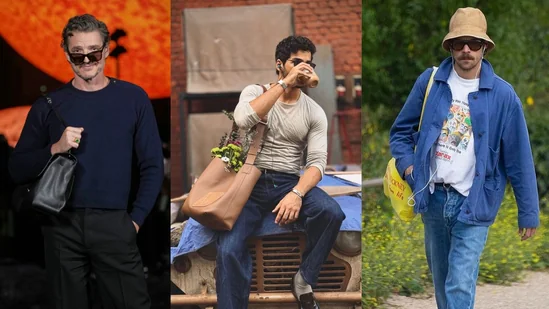
He carries a tote bag, wears a pastel oversized sweatshirt and probably has a labubu doll as a bag charm. He is a ‘performative male’, a term that is a new interpretation of the ‘soft boy’ aesthetic, but much more in your face. With over 20 million views on posts and reels tagged #performativemale, the trend is breaking the internet.
There was a time when men’s wardrobes were built for utility, like the crisp shirt, the sturdy shoe, the reliable trousers. But today, the modern man performs, leaving the ‘just getting dressed’ mindset behind.
His starter pack is easy to spot: mesh tops layered with pearls, skirts with sneakers, tote bags, oversized sweatshirts, loose high-waisted pants or wide-legged jeans, wired headphones, bag charms (Labubus, currently), and often a matcha or a book as a prop. He strikes selfies that blur the line between fashion and flirtation.
Fashion has become his stage, and the performative act of being seen is as important as what he’s wearing — much of which is deliberately appealing to women. “Many men are indeed embracing fashion as a form of self-expression— experimenting with silhouettes, colour, jewellery, and grooming that past generations might have considered ‘unmasculine.’ You can see it in the satin, the pastels, the cropped jackets, the tote bags. It’s about owning the gaze rather than avoiding it,” opines designer Prasoon Sharma of label Triune.
He points to designer Thom Browne’s exaggerated proportions and conceptual suits. “This transforms a business staple into performance art,” he adds.
Designer Taarini Anand says that a lot of what humans do, including how they dress, is tied to perception. “Fashion is self-expression, but expression always implies an audience. There’s undoubtedly a performative layer to dressing for social media, but that doesn’t make it hollow. Visibility doesn’t cancel authenticity; it reframes it,” she adds.
This aesthetic is also being shaped by a growing culture of male beauty contests, which have quietly taken root across campuses and public spaces, from the University of Minnesota, MIT, and Yale to San Francisco’s El Square Park and Delhi’s Safdarjung Enclave.
These are not traditional pageants; they’re part parody, part social commentary, and part fashion spectacle. Contestants perform for an audience, often composed largely of women, by answering questions on music or culture, carrying props like feminist books or analogue cameras, and leaning into highly stylised ‘performative’ traits.
This shift didn’t happen overnight. The seeds were sown when pop icons and K-pop idols made high-gloss self-styling aspirational. And the many memes defining the ‘performative male starter pack’, including what he wears, listens to, drinks, and posts, have only accelerated the trend.
But while the aesthetic celebrates self-expression, it also raises questions about pressure and presentation. In a world of filters and fit checks, is performative masculinity freeing — or is it another aesthetic cage?
“Performativity in men’s fashion exists in a paradox. On one hand, it’s deeply liberating; it’s allowed men to explore beauty, emotion, and sensuality in ways that were once off-limits. But on the other hand, it can easily become another aesthetic mould — one that chases validation through trends or the external gaze, often designed to appeal outwardly rather than inwardly. For me, real liberation begins when performance becomes personal — when style isn’t about impressing but expressing,” says Meenia Sahil, creative director and designer at label Hindostan Archive.
