

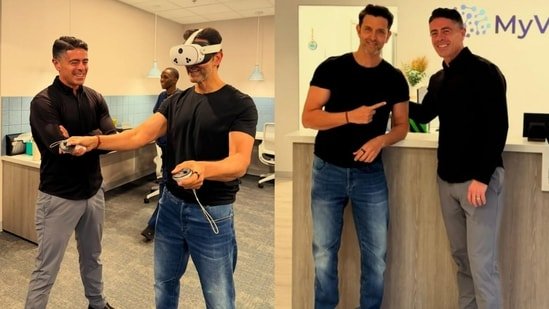
Actor Hrithik Roshan, 52, recently set social media buzzing after claiming his eye prescription reduced significantly through what he described as an “eye workout”. But eye specialists say the claim needs careful context. Sharing his decade-long journey on Instagram, Hrithik recalled that a doctor had once told him at age 42 that spectacle numbers are irreversible. According to him, the doctor had said the eye is not a muscle that can be trained. Unconvinced, the actor said he later travelled to Washington, DC, to train under optometrist Dr Bryce Appelbaum.
“Cut to 10 years later, my search led me to Washington DC where I spent five days training the ‘muscle’ of the eyes for four hours a day and surprise, my number went down by half. I now have to buy new frames and get a new prescription,” Hrithik wrote.
While the post was meant to be motivational, it has triggered concern among medical professionals about possible misinformation around eye health.
Why doctors say the claim has limits
Experts believe Hrithik’s improvement may be linked to age-related focusing issues rather than a permanent reduction in spectacle power. Dr Samita Moolani of Moolani’s Eye Care Centre explains: “After 40, many people develop presbyopia, an age-related condition that affects near vision. In simple terms, reading becomes harder because it depends on the eye’s focusing ability, which requires the lens and eye muscles to work together.”
She adds that some people in this age group may benefit from targeted exercises that improve focusing and eye coordination, which could be what the actor experienced.
Can eye exercises fix all vision problems?
Doctors stress that most people wear glasses due to structural issues such as: Myopia (near-sightedness), Hyperopia (far-sightedness) and Astigmatism.
Dr Samir Sud, co-founder of Sharp Sight Eye Hospitals, says these are anatomical conditions. “These are mainly optical problems, not muscle problems. Strengthening eye muscles cannot reshape the eye’s structure,” he explains.
Dr Sujal Shah, director of ophthalmology at Sir H. N. Reliance Foundation Hospital, adds that spectacle power depends on the length of the eyeball and the curvature of the cornea. “These factors are not altered by external eye exercises, so such workouts cannot reduce true refractive error,” he says.
Why some people may still notice improvement
Doctors share there is one important nuance. Prolonged screen use or intense near work can strain the eye’s focusing muscle, called the ciliary muscle. This can temporarily worsen vision, a condition sometimes called a pseudo-myopic shift.
“When this strain reduces through rest, relaxation or certain exercises, a person may feel their vision has improved,” explains Dr Shah. However, he emphasises that this is not the same as permanently correcting refractive error.
The real concern
The biggest risk is not the exercise itself but the expectations it creates. Dr Samir Sud, co-founder of Sharp Sight Eye Hospitals warns, “Claims of dramatic changes within days are misleading. Structural changes in the eye do not occur that quickly without medical intervention.” He adds that viral health claims can be harmful if people start delaying proper eye care or stop using prescribed correction. “Good vision care means regular check-ups, proper glasses, healthy habits and evidence-based treatment, not quick fixes,” he says.
What is this ‘eye workout’?
Dr Bryce Appelbaum’s vision training programme, estimated at $3,500 to $6,000 (around ₹2.9 lakh to ₹5 lakh) and not officially priced by the clinic, focuses on improving coordination between the brain and the eyes rather than altering the eye’s structure. The five-day bootcamp uses diagnostic tests, retinal imaging and digital visual mapping to create personalised exercises aimed at helping the eyes and brain work more efficiently together.
Appelbaum recommends the 20-20-20 rule, looking 20 feet away for 20 seconds every 20 minutes, and “eye push-ups”, which involve shifting focus between a nearby finger and a distant object to build flexibility. He also suggests eye stretches toward the extreme edges of vision and peripheral awareness walks. Additional advice includes switching to physical books over e-readers where possible, keeping screens 16 to 30 inches away with brightness at 40 to 65%, and getting natural morning and evening light exposure to support circadian rhythm through what he calls a “panoramic gaze”.
