

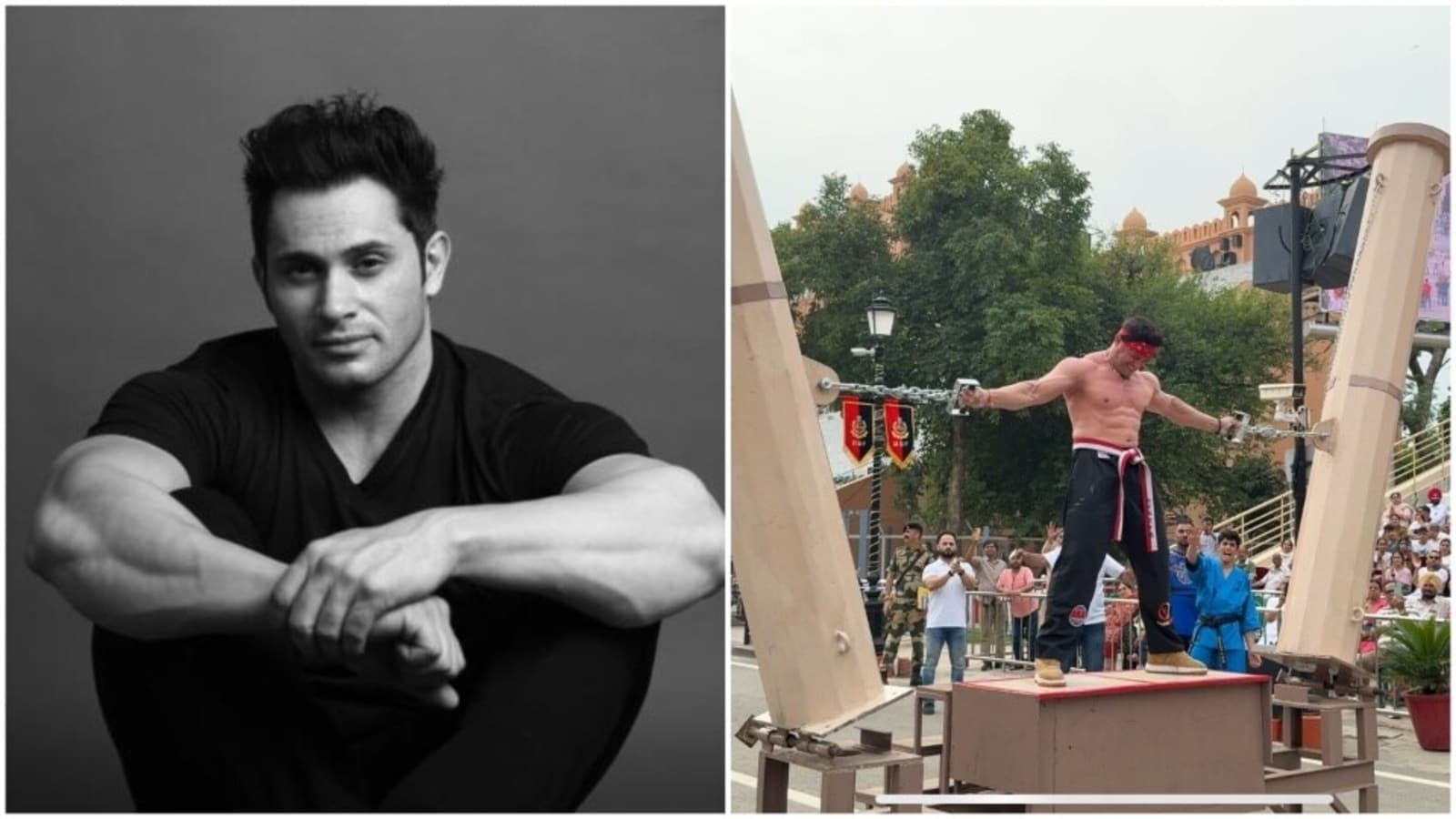
“The real suffering starts after about 40 seconds,” says Vispy Kharadi, the newly-minted Guinness World Record holder for the longest Hercules pillar hold. “Most strongman athletes will tell you that they feel they are doing fine until about half a minute. But in the next ten seconds, the game changes,” he says. Also read | Indian athlete Vispy Kharadi sets Guinness World Record for Hercules pillar hold
The Hercules pillar hold is strongman sport’s most theatrical test. It recalls the Graeco-Roman legend of Hercules rending Gibraltar’s mountain, leaving two pillars that marked the world’s edge. In the modern-day event, an athlete stands between two gigantic pillars, each weighing over 150 kilos, holding them apart until they reach the limits of their endurance.
A record-breaking feat
In November last year, in Surat, with 10.25-foot pillars weighing around 166 kg, Kharadi endured the ‘suffering’ for two minutes and 10.75 seconds, obliterating the previous Guinness record held by Dutchman Kelvin de Ruiter by 90 seconds. Elon Musk was among those who took note of his feat and spread the word on X.
Kharadi’s achievement is doubly impressive, because he is not in the typical ‘strongman’ mould. At 5 feet 10 inches and 87 kg, his proportions are easier for the brain to process compared with some of the others in the fray. “Vispy has set a completely new benchmark. The people he competes with are literal giants – almost all of them are way over 6 feet and weigh about 150 kg,” says Sanjit Paul, president of the Kolkata-based Strongman India, which promotes strength-based sport.
Last month, at the Attari-Wagah border, Kharadi stamped his dominance again by performing the Hercules hold with 261-kg pillars for a minute and seven seconds, surpassing the legendary British strength athlete Mark Felix’s earlier 200-kg attempt.

Inside the strongman world
Modern strongman sport, which has its roots in Northern European strength traditions, was institutionalised in the 1990s. Today strength athletes with intimidating names such as Halfthor Bjornsson (who starred as ‘The Mountain’ in the HBO series Game of Thrones) and Tom ‘The Albatross’ Stoltman lift massive Atlas stones, perform monstrous deadlifts, and pull cars and aircraft at competitions across the world. They train with equipment straight out of a medieval armoury: iron logs, yokes that sag across the shoulders, and stones hewn like boulders.
Kharadi, who lives in Surat, grew up wanting to emulate his banker father Jimmy, a hobby wrestler. A decade ago, he gave up his own career in wealth banking to plunge headlong into the business of fitness. The martial arts expert and paediatric nutritionist runs Athletica Fitness, which claims to be Surat’s largest sport and fitness centre; trains actors; and the Border Security Force in unarmed combat.
No stranger to records
Kharadi is no stranger to records. In 2022, he set a Guinness World Record for the most concrete blocks broken with the elbow in one minute — a staggering 64. The 42-year-old decided to have a crack at the Hercules pillar hold record after watching de Ruiter in action in Italy in 2022. “A lot of my drills come from judo practice – rope climbing is one of them. I have also always been into arm wrestling so I was confident of my grip and forearm strength,” says Kharadi.
In 2023, he commissioned a steel manufacturing company in Surat to make 11-foot-tall, 150-kg pillars and began his preparations about two months before his record attempt, complementing his training with strongman staples such as the Farmer’s Carry, where athletes walk with enormous weights in each hand, and the Tire Flip, which involves heaving tractor-sized tyres end over end. “I would train every alternate day at the company’s massive warehouse, where the pillars were stored,” he says.
The Hercules pillar hold, an intense isometric test where the athlete resists against crushing forces without moving an inch, is largely about grip endurance. To prepare, Kharadi built his training around grip-specific drills: hanging from a pull-up bar with just one arm, holding a loaded barbell at his thighs for as long as possible, and constantly testing himself with variations: thick grips, square grips, different textures, and widths. “My DMs are full of people wanting to know more about the event,” says Kharadi. “I simply tell them: just try hanging with one hand on a pull-up bar for a minute. If you can do that, you’ll have a sense of the effort this stunt demands.”
Raw strength and endless hours of training can only take you so far — in the end, the real test is mental. The last 30 seconds of his world-beating attempt in November felt like “the longest half a minute of his life,” says Kharadi. To push through the pain, the Parsi strength athlete turns to a deeply personal visualisation. “I imagine I’m holding on to my two sons, Zidaan and Yazdan, for their dear life, like that scene in Sylvester Stallone’s Cliffhanger. In my mind, I just can’t let go.”
A fading legacy
As a Parsi strength athlete, Kharadi is the inheritor of a fading legacy. Parsis, part of the colonial elite, were among India’s earliest physical culturists. Influenced by the British, they took up bodybuilding along with opera and cricket. HD Darukhanawala’s Parsis and Sports, published in 1935, lists several prominent Parsi physical culturists of the time, including Mahatma Gandhi’s naturopathic physician Dinshaw K Mehta. Several gymnasiums in south Bombay were either owned or funded by Parsis at the turn of the last century. In 1904, Dhunjibhoy Bomanji, a wealthy Parsi merchant, invited Eugen Sandow, the Prussian strongman and first modern superstar of physical culture, to Bombay, where he received a rousing welcome.
The community’s involvement in physical culture, and its respect for strongmen, continued well after Independence, and several Parsis featured on the podium at bodybuilding competitions in the city. During his visit to India, Sandow also visited Calcutta, where he dismissed the colonial stereotype of the ‘effete Bengali male’. As recorded in David Waller’s The Perfect Man (2011), he broadened the point in remarks to reporters: “The native Indians have a foundation for the building of large physical men… It is only because of their lack of proper food and systematic exercise that they are thin and haggard.”
Over a hundred years later, the stereotype persists, says Kharadi, who sees his Hercules hold records as a pointed rebuttal. “There is this view that Indians don’t have great genetics, and we cannot do all these things. I just wanted to prove a point, especially to Indian youth, that it’s simply not true.”
