

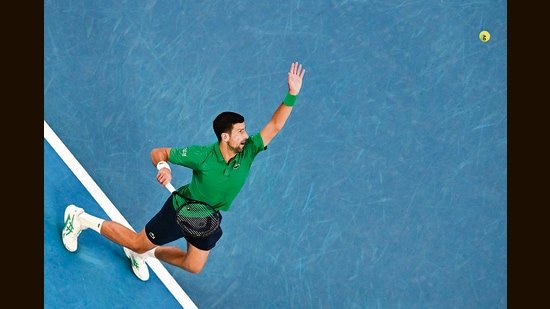
The Novak Djokovic farewell tour swept into Melbourne Park earlier this month.
For a tennis world that had already moved on to its next great battle, the display of love and affection for a 38-year-old ten-time former champion seemed like a fitting and heart-warming sideshow to the inevitable Jannik Sinner vs Carlos Alcaraz main event.
So, the Djokovic entourage turned up in huge numbers for a swansong that could end at any moment. Though he was still good enough to survive into the later rounds, a quarterfinal or at best a semi-final appearance was all his legions of fans were hoping for. A 25th Grand Slam title was a bridge too far, and a victory against either Sinner or Alcaraz at the peak of their powers seemed out of the question.
This was an opportunity to watch the lion of Melbourne, now in his winter, perhaps one last time; to be able to say “I was there” when the curtain came down.
But no one sent Djokovic the memo. Or if they did, he looked at it and smiled. He had decided that he wasn’t history. He was just getting ready to make some.
THE DISRUPTER
Few players have changed their sport in the way Djokovic has changed tennis over the past two decades. When he began his career, he was faced with a Roger Federer vs Rafael Nadal bipolarity in which there was no room for him.
One was an elegant, free-flowing, single-handed-backhand-wielding exponent of power hitting. The other was a grunting, grinding, top spin machine who chased down every ball and fought for every point. Federer and Nadal were the definitive specimens of the two poles of tennis, and the rest of their peers were expected to cheer this ultimate contest on, not participate in it.
For the first few years, Djokovic was happy to play the role of court jester. He would mimic Maria Sharapova’s pouty serve, Federer’s lunging backhands, and Nadal’s pulling of his shorts to offer some comic relief while the serious business of tennis supremacy raged on alongside. Then, almost unbeknownst to the other two champions, Djokovic emerged as the sport’s supreme disrupter, unleashing a brand of tennis neither was prepared to tackle.
If Federer was a ballerina with an aggressive, on-the-rise position on court and Nadal, a slugger who stood 15 ft behind the baseline, Djokovic adopted a modular baseline approach and combined it with a wider return stance and a sliding technique while covering corners. His hallmark was a kind of biomechanical precision hitherto unseen in world tennis.
Though there was talk of the “kinetic chain” in the sport since the 1990s — that’s the sequential transfer of energy from the ground through legs, hips, torso, shoulder, arm, and eventually racquet, to generate velocity and power while hitting groundstrokes — Djokovic mastered the mechanics to a point where he could perhaps copyright them.
His stability on the ground and transfer of energy through a series of elastic movements allowed him to neutralise Federer’s inside-out tactics and Nadal’s massive top spin by responding to these weapons with aggressive counters instead of defensive slices or pushes.
For two players focused on beating each other, the new challenge was a bolt from the blue. And while opinions vary on which of the three is the true GOAT, Djokovic not only has more Grand Slam titles, but also leads the head-to-head against Federer (27-23) and Nadal (31-29), after trailing 3-7 against both in first 10 encounters with them.
THE OLD WARHORSE
During the Australian Open campaign this January, Djokovic added new records and a fresh chapter to his legend.
At 38 years and 255 days of age, he became the oldest finalist in the 121-year history of the tournament, and the second-oldest at any Grand Slam after Ken Rosewall reached the Wimbledon and the US Open finals as a 39-year-old in 1974. (Rosewall, incidentally, lost both those finals to Jimmy Connors, 22.)
The real story was how Djokovic adapted his game to take on the might of the tennis world’s two modern powerhouses, Sinner and Alcaraz, who are 14 and 16 years younger than him respectively.
First, he partnered with performance physiologist Dr Mark Kovacs to finetune his kinetic chain to compensate for age, focusing on smoother groundstrokes and more efficient movement to gain a few tenths of a second in court coverage during rallies.
Second, he chose to expend energy in bursts rather than through the match; he’d get into beast mode for key points and crucial phases while holding back at non-critical moments. He was less likely, for instance, to chase a drop shot at 30-0 with the set score 3-3 and more likely to make a dash for it at break point or at the business end of a set.
Finally, he leaned heavily on his serve — some of the 185kmph+ second serves down the centre line against Sinner and Alcaraz illustrated this shift — to shorten points and conserve energy.
The strategy did come apart in the quarterfinal against Lorenzo Musetti, 23, until the Italian had to retire due to injury. But it dismantled Sinner in an epic five-set semifinal, and almost unsettled Alcaraz in the final before the wily Spaniard, who had learnt from his compatriot’s mistakes two days earlier, managed to slow the game down and extend rallies until Djokovic ran out of steam.
Alcaraz, at 22 years and 272 days of age, is now the youngest player in history to complete a career Grand Slam. Who knows how many more titles he will win, and how many finals he and his great rival Sinner will play against each other over the next decade. Still, they’ll both remember the 2026 Australian Open as the tournament where Djokovic, close to 40, crashed their party — just like he’d disrupted the Federer-Nadal travelling circus all those years ago.
(The views expressed are personal.)
