

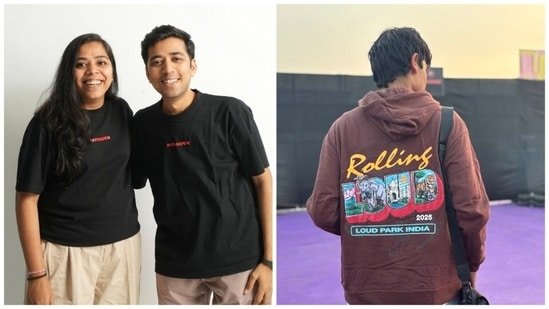
The Indian music landscape has shifted from sporadic international visits to a consistent stop on the global tour. As stadium-sized spectacles become the new norm, the culture surrounding them is undergoing a sophisticated transformation. At the forefront of this movement are sibling Jinal Ajmera and Vivek Ajmera – the co-founders of MyFandom, known for their official, premium merchandise– who are redefining how fans interact with their idols. Also read | After Coldplay and Diljit gigs can India establish itself as premier global concert destination? What travel experts say
Having powered the merchandise engines for global heavyweights like Coldplay, Ed Sheeran, Travis Scott, Anoushka Shankar, Dua Lipa, the Ajmeras are witnessing a transition in which concert gear is no longer a souvenir — it is a subculture.
The evolution of concert merch in India
Historically, Indian concert-goers had few options beyond low-quality bootlegs sold outside venue gates. In an interview with HT Lifestyle, Jinal Ajmera notes that the digital age has closed the gap between Indian fans and their global counterparts.
“The concert merchandise in India has evolved rapidly in recent years,” Jinal explains. “Earlier, merch in India was almost an afterthought. But today that has changed. Fans arrive expecting to buy official merchandise. They want the hoodie, the limited drop, the tote bag. They’ve grown up watching concert culture on social media around the world, and they want the same thing here,” she adds.
This shift isn’t just about availability; it’s about authenticity. Jinal highlights that MyFandom acts as a cultural translator: “Our role is to make sure the merchandise reflects [the artist’s identity] while still resonating with Indian audiences. Our job is to represent Indian fans to their idols as authentically as possible.”
The Instagram effect and everyday fashion
One of the most significant trends identified by the MyFandom founders is the integration of tour gear into daily wardrobes. Merchandise is shedding its ‘event-only’ label and entering the realm of streetwear.
“Merch used to sit in a drawer after the show. Now it lives on Instagram. People are styling it on regular days, building outfits around it. When something is well-crafted, fans wear it because they love the artist, and we are always focused on making sure that it genuinely looks good,” Vivek Ajmera tells HT Lifestyle.
Vivek notes that the industry is moving away from generic designs. Today’s fans are looking for ‘time capsules of memories’, leading to a surge in collectables like posters, pins, bags, caps, and flags.
Consumer psychology: official vs unofficial merch
While unofficial knock-offs remain a challenge in the Indian market, Jinal believes the quality gap is now so wide that fans are self-selecting into the official ecosystem. “Fans today are smarter; we don’t really need to convince anyone,” Jinal asserts. She adds, “When they hold an official piece, they feel the difference. The quality, the finish, the packaging, and most importantly, the feeling that this is real, that it’s connected to the artist.”
Sustainability: fandom with a conscience
In a world increasingly wary of fast fashion, MyFandom is pivoting toward a ‘fan-first, planet-first’ model. Vivek highlights that longevity is the ultimate form of sustainability, as it minimises waste at every stage of production and distribution. Both primary and secondary packaging options are designed for reuse, he adds.
“Our entire existence is based on making merchandise that fans actually want to use and reuse multiple times,” Vivek notes, adding, “Every piece of merch we enable reflects our respect for Mother Nature.”
The cultural impact: the Coldplay case study
Reflecting on the monumental impact of the Coldplay India shows, Jinal illustrates how merchandise serves as a physical bridge between generations. She recalls, “What made it stand out wasn’t the volume. It was what it meant to people. They weren’t buying a product. They were buying a memory. Imagine keeping a piece of merchandise from a 2025 Coldplay concert and passing it down to the next generation in 2040. It’s about memories you can keep.”
The road ahead
With more cities hosting international tours, the Ajmeras see no ceiling for the growth of the Indian market. Vivek suggests the relationship between artists and fans is becoming less ‘transactional’ and more ‘collaborative’, with merch serving as the artist’s creative identity.
Jinal concludes, “We are on the brink of a massive boom. With the kind of support and patronage Indian fans are offering right now, there really is no mountain high enough to curb the rate at which the Indian fandom economy is accelerating.“
