

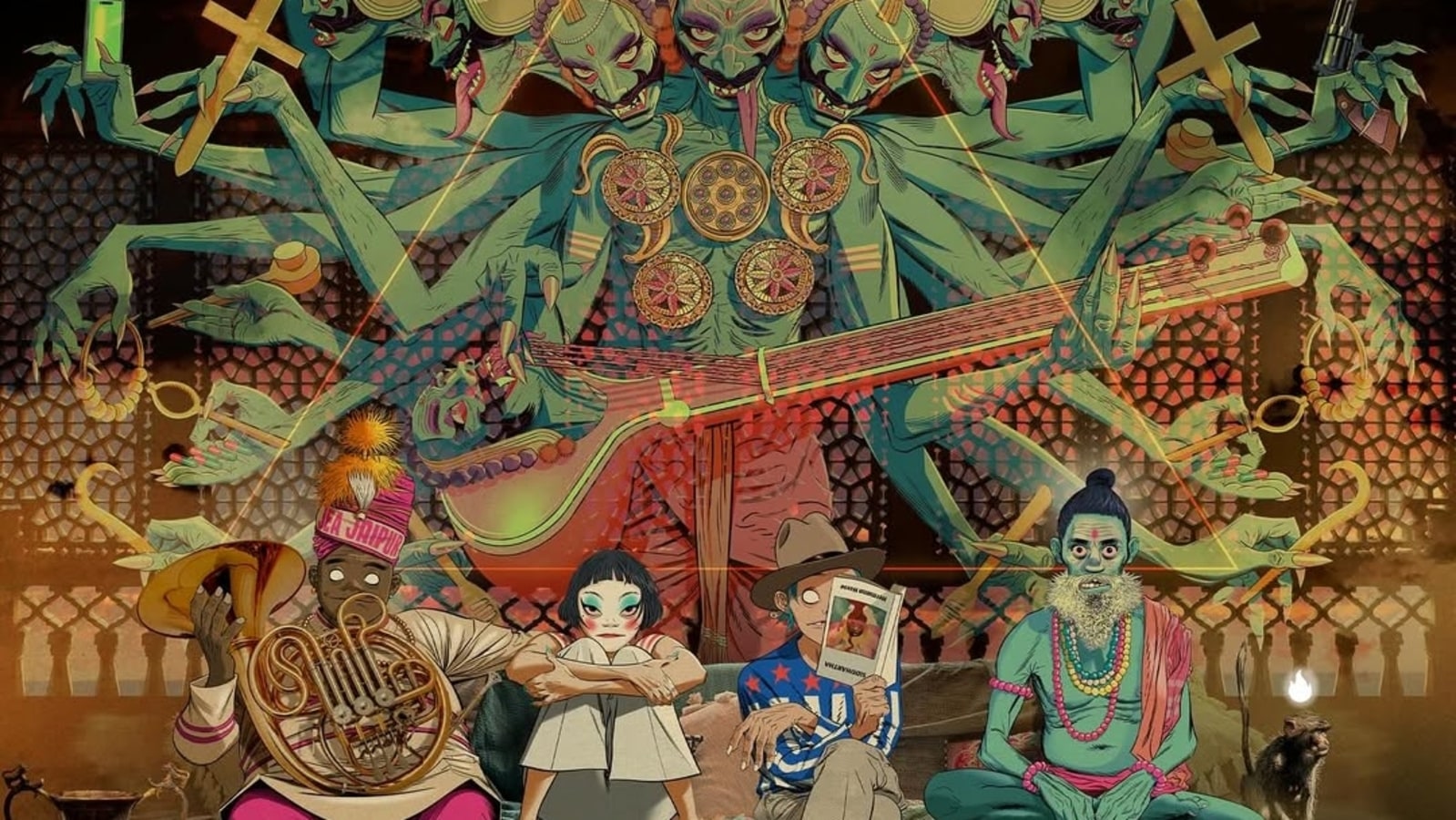
Animated alternative rock band Gorillaz, led by Damon Albarn and Jamie Hewlett, have announced their ninth studio album The Mountain, releasing on March 20, 2026. This new project is a departure from the virtual band’s wide-ranging earlier catalogue – which usually blends alternative rock with synth-pop, electronica and hip-hop – incorporating Indian themes, Hindustani classical music, as well as collaborations with Indian artists including the likes of Anoushka Shankar and Asha Bhosle.
The artwork and tracklist
The album cover, artwork, and tracklist were revealed on social media on September 12. The album cover says “Parvat” in Hindi letters and the artwork features the four animated band members with various oriental overtones – Murdoc as a full-blown sanyasi or yogi wearing rudraksh-style beads, Russel sitting with a tuba donning a kurta-pajama set, complete with a pagri, Noodle acting as the bridge between the mystical and the modern, with a face full of Kabuki-inspired makeup, and 2D posing as the American traveler – and a representation of Nataraj in typical Gorillaz art style, holding various items including two crosses, a mobile phone and a sitar. It also features a royal Bengal tiger, a goat and a monkey.
The tracklist revealed epic collaborations in five different languages with artists including Asha Bhosle, Amaan and Ayaan Ali Bangash, Ajay Prasanna, Omar Souleyman, Asha Puthli, Anoushka Shankar, IDLES, Paul Simonon, Jalen Ngonda, and Johnny Marr from the Smiths (interesting, right?). In an interview with Rolling Stone UK, Damon Albarn and Jamie Hewlett discussed their inspiration behind the album, their travels to India, their experience collaborating with Indian artists, and the theme of life, death, and transition, which is central to the project.
From voiceless muse to cultural agency
When Hindustani classical music was first popularised in Western music by the Beatles, back in the 60s, they borrowed musical elements, including instruments like the sitar and tambura, and appropriated the ‘exotic’ soundscapes into British psychedelic rock. Ever since the hippies turned to India for spiritual and religious transcendence, the country has been branded as a kaleidoscopic land of psychedelic visions, trippy colours and drugged ascetics lost in mind-bending meditation. Along with this came the appropriation of Hindustani music – long sitar solos and tambura drones in the backdrop – again branded as exotic background ambience for the Western imagination rather than celebrated as the work of skilled Indian musicians.
Gorillaz’s new album marks a departure from this century’s old Western tradition of idealising the East as the exotic land without a voice – the narrative of representation and the politics of authenticity has always been controlled by the West. The album explores the fictional travels of the four animated bandmates through India, and was recorded in London, Devon, and places in India. In the Rolling Stone interview, both Albarn and Hewlett talk about going through tragic losses – the deaths of their fathers and Hewlett’s mother-in-law – and finding comfort in the attitudes of Hinduism, Buddhism and Sikhism towards death. Belonging to a fundamentally Anglo-Christian background, their response is comparable to the hippie movement’s attraction to the east.
Collaboration with Indian artists
The duo mentioned having their best time working with Indian artists and experiencing the country in ‘glorious technicolour’. One collaboration, however, stood out for Albarn – Anoushka Shankar. He was introduced to sitar virtuoso Pandit Ravi Shankar at an early age, courtesy of his parents’ deep appreciation for Indian classical music and ragas, and having the sitar guru’s daughter on his record marks a full circle moment for him. He told Rolling Stone, “I probably listened to Ravi Shankar before I listened to The Beatles when I was a kid,” and added, “to have Anoushka Shankar on the record is not only a real privilege, but the connection with my dad and his love of Ravi Shankar is great.”
This collaboration is not only a defining moment for Damon Albarn’s experience, but also marks a poetic return to the era when psych rock first wove Hindustani classical into its sonic tapestry – from the Beatles’ transformative journey to Rishikesh, where George Harrison learnt to play the sitar under the guidance of the legendary Pandit Ravi Shankar.
Allowing Indian artists to have a voice and representing them on the global stage restores an agency to Eastern culture that was long overdue. Unlike past Western projects that borrowed Indian sounds as exotic adornments, this album places Indian musicians and instruments at the heart of its sonic identity. From Anoushka Shankar’s sitar to the intricate rhythms of classical percussion, the contributions aren’t background flourishes – they shape the very texture of the music. In doing so, Gorillaz challenge the old orientalist template, transforming India from a passive muse into an active co-creator in a globally resonant soundscape.
