

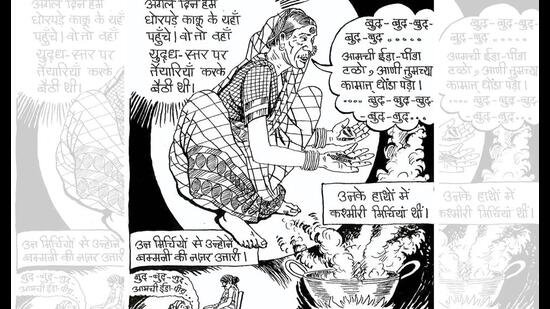
Comics and graphic novels fulfil a very fundamental requirement of art. It’s, at its simplest, a storyboard – images and text that propel a tale forward. The format sets the pace, builds the action, lays out the montage and allows for both panoramic scenes and quiet moments. All a reader has to do is sit back and let the panels do the work.
It’s probably what makes them such a great vehicle to convey complex ideas about power, gender, caste, and social structures, and often do it with humour, satire and irony. Kids love it. Grown-ups love it. Even those who’d look down on comic books recommend Art Speigelman’s Maus (in which mice and cats stand in for Jews and Nazis during the holocaust); or Persepolis, Marjane Satrapi’s tender coming-of-age story in 1980s Iran. Artists have tried the format too. Ai Weiwei’s Zodiac is a memoir that explores art and freedom. Bhimayana tells the tale of BR Ambedkar, and modern-day casteism through Pardhan-Gond art.
So, obviously, it’s possible to see a graphic novel as a work of art in its own right. Baroda-based Lokesh Khodke is known for bold, bright paintings and illustrations. But I’m most drawn to his comics, which carry a gentle humour.
Start with Chudail. Khodke takes the idea of the witch – grotesque, scheming, sly, female – and turns it on its head. His chudail possesses the body of a Brahmin woman, developing an unexpected companionship with her in the process. It’s a bond that forces us to question social hierarchies, caste restrictions and the expectations placed on women.
Khodke writes in conversational Hindi, mirroring the tone and expressions people use in everyday life. His settings and objects are inspired by the familiar: Homes, streets, domestic life – which makes his story seem real despite the supernatural element. The dialogue is tongue-in-cheek; the visuals too. The chudail is a skinny, naked figure, hungry for power (or more objectively, just acknowledgement), while her upper-caste host is stout, sari-clad and complacent.
Comics, perhaps more than most art forms, reflect oral storytelling traditions. Chudail, in addition, features anecdotes that Khodke’s mother, Kiran, passed down to him. His comic also unfolds like a spoken story. It’s casual and conversational while carrying within it a sharp social and political commentary.
Khodke is director of education at Art1st, India. He’s also co-founder of BlueJackal, an independent publication for comics, graphic narratives and picture books. He’s aware of the power of a simple visual in putting forth a complex story. And he knows how easily we respond to visuals with cultural references, social relationships and oral narratives. I admire this ploy as it allows complex ideas to emerge naturally rather than being imposed forcefully on the reader. It’s sly, funny and layered – that’s a potent mix for any storyteller.
Artist bio: Vaidehi Sadiwala’s work explores how identities are formed and contested within the larger fabric of caste, gender, religion and sexuality.
From HT Brunch, March 21, 2026
Follow us on www.instagram.com/htbrunch
