

One look at Anant Nikam’s work, and it’s easy to tell where he comes from. Much of his painting, printmaking and sculpture draw from his childhood years in Ambajogai, a town in Maharashtra built around the Yogeshwari Devi Temple. He captures not just the religious rituals, ceremonies and devotional gatherings, especially those conducted by the women, but echoes the colours, vibrancy and meditative quality of the moments. The work includes geometric patterns, curves and forms inspired by nature. There are also elements of folk and tribal art. Think of it as nostalgia, with a spiritual filter, but without the usual cliches.
There’s no literal representation of gods, goddesses or mythological figures. Instead, Nikam picks up on the mood of worship: Offerings made at roadside shrines, obscure dargahs, pilgrimage spots that are off the beaten track, symbols of the divine. The colours are muted (umbers, yellow ochres and greys), the shapes (both angular and curvilinear) show restraint. The viewer must do the leaning in to figure out what’s going on.
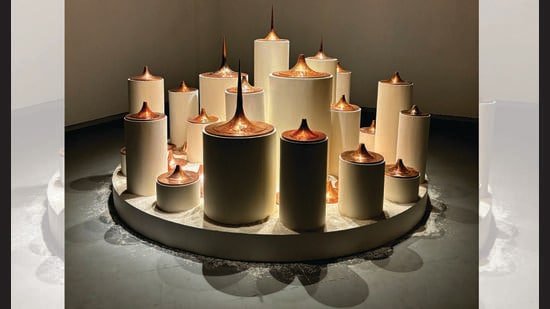
You’ll be leaning in a lot when you look at Transmit, his 2024 installation. It features, at first glance, multiple poles of varying heights and thicknesses, resting on a raised platform laden with rice. The poles bear the load of conical-shaped copper structures of different sizes, each intricately decorated. It looks much like a plinth holding candles lit by devotees. But up close, each piece pulsates with a life of its own. Copper and rice are both materials sacred to Hindu spirituality. The red metal represents the richness and vitality ascribed to fire, the rice signifies abundance and prosperity, a common spiritual offering.
As for those triangular shapes, they might stand for the human body, perhaps even the web of life. Consider that the human, that life itself, is sitting on a strong base of memories, lived experiences. That the huddled poles represent the village – everyone different but together – celebrating life that emerged from a common space, and the physical and spiritual journeys we undertake as individuals, but together.
Viewing it requires a bit of a journey too. One must circumambulate it, the way one would perform the ritualistic act of pradakshina, to see all of it. Nikam cleverly turns spectators into participants, by encouraging them to enjoy the meditative rhythm they might experience in sacred spaces. All this happens without any overt religious iconography.
Along similar lines is the massive installation Wish-Threads, Copper Spires and Hope (2025), in which the same conical shape acquires a larger-than-life persona. Tiny sacred threads, like the ones knotted to make mannats in temples and shrines, are interwoven into its beaten and worn copper surface. It’s a plea to recognise the power of hope and human persistence in the face of adversity.
I became aware of Nikam’s work when taking his classes at the Sir JJ School of Art in Mumbai. His work makes me think about the way surface, texture and process come together to tell new chapters in a story. You might never make it to the Yogeshwari Devi Temple (or want to). But through Nikam’s work, an unlikely pilgrimage will have been made.
ARTIST BIO: Gourmoni Das, founder of Mumbai’s Dot Line Space Art Foundation, also creates mixed-media works that draw attention to the importance of community engagement and local crafts.
From HT Brunch, February 21, 2026
Follow us on www.instagram.com/htbrunch
