

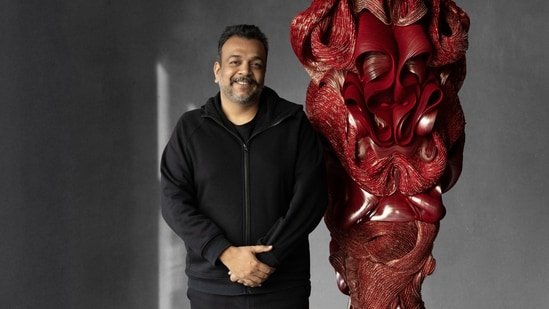
Amit Aggarwal, a celebrated Indian fashion designer, is known for his futuristic silhouettes, innovative textiles, and sustainable approach to design. Seamlessly blending technology with tradition, he has carved a distinct identity on both the Indian and global fashion stages.
He recently unveiled his new AM:IT collection at the India Art Fair in Delhi, held from February 5 to 8, reintroducing his original design language as a contemporary prêt label that brings his couture sensibility into everyday wear. (Also read: Designer Gaurav Gupta calls ‘Jr NTR at Oscars’ his most memorable look; reveals top fashion trends for 2026 | Interview )
In an exclusive interview with HT Lifestyle, Amit shares insights into his design journey, new collection, and his evolving creative philosophy.
Excerpts from the interview:
You’ve built a strong couture identity over the years. What prompted you to explore contemporary Prêt at this point in your journey?
Couture remains a vital and deeply fulfilling part of my practice. It is where I explore material, form, and emotion at their fullest expression, and where many of my longest relationships with patrons have been built.
Over time, I began thinking about how that relationship could extend more continuously through everyday life as well. AM:IT emerged from this reflection. It allows the same design language, values, and material intelligence to exist across different moments from daily expression to significant celebrations. Together, they create a more complete and lasting dialogue with the wearer.
What were the biggest challenges in adapting your couture design language for everyday wear?
The challenge was not about reducing complexity but about distilling it. Couture and prêt operate in different contexts, but they are guided by the same principles of material intelligence and construction.
With AM:IT, the focus was on translating sculptural thinking, surface development, and layering into garments that prioritise versatility, comfort, and function. Every piece had to retain design depth while responding naturally to everyday use and movement.
Can you share the story behind one of your most challenging designs and what made it stand out in your journey as a designer?
One of the most formative experiences in my journey involved developing early pieces that relied heavily on material transformation and re-engineering. At the time, many of these processes were untested within a fashion context.
They required long periods of experimentation, repeated failures, and close collaboration with artisans and technicians. What stood out was not only the final result but the discipline of learning how to work with material as a system. That approach continues to inform both my couture and prêt work today.
The installation at the BMW Lounge features Banarasi textiles. What inspired you to bring these heritage fabrics into a contemporary installation at India Art Fair?
Pre-loved Banarasi textiles have been central to our creative practice at the studio for many years. What continues to draw me to them is not only their visual richness but also the depth of knowledge and memory embedded within each weave.
With this installation, we wanted to explore textile as a carrier of memory, shaped by technique, time, and accumulated experience. Working with pre-loved Banarasi sarees allowed us to extend an ongoing dialogue with these materials and place them within a contemporary spatial context.
Is there a colour, fabric, or silhouette you’re especially obsessed with at the moment?
I don’t tend to think in terms of colours, fabrics or silhouettes. My work has always been guided more by evolution than by preference. Each collection grows out of the last, responding to material, context, and time.
My approach is less about pursuing specific obsessions and more about steady progression. It is a continuous process of refining the design language, allowing it to evolve in response to experience, context, and time, and to gain greater clarity with each phase.
As a designer known for innovation, how do you see sustainable fashion evolving in India over the next few years?
In India, sustainability has strong cultural roots in reuse, repair, and material consciousness. I believe the next phase will focus on embedding these values into contemporary systems.
We will see greater emphasis on circular design, upcycling as a core practice, and technological integration. Sustainability will increasingly be understood as an ongoing process of evolution, rather than a static label.
Looking ahead, which fashion trends do you believe will shape 2026, especially in the Indian and global context?
I think we are moving towards a more considered phase in fashion, where value is defined less by novelty and more by relevance and longevity. Consumers are becoming more discerning, seeking depth, transparency, and emotional connect. In that sense, I believe the future will be shaped less by trends and more by meaningful, well-resolved design.
