

It was a meeting with the legendary conservationist Fateh Singh Rathore in 1976 that changed Valmik Thapar’s life.
Rathore was then director of the Ranthambore Tiger Reserve in Rajasthan, and took the passionate 24-year-old conservationist under his wing.
It was very rare to see a tiger at Ranthambore in those years. One might get a fleeting glimpse at night, often only if bait was set first. There were few tourists, fewer jeeps, and almost no hotels.
This was three years into Project Tiger, an initiative launched by the government of India in a desperate bid to keep these majestic beasts from dying out amid widespread poaching and habitat loss. The tiger population was estimated at 268 individuals at the time. (There are now over 3,600.)

Thapar would go on to serve on scores of government panels and the National Board for Wildlife, write books and helm documentaries (including a number for the BBC). But at first, he was simply determined to understand why tiger numbers weren’t rising.
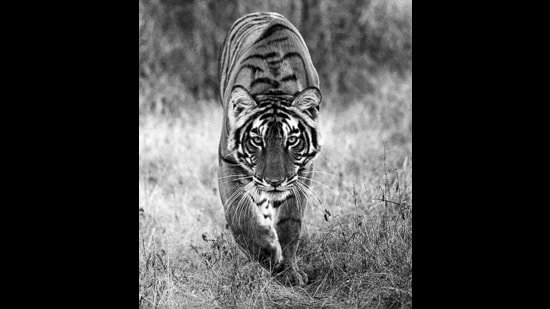
Through decades of research and advocacy, outreach to the public — students, nature lovers, NGOs and conservation organisations worldwide — and, of course, through his stunning photographs, he gave the tiger a voice and a platform.
In Ranthambore, he secured for the regal beasts a kingdom.
When he arrived there, at the smallest of India’s first nine tiger reserves, tiger numbers were estimated to be lower than a dozen. Villages and human activity had driven the few that remained to become completely nocturnal. What would help restore their habitat to them?
Thapar and Rathore immersed themselves in fieldwork, spending hours in the wilderness studying tiger behaviour and habitat. They emerged with findings that helped shape forest policy here. (Thapar would describe Rathore as his “tiger guru”, in later years.)

The two men’s formula was far ahead of its time. They campaigned for local communities to be roped in to help with conservation efforts; eventually, villages would be relocated from core areas, anti-poaching patrols would be enhanced; new technology would be deployed; and alternative livelihoods for local communities made possible, as the park grew and began to draw tourists.
By 1988, Thapar had set up the Ranthambore Foundation, to help villagers displaced by the creation of the Ranthambore National Park in 1980; the foundation continues to aid with healthcare and employment opportunities, and is now also working to rewild degraded tracts of land on the edges of the reserve.
ROAR AND BEHOLD
Today, the Ranthambore National Park is an almost mythically beautiful landscape of big cats draped along fort walls and at temples, stalking through ruins, deciduous forests and dramatic brown rocky terrain.
This is now one of the world’s best destinations for wild tiger viewings.
Thapar lived to see and celebrate the change; to author more than 40 books on wildlife in India, with a special focus on the tiger; and to take thousands of photographs, some of which are instantly recognisable because they have been celebrated so widely and used to such effect in conservation initiatives, magazines, and sustained coverage of the great change in the tiger’s fate.
Last May, Thapar died after a battle with cancer, aged 73.

A new photobook, Ranthambhore: Fifty Iconic Years, celebrates the park he helped shape.
It is the last book he worked on, together with photographer and conservationist Kairav Engineer. Across two volumes, it brings together photographs curated from across five decades of documentation.
In the book, launched in Delhi this week, Valmik notes that the idea originally came from Engineer. “The initial thought and structure did come from me, but very early on it became a shared vision,” Engineer says. “Once Valmik came on board, the project gained depth and direction from his understanding of Ranthambore.”
Over time, the two volumes evolved into something of a love letter to the national park. As word of the project spread, the duo received more than 5,000 submissions, from over 1,000 photographers. The final volume, which Engineer describes as a collective effort, features 800 curated images from 130 photographers.
“Even in his final days, Valmik continued to take interest in the work, which was deeply moving for all of us,” Engineer says.

Introducing the project to readers, Thapar wrote, days before his death: “These two volumes… cover a time when it took months to see a tiger during the day to now, when you see several each morning and evening… Many exceptional forest staff (dedicated) their lives to (making) this possible.”
Departing from a standard chronological record, the volumes honour Thapar’s vision of the jungle as a place of constant discovery. “The book itself is structured like a series of spectacular safaris,” Engineer says, “where every turn of the page brings an unexpected surprise.”
TRACK RECORD
Ranthambhore: Fifty Iconic Years serves, overall, as a long-view visual archive.
An accompanying exhibition was held at Bikaner House in Delhi this week (and expected to travel to venues across the country). In addition to the photographs, the exhibition contains historical maps and early wildlife records, paintings, video installations, and soundscapes recorded in the forest. A juxtaposition of old and new images reveals just how much the forest changed, as it was rewilded.
“It is a safari through five decades of this iconic space and shows how Ranthambore changed the landscape of wildlife conservation,” says Rahil Mehra, co-curator of the exhibition.
A timeline section offers context, guiding the visitor through milestones such as the 945 CE laying of the foundation for the Rajput fort, wars and the post-Independence era, the rebound in the tiger population in the 1980s and the resurgence of poaching in 1991-92 and 2003-04.

The reserve now sustains about 70 tigers, the highest this number has been in recorded history. A film room screens rare documentary footage from Thapar’s iconic works for BBC, a cinematic tribute to the man who brought the Bengal tiger into living rooms around the world.
The big takeaway from the book and the exhibition, says Engineer, is patience. “Conservation doesn’t work on short timelines. Ranthambhore is a reminder that when systems are protected over time, balance slowly returns.”
In keeping with the spirit of the project, all proceeds from the book and exhibition will be donated to the NGO Tiger Watch, as Thapar had wanted, to support anti-poaching initiatives, community-based tiger conservation, and the welfare of frontline forest guards.
