

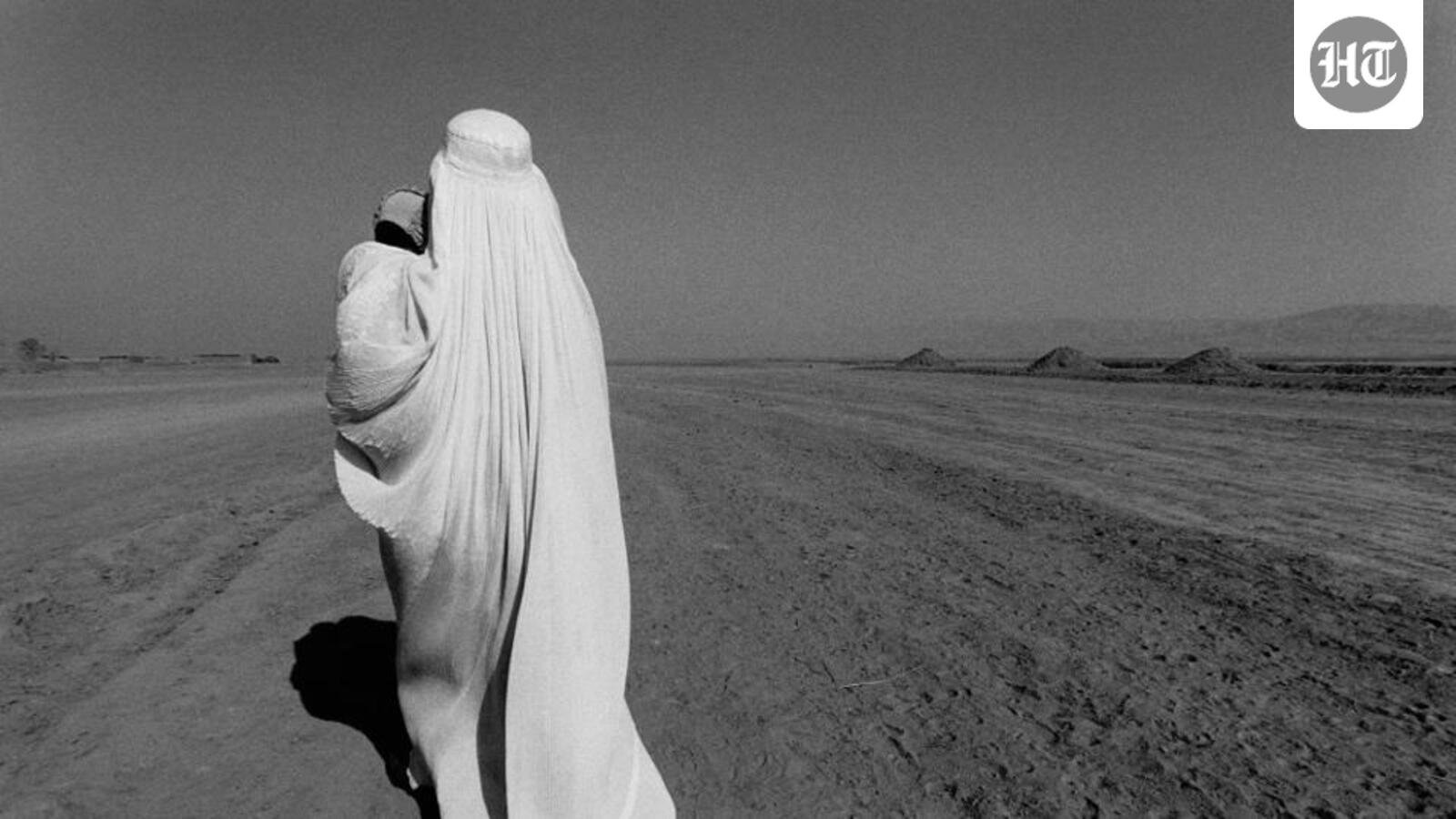
Seamus Murphy doesn’t call himself a photojournalist, though the 66-year-old has won no fewer than seven World Press Photography awards for images captured in Gaza, Trujillo, Kabul, Sierra Leone, Ireland, London and Beirut, capturing, variously, a network of underground tunnels that aided Palestinians in smuggling supplies out of Egypt; a young televangelist, Nezareth Castillo, who preached the word of God to Peruvians at the tender age of eight; the opening of a racetrack on the Green Line, the famous divide that separated the warring sides of a 15-year-long war in Lebanon; and members of the Ba Deli family living through (and dying from) the Taliban regime and US occupation of Afghanistan between 1994 and 2024.
However, it is his work in Kolkata — begun more than six years after a family holiday in 2017 left him mesmerised by the city — that truly defines his impulse to make images: not as a reporter but as an archivist, interested in memorialising time.
Murphy, who is currently in India to set up his works for an upcoming exhibition at Museo Camera, Gurugram, recognises the difference between both sets of practices — and his remarkable ability to straddle them.
An oversized flower attached to the handlebar stem of a garbage collector’s bicycle; a boy impossibly twisted mid-air in a bid to kick a football; a crow flying past two buildings, only one of which recalls the city’s rich Art Deco past; a greasy arm emerging from below a broken-down bus: Murphy captures a side of Kolkata that we do not encounter in a politically saturated news environment. He calls it Kolkata noir.
“Is there a more photographed city on earth than Kolkata? There are so many cliches to avoid,” said Murphy, who spends a few months in the city each year.
“It’s the quiet, everyday moments that I have tried to capture,” he said. “There’s also something very noir about Kolkata—when you’re walking around at night, the angles of the buildings throw shadows that are so filmic.”
But there was another imperative that drove him. He wasn’t shooting Kolkata for any news outlet — on most days, it was just him and his Canon digital camera, walking around the city, capturing Kolkata’s disappearing Art Deco buildings by day and its deepening shadows by the streetlight at night.
Photojournalism thrives on recognisable visual aids that help a reader place the photograph in a corresponding news event, even as it serves an evidentiary purpose and follows a strict editorial mandate. Murphy has certainly been there and done that.
“Western media outlets cater to what the market wants. We also take images thinking, this might get me a double-spread in a magazine,” he said, explaining the difference between the work of a photojournalist and shooting “his own work”.
In 2005, he shot “for himself” in the United States, and by his own admission, he was highly unsure of the photos he had taken.
“It all seemed peripheral and ambiguous. I looked at the negatives and thought I have wasted a month — there’s nothing going on! But in time I realised that the reason why the photographs looked different was because I wasn’t looking for anything that would make a huge impact.”
Murphy continued to revisit the States over the next 15 years — another deviation from photojournalistic practice that prioritises the here-and-now over continuity.
The images, shot between 2005 and 2019, made their way into a book, Strange Love, in which Murphy posits unexpected similarities between the common people of the United States and Russia.
He reckons a similar attitude pervades his Kolkata images.
Starting Saturday, viewers will be able to see a set of 30 images captured in Kolkata along with 77 other works from far-flung places across Russia, North America, his home country of Ireland, as well as Afghanistan at the Gurugram museum dedicated to the art and history of photography.
The exhibition, titled Life Is In Many Days, is put together by renowned curator Zelda Cheatle.
“The new Kolkata photographs, many made in 2026, belong naturally within Seamus’s remit. Living part of the year in Kolkata, Murphy approaches the city neither as an exotic destination nor as an urban problem to be explained. Instead, Kolkata becomes another place through which to examine the extraordinary in everyday life. His attention is focused on transient encounters, gestures, colour, architecture, light and spatial relationships that resist easy narrative resolution. As in his work from Afghanistan, Ireland in [the book] The Republic and Russia and the United States in Strange Love, the photographs avoid typology and cliché, refusing to categorise or explain,” she said.
A note by author Amit Chaudhuri on his Kolkata work draws our attention to the calm formalism that underlies Murphy’s photographs.
“In a way, Murphy taps into Calcutta’s own extraordinary history of design and formalism both in the visual and popular arts: its history of paintings, saris, signboards, and typefaces which he rediscovers and recreates in the texture of its unprepossessing present… It’s as if Calcutta, unaware of itself as anything but terrain and habitation, continues to create, inadvertently, new fields of line, movement and colour.”
Next on the agenda for Murphy is a tight itinerary — squeezing in a trip to Kolkata for more photographs before returning to their London home base. Murphy will also make a trip to Germany to meet the last-remaining son of the Ba-Deli family whom he first encountered in Kabul in 1994. Murphy returned to Kabul 20 times over a span of 30 years, through the devastation caused by the Taliban and the United States. Nearly each time, he photographed the family as it grew smaller — losing members to the Taliban and to sickness and age. He is working on a film on the family, which he hopes to release at the start of 2028.
“I really just want to show the world what these people are like. Because I think they’re going to fall in love with them. And with the anti-migrant sentiment in the West right now, particularly in Germany, Turkey, England, it’s really important for people to see what foreigners and immigrants have been through and how much effort they put into their lives and their children’s education.”
That’s a tall order for a photojournalist, but not one for an archivist with a camera lens.
The exhibition will be on view till October 25 at Museo Camera, Gurugram.
