

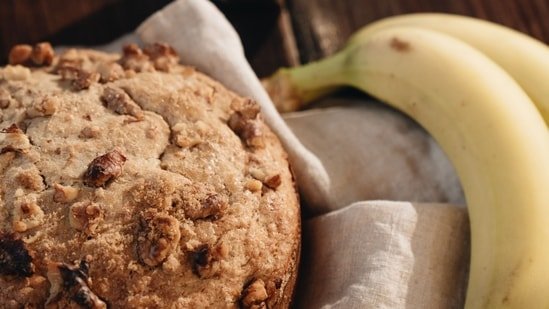
Warm, freshly baked banana bread is a treat in itself. However, the ones available in bakeries are usually loaded with carbs, making them a sugar bomb and not the best option for indulging while following a strict diet.
But what if banana bread could be gut-friendly instead? Taking to Instagram on July 12, Dr Saurabh Sethi, a California-based gastroenterologist trained at AIIMS, Harvard, and Stanford Universities, showed how to do just that with his own banana bread recipe.
The recipe uses chocolate chips, making it extra indulgent and delicious. But it is more than 70 percent dark chocolate, which is rich in antioxidants and micronutrients. The detailed recipe of the high-fibre banana bread, as shared by the gastroenterologist, can be made as follows:
Ingredients for high-fibre banana bread recipe
- Fully ripened bananas – 4
- Whole eggs – 2
- Chia seeds – 1 tbsp
- Ground flaxseed – 1 tbsp
- Oats – 2 cups
- Baking soda – 1 tsp
- Olive oil or ghee – 1 tbsp
- Dark chocolate chips (more than 70 percent) – ½ cup
Method of preparation
- Wash and peel four fully ripened bananas. In a blender, add the bananas and crack in two whole eggs. Then add the chia seeds, ground flaxseed, oats, baking soda, and olive oil or ghee, as stated.
- Blend well until it reaches a smooth consistency.
- Pour the mixture into a baking pan. Sprinkle the dark chocolate chips on top. Bake in the oven until the bread rises up, and it’s cooked inside. Enjoy.
How does fibre benefit the gut?
The banana bread recipe shared by Dr Sethi is loaded with dietary fibre, which is tremendously beneficial for gut health. It is a type of plant carbohydrate that cannot be broken down by the digestive system.
As per the Mayo Clinic website, there are two types of dietary fibre: soluble and insoluble. Each has its own distinct dietary benefit.
- Soluble fibre: As the name suggests, it dissolves in water and forms a gel-like material in the stomach that slows down digestion. It can help lower cholesterol and blood sugar, and is found in oats, peas, beans, apples, bananas, avocados, citrus fruits, carrots, barley and psyllium.
- Insoluble fibre: This type of fibre does not dissolve in water. It supports the movement of material through the digestive system and adds bulk to stool. Sources of insoluble fibre include whole-wheat flour, wheat bran, nuts, beans, and vegetables such as cauliflower, green beans and potatoes.
Note to readers: This article is for informational purposes only and not a substitute for professional medical advice. Always seek the advice of your doctor with any questions about a medical condition.
This report is based on user-generated content from social media. HT.com has not independently verified the claims and does not endorse them.
Dr Saurabh Sethi is a California-based gastroenterologist with training from AIIMS, Harvard, and Stanford and more than two decades of clinical experience. He became a social media content creator sharing insight on his area of expertise during the Covid-19 pandemic.
