

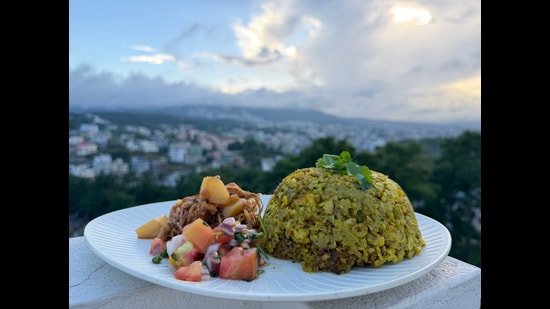
For Mumbai food writer Priyadarshini Chatterjee, 39, breakfast has always been the best meal of the day.
It irritated her when people called it a foreign import and argued that India’s was traditionally a two-meal culture. But she didn’t have enough information to settle such arguments.
So, she decided to do some digging.
What she found was a layered history of pre-dawn meals for fishermen; calorie-rich farmers’ fare such as pinni, drizzled with ghee. Perhaps most remarkably, the meals were all still out there, even in the most bustling, cosmopolitan cities.
Over two years, Chatterjee travelled across 10 cities (see the story alongside for more on the specific morning meals she found), ate multiple breakfasts, combed through historical records, novels, short stories, poems and ancient texts.
The result is her debut book, First Bite: Breakfast Stories from Urban India, published in March. She now has more than enough information to shut down any argument. “The Sanskrit word pratarasa,” she says, by way of example, “means morning meal, and it appears in the Ramayana.”
Excerpts from an interview.
What has changed most about breakfasts in India?
Well, they’ve been shaped by industrialisation and the need for speed, colonial trade and new ingredients, liberalisation and packaged foods. Yet they have remained consistent in one key respect: Over centuries, for a vast majority of people, the morning meal has been about functionality, mobility and sustenance.
It’s interesting how that divide persists, and is clearly visible on Instagram…
Oh, in the age of Instagram, breakfast might look like a bowl of muesli topped with glistening berries, or creamy avocado toast with a side of matcha. But for the majority, this meal is still shaped by need and convenience.
It often involves rice fermented overnight or forms of fortifying gruel; rotis from the previous evening served with reduced gravies; or rice cakes made hurriedly atop the same kettles steeping the tea.
Fresh, hot breakfasts are made in larger batches, using less-expensive ingredients. This may be a woman cooking for a family, or a stall set up along the commuter route. Which is why an entire economy is based on calorie-dense, deep-fried or meat-heavy morning meals sold on the street: aloo-puri, misal, nihari-naan or paya-parotta.
For the working-class, the morning meal remains not an option but a necessity, a buffer against the day’s uncertainties.
Were there moments when you had to rethink familiar foods through this new lens?
In Bengaluru, I was struck by how much meat there was at breakfast time.
The idli-dosa-vada breakfasts were popularised, of course, by Udupi eateries, which were traditionally owned and run by Udupi Brahmins. Bengaluru’s eateries, meanwhile, serve up meat curries and parottas in the morning; as well as rich pulaos served with a side of offal.
Also popular are glasses of ragi ganji or ambali, a gruel made from broken wheat mixed with buttermilk. Ragi has for ages been the food of the poor, a resilient crop that was eaten every day, while rice was the food of special occasions, and of the elite.
Why do we have this idea, then, that this meal is a colonial inheritance?
The one major colonial inheritance that still defines many urban breakfast-scapes is the public eatery, which emerged to cater to industrial-era workers in cities such as Calcutta, Mumbai and Ahmedabad. Perhaps that is why.
The modern office also reinforced the importance of breakfast. Since many caste-conscious Indians hesitated to eat outside the home, the pre-office meal became their key fuel for the day.
And, of course, the colonisers promoted tea and coffee so successfully that it displaced traditional morning beverages such as the gruels, to some extent. In these ways, and with the later addition of packaged foods, the colonial and industrial eras have certainly shaped what we eat at this time of day.
