

It’s hard to tell how far back breakfast goes.
We know a bit about what ancient humans ate, but not when. That picture only becomes clearer with the arrival of the written word, and the records more or less confirm that we have breakfasted for millennia.
The Iliad, written in Greece about 3,000 years ago, mentions a pre-noon meal prepared by a weary woodsman before beginning his day’s labours. Ancient Indian epics use the word “pratarasa” for the morning meal. In the Ramayana, in fact, Ravana threatens to chop the unyielding Sita into pieces for his pratarasa.
It meant very different things though, to those two demographics: the workers and the elite. The former grabbed what calories they could access and afford. The latter typically sat down to a meal of their choice, at a time of their choice. This remains true today.
Class was so woven into the idea of breakfast, in fact, that it even fell out of favour in medieval Europe. In her 2013 book, Breakfast: A History, food historian Heather Arndt Anderson writes that eating such a meal in this era “meant that one was poor, and needed precious calories to get to the business of peasantry”.
That outright rejection of the morning meal didn’t last very long. For one thing, the afternoon meal was so elaborate that the nobility required a light snack while it was being prepared. Then, the colonial era brought in products such as tea, coffee and chocolate, and breakfasts, of a certain kind, became fashionable.
This was the first major intersection of commerce with breakfast. There would be so many more.
***
The morning rush, scarcities of war, women in the workplace and concerns about nutrition have all fed into the great advertising campaigns built around this meal.
It started in the early years of the industrial revolution, when the world’s first packaged breakfast cereal, Granula, was invented by James Caleb Jackson in 1863. This one was sugar-free. But then came Kellogg’s cornflakes, invented by brothers John Kellogg and Will Kellogg in 1894. Will, distinctly pro-sugar, set up the company, and began to pitch this sweetened treat as the sensible, healthy, convenient choice.
A trendsetting campaign by General Foods came next, created for the breakfast cereal Grape-Nuts, in 1944. “Eat a Good Breakfast — Do a Better Job” went the slogan. Amid its radio advertisements, it quoted “nutritionists” as saying breakfast was “the most important meal of the day”.
In these early years of advertising, this sparked something of a panic: was the family getting the morning meal it needed and deserved?
Cue packaged cereals in a range of flavours, as well as products like biscuits, malted beverages, condensed milk and cured meats, all high in salts, carbohydrates or sugars, and using these highs to pitch themselves as the ideal source of energy for the day.
“The message was that you shouldn’t linger in the morning, you should be out there — winning,” says food historian Megan Elias, curator of food and wine history at the Smithsonian National Museum of American History. “And because these were the food ways of the Global North, where industrialisation began, they became associated with modernity.”
Today, affluent Indian households are still drawn to packaged foods marketed with buzzwords such as ‘protein-rich’ or ‘probiotic’ that signal wealth and modernity, points out author and independent brand coach Ambi Parameswaran. In the same way that we swapped our nutritious and climate-friendly morning gruels for sugary coffee and tea.
***
Do we need breakfast today? The debate on that continues.
For those who wake hungry, a healthy morning meal containing protein, fibre, fruit and vegetables acts as an appetite moderator and can prevent snacking later in the day, studies have shown.
Alexandra Johnstone, professor of appetite research at University of Aberdeen, Scotland, who conducted a government-funded study between 2017 and 2022 (published in the journal Cell Metabolism), found that people who ate a substantial breakfast reported feeling fuller for longer, and were less hungry during the day. But she also found that people burned the same calories no matter what time they ate their biggest meal of the day.
It will take more research to establish links between mealtimes and metabolism. “The science of when to eat, called chrononutrition, is vital but relatively new,” she says.
For the moment, she recommends following cues the body offers, because it is basing them on your specific conditions: circadian rhythms, lifestyle, age and metabolic health.
***
In India, tradition can serve as a good guide too.
Since most of the country did not have to factor in scarcities, thanks to temperate climates and lush vegetation all year round, conventional recipes shaped by local conditions remain a healthy option for person and planet.
South India’s warm temperatures still allow idli and dosa batter to ferment, yielding doughs that can be turned into nutritious morning meals with a little steaming or roasting.
Light and comforting, these breakfasts are healthy and nourishing too, says food science writer and HT Wknd columnist Swetha Sivakumar. “Fermentation breaks down some starches and proteins and reduces compounds such as phytic acid, which bonds with minerals such as iron and zinc. This makes nutrients more available to the body, and the grains easier to digest,” she says.
There is of course the matter of the hours required to make the chutney and sambar that really turn these batters into a balanced meal. These could simply be made in large batches, she says with a laugh (since the suggestion often prompts outrage). “Make enough to last two days or three.”
Similarly, from rice cakes and stews to dhoklas and gruels, hearty options abound across the country. (See the story alongside for more on these.)
Some are being crowded out by more-recent inventions, which range from packaged indulgences to Instagram trends. Together, the options represent something less visible: an environmental footprint that is increasingly being shaped by what we choose.
In the first ever study of the carbon footprint of sandwiches, for instance, researchers at the University of Manchester found in 2018 that an all-day breakfast sandwich (loaded with cured breakfast meats such as bacon and sausage, and condiments such as mayonnaise and ketchup) generates 1,441 gm of CO2eq, roughly the same as driving a car for 19 km. This is mainly because of how carbon-intensive meat is; how much packaging and refrigeration are involved; and how far many of the components have to travel before they are even manufactured.
India doesn’t eat a lot of breakfast sandwiches; here, sugar is among the most water-intensive ingredients on the breakfast table. So, what should one choose instead?
“When it comes to planetary and gut health, few breakfasts can compete with traditional fermented or millet recipes,” says Mridula Ramesh, a climate-tech investor, Wknd columnist, and founder of the research body Sundaram Climate Institute. “Fermented options like the good old idli, or neeragaram, are great for the gut. The latter is a handy way to use leftovers. Millets contain more fibre, protein and nutrients and are hardy and climate resilient, making them a better choice than rice or wheat.”
“But the millet cannot compete in taste with sugar, and doesn’t have large companies backing it. Without this backing, and solid innovation in recipe innovation, as is happening in Odisha, the millet cannot scale,” Ramesh says.
This is one of the key troubles with breakfast: the noise. Urban India has the answers, waiting in childhood memories and old recipe books. What’s needed is to tune out the din and reclaim them.
“We may think we are eating what we want to eat,” as Elias of the Smithsonian museum puts it, “but our desires have roots in culture, and they are shaped by the market.”
It isn’t just breakfast, of course. Sit down to any meal and ask yourself: Who really chose what’s on your plate?
.
RUSH HOUR SPECIALS: CHECK OUT BREAKFASTS FROM ACROSS INDIA
KOCHI
A chivda of peas: Called chura matar, this is a winter dish of green peas and flattened rice, eaten across homes in winter, and often paired with gajar ka halwa at street stalls. Flavoured with a complex mix of spices, as well as roasted melon seeds and powdered gooseberry, it makes for a delicious and nutritious sweet-sour-savoury snack.
KOLKATA
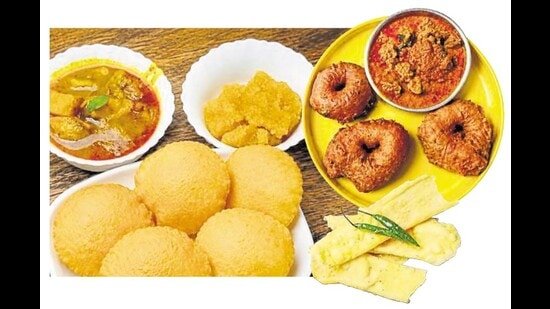
Puris and stew: In the Musalman para or Muslim neighbourhoods, deep-fried puris made with split Bengal gram are served with a fatty, spiced salan (or thick gravy of meat and offal). The dalpuri, incidentally, has roots in Uttar Pradesh and Bihar. It arrived in Kolkata via indentured labourers, travelling onwards to island colonies and transported through Calcutta. In Kolkata, it is typically used to mop up tamatar ishtu, a soupy mutton curry with a sprightly sourness from sundried tomatoes.
Bakarkhani: This golden, crusty bread made with refined flour, eggs, milk, sugar and ghee, is slathered with butter and served with tea (or nihari; or the thick Mughlai rezala meat gravy) as a morning meal to carry one through the day.
SHILLONG
A pork khichdi: A dish of rice (typically unpolished red rice) cooked with pork and flavoured with spices, jadoh is sold early morning at kong shops run by Khasi women (kong is Khasi for sister). A popular accompaniment is a pork “salad” made with pig’s brain, boiled or steamed in a banana leaf with onions and ginger.
.
Kettle cakes: An array of rice cakes are eaten across north-east India. At breakfast stalls in Shillong, one will often find soft-steamed versions called putharo that are perfect for sopping up a gravy of pork cooked in a black-sesame paste (or a protein-rich chutney made of fermented soybean paste).
In Assam, bowl-shaped treats of rice, jaggery and scraped coconut are steamed in damp muslin by setting them in the open tops of tea kettles, which is where they get their name: tekeli pitha. A variation in Mizoram is made by steaming a thick paste of glutinous rice in banana-leaf parcels and serving with a drizzle of honey or melted jaggery, and tea.
AHMEDABAD
Aloo-puri-halwa: Crusty and spice-flecked bedmi puris, with roots in rural Uttar Pradesh, are made with a mix of wheat flour, ground lentils and spices such as amchur, chilli powder and hing. In Delhi, they are served with a thin tomato-and-potato gravy. Often available alongside is halwa-nagori, a dish in which crusty little shells of deep-fried dough are filled with sooji halwa, and sometimes topped with a bit of the spicy potato curry, for a burst of sweet-savoury flavour.
MUMBAI
Bhakri-kanji: In a city of vada pav, omelette pav and constant change, the traditional breakfast of Mumbai’s fisherfolk — bhakri or rice chapatis paired with a kanji or leftover fish curry — is still eaten in Koli homes. Fishermen leave too early for a fresh meal to be prepared, so leftover curry is reduced on a low flame, to intensify the flavour. In Koli neighbourhoods, food stalls offer the staple too: bhakris and fish curry, sometimes with a side of boiled eggs. In winter, methi ladoos are added to the meal, for further fortification in the cold morning hours.
