Football is the world’s most-loved sport, yet it once belonged, if it can be said to belong to anyone, to one country. Brazil was football, and football was Brazil.
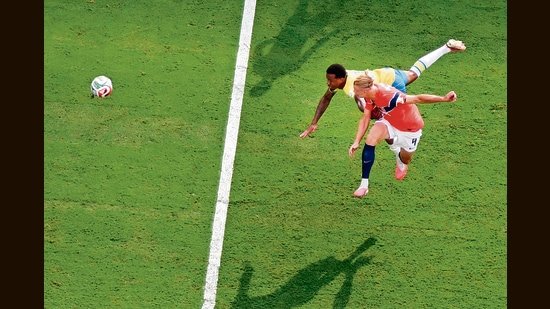
Norway’s Erling Haaland (right) scores in the July 6 game that saw Brazil dismissed from the tournament. (AFP)
That was where the game went to find its soul, its fountain of creativity; its artists and soldiers, gods, priests and troubadours. Barefoot and in nothing but tattered shorts, playing with a ball made from scraps of cloth tied together, or dazzling the world in cobalt blue and canary yellow, it was all the same.
“The ball is my best friend,” said Pele.
“I learned all about life with a ball at my feet,” said Ronaldinho.
This is a country where a newborn’s parents hang the shirt of the team they support on the door of their baby’s room. And where people, when they die, have their coffins draped in the flag of the team they supported in life.
Brazil still holds the record for more World Cups won — five — than any other country. Yet nearly 25 years have passed since the last one, in 2002; years in which the footballing world appears to have shrugged them off.
The muse has left them, the mystic is long gone. Young fans of the game don’t automatically associate beauty, artistry and sheer dominance with this country.
So when Norway — who last qualified for the World Cup in 1998, and was playing in the knockout round for only the third time in its history — dismissed Brazil from the ongoing tournament on July 6, it didn’t come as much of a shock to the world.
How did it come to this? That is a question that demands serious research. Economics, changes in social structure and urbanisation have erased informal playing spaces. Corruption and a lack of vision in the domestic league has led all the best talent to leave the country to play club football abroad. There’s plenty more; the list of factors is long. But there is one aspect of the Brazilian game that may hold the key to everything.
At the 1982 World Cup, Brazil, as it tended to do back then, sent in a team of wizards; the likes of Zico, Eder and Falcao, led by the chain-smoking, guitar-playing physician and football magician Socrates. The way they played captivated and thrilled even their opponents. This was football as most people had never seen it before.
Then they were beaten, in the quarterfinals, by a hard-edged, defensive and sleekly organised Italy. “No one understands this world anymore; Brazil eliminated,” read a newspaper headline in Barcelona.
Brazilian football would never be the same. The team’s focus shifted from creativity and artistry to pragmatism.
Socrates’s famous motto, “Beauty comes first. Victory is secondary”, was emphatically rejected. There was now a wall between playing to win and the traditional Brazilian idea of playing beautifully. The country went on to win the World Cup in 1994 (its first such win in 24 years) and again in 2002. But this was not the same mystic force. There was little difference between them and a good team from Europe. Soon, they stopped winning against those teams, starting a slow downward slide.
Meanwhile, the beauty in football didn’t disappear. It moved to other places. In Spain, inspired by Barcelona’s philosophy, lithe players combined creativity, artistry and control to shatter the most intimidating defences. Spain went on to win its first World Cup in 2010. In France, impoverished neighbourhoods turned out successive generations of daring, free-flowing artists, from Zinedine Zidane in the late-1990s to Michael Olise today. France has since won two World Cups, in 1998 and 2018, and is setting off fireworks at the ongoing edition.
I see, in their sense of joy and their phenomenal success, something that looks familiar. Perhaps Brazil will find its way back to the path described by Socrates, and rediscover what has always been in its DNA.
(Email Rudraneil Sengupta on rudraneil@ gmail.com. The views expressed are personal)
सिद्धभूमि के लेखक एक प्रमुख समाचार लेखक हैं, जिन्होंने समाज और राजनीति के महत्वपूर्ण मुद्दों पर गहरी जानकारी और विश्लेषण प्रदान किया है। उनकी लेखनी न केवल तथ्यात्मक होती है, बल्कि समाज की जटिलताओं को समझने और उजागर करने की क्षमता रखती है। उनके लेखों में तात्कालिक घटनाओं के विस्तृत विश्लेषण और विचारशील दृष्टिकोण की झलक मिलती है, जो पाठकों को समाज के विभिन्न पहलुओं पर सोचने के लिए प्रेरित करते हैं।
एक ऐसे समय में जब प्रिंट एवं मुद्रण अपनी प्रारंभिक अवस्था में था ,समाचार पत्र अपने संसाधनो के बूते निकाल पाना बेहद दुष्कर कार्य था ,लेकिन इसे चुनौती के रूप में स्वीकार करते हुए स्वर्गीय श्री शयाम सुन्दर मिश्र “प्रान ” ने 12 मार्च 1978 को पडरौना (कुशीनगर ) उत्तर प्रदेश से सिद्ध भूमि हिंदी साप्ताहिक का प्रकाशन आरम्भ किया | स्वर्गीय श्री शयाम सुन्दर मिश्र “प्रान ” सीमित साधनों व अभावों के बीच पत्रकारिता को मिशन के रूप में लेकर चलने वाले पत्रकार थे । उनका मानना था कि पत्रकारिता राष्ट्रीय लोक चेतना को उद्वीप्त करने का सबसे सशक्त माध्यम है । इसके द्वारा ही जनपक्षीय सरोकारो को जिन्दा रखा जा सकता है । किसी भी संस्था के लिए चार दशक से अधिक का सफ़र कम नही है ,सिद्ध भूमि ने इस लम्बी यात्रा में जनपक्षीय सरोकारो को जिन्दा रखते हुए कर्मपथ पर अपने कदम बढ़ाएं हैं और भविष्य के लिए भी नयी आशाएं और उम्मीदें जगाई हैं । ऑनलाइन माध्यम की उपयोगिता को समझते हुए सिद्ध भूमि न्यूज़ पोर्टल की शुरुवात जुलाई 2013 में किया गया |
हमसे संपर्क करने और जुड़ने के लिए मेल करें -
siddhbhoomi@gmail.com
Subscribe to Updates
Get the latest creative news from FooBar about art, design and business.