

There’s no story like an underdog story. From history to literature to fantasy — be it a handful of Athenians holding off a Persian invasion in 500 BCE, Edmond Dantes escaping his prison chateau to rebrand himself the Count of Monte Cristo, or two puny Hobbits destroying the One Ring in the fires of Mount Doom — nothing quickens the pulse and stirs the imagination quite like an against-all-odds triumph.
In sport, there are some moments when underdog stories are the only ones that matter.
So, France’s total domination so far and Brazil’s shock exit last week notwithstanding, the early stages of all football World Cups are inevitably the songs of the unsung. Expand the field to 48 teams instead of 32, as this 2026 edition has done, for the first time, and the music is bound to get louder.
This year, the chorus has come from Cabo Verde, a nation of 10 small volcanic islands in the Atlantic Ocean. It’s come from the Democratic Republic of the Congo, the beating heart of Central Africa. And it has come from Norway, the frigid land of the Vikings across the North Sea. Meanwhile, Morocco have added new riffs to North Africa’s rising football tempo, and USA and Canada have thrown in a few North American beats for good measure.
None of these teams may go on to win it all — Norway are the only team definitely in the competition at the time of going to print, and the narrative will most likely shift to the traditional powerhouses by next weekend — but the legend of the longshots will be told and retold for generations.
ISLAND OF DREAMS
Look at the unlikely heroes from Cabo Verde, for instance.
Deroy Duarte and Sidny Lopes Cabral were born in Rotterdam in the Netherlands, nearly 3,000 miles from their parents’ homeland, descended from seafarers who signed up with Dutch shipping companies in the 1950s.
Duarte, 27, is a central midfielder who likes to make late runs into the penalty box. Cabral, 23, is a fullback who can be deployed on both the left and right sides of the pitch. They are journeyman footballers in the Bulgarian and Turkish leagues respectively — both were good enough to get professional contracts but weren’t exactly on the radar of the megaclubs in England, Spain, Germany, Italy and France.
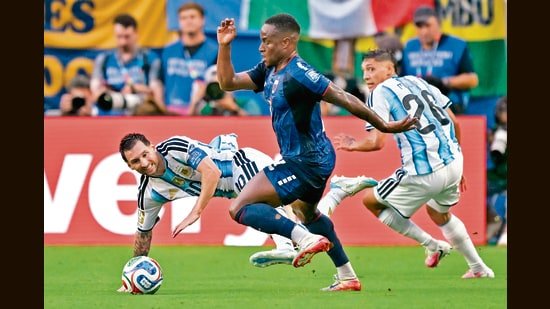
Last week, in the 59th minute of a supposed mismatch against Argentina, Duarte made one of his late runs into the box. He got a nutmegged cross from winger Ryan Mendes and slotted a flat right-footer into the back of the net to cancel out Lionel Messi’s opening goal.
An hour later, deep into extra time with Cabo Verde behind again, Cabral cut inside his marker on the left edge of the penalty box. His shot sailed across the face of the goal and curled into the far corner to make it 2-2, pushing the world champions to the brink of a penalty shootout. “Oh, my word!” exhaled the commentator. “Cape Verde have stunned Argentina for a second time!”
Argentina did find a winner in the nick of time, but the tiny dots on the world map were already part of footballing lore by then. Like Erling Haaland’s two late strikes to knock out Brazil, and Paraguay’s dogged resistance to eliminate Germany and almost hold off France, and DR Congo’s entry into the knockouts in what is only their second World Cup (the first was as Zaire, in 1974).
NORTHERN DELIGHT
Eight years before Zaire’s first foray, the World Cup’s most famous underdog story came from another unlikely quarter.
Just over a decade after the Korean War led to the creation of the Demilitarized Zone (DMZ) on the Korean peninsula, North Korea managed to qualify for the 1966 World Cup in England, sending political ripples across the Western world.
Expected to be no more than makeweights, the North Koreans duly began with a 3-0 defeat at the hands of the Soviet Union but somehow managed to find a late equaliser against Chile in the second match to keep themselves in the hunt. That goal by Pak Seung-zin was incidentally the first by an Asian at any World Cup.
The final group match was a potentially painful test against mighty Italy. The Italians started well but striker Giacomo Bulgarelli suffered a knee injury early in the game. No substitutes were allowed at the time, but no one was worried that the Azzurri were a man down. The moment of disbelief came in the 40th minute. Ha Yong-won intercepted a clearance towards Pak Doo-ik, who let the ball run across his body and slotted a low shot into the right corner of the net. “The North Koreans take the lead five minutes before the break,” the iconic Frank Bough shouted on BBC. “What a sensation! What a sensation!”
An hour later, North Korea had sealed the greatest moment in their sporting history. The stadium at Middlesborough erupted in joy. In that moment, the 38th Parallel was nothing more than a line on the map.
In the quarter-final, North Korea took a 3-0 lead in just 24 minutes against Portugal, before Eusebio scored four stunning goals to single-handedly end the run. A dream run that would echo through time, becoming the template for Cameroon’s heroics in 1990, Croatia’s masterclass in 1998, Senegal’s victory over defending champions France in 2002, Costa Rica surviving the group of death in 2014, and Morocco storming into the semi-finals in 2022.
Each one of these mattered nearly as much as the eventual champions did. They connected us to people and places in a way only sports can. And got the world hooked in a way that only underdog stories do.
(The views expressed are personal)
