

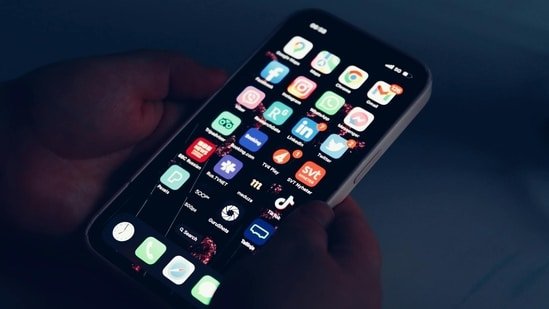
Have you ever felt anxious after keeping your phone away for a moment? Not in a situation where you need to stay connected, like when you are outdoors or waiting for a call or update, but in general, at home. It is that sudden flare of panic when you cannot find your phone. Nowadays, phones feel like an extension of the body, always on your person, even in the bathroom.
ALSO READ: How to deal with ‘narcissistic’ people? Psychiatrist shares 5 ways to protect your mental health
While staying connected may feel like a reflex, from friends’ calls and work texts to news updates and social media, digital use takes up a sizeable part of your daily routine. But when the phone becomes the first thing you reach for in boredom, stress or silence, the dependence can go beyond convenience and start tampering with your attention, mood and emotional well-being.
HT Lifestyle attempted to take a deep dive into this impulse with the help of expert insights, exploring why parting from your smartphone can make you break into sweat and, more importantly, what this dependence can do to your mental health.
Why do you feel anxious without your phone?
We asked Dr Sameer Bhargava, psychiatrist at Fortis Memorial Research Institute (FMRI), Gurugram, whose expertise lies in managing anxiety disorders, depression, stress-related issues, psychosis, addiction and emotional health concerns, if he sees such cases in his clinic.
He said it is actually quite common. “As a psychiatrist, I see this reaction becoming increasingly common. Our smartphones are no longer just communication devices; they are our calendars, cameras, entertainment hubs, workplaces and social lifelines.”
Now, there are a couple of reasons why people may feel jittery without their phone.
First is the phone being a quick source of reward. The psychiatrist expressed his concern that every notification, message or social media update on gets on their phone they all give a small sense of pleasure or relief. Soon, the mind begins to expect this constant stimulation.
“Each interaction with the phone triggers the release of dopamine, a neurotransmitter associated with reward and pleasure. Over time, the brain begins to expect these frequent rewards. When the phone is unavailable, many people experience restlessness, irritability or difficulty concentrating, which we may consider as psychological withdrawal signs,” Dr Bhargava said, suggesting the possibility of psychological withdrawal symptoms when left without a phone.
The next is emotional dependence. Why do you pick up the phone? What exactly is the root cause? The psychiatrist decoded, “We often use our phones to avoid boredom, loneliness or stress. Without them, we are left alone with our thoughts, which can feel uncomfortable.”
How to know if you have phone addiction?
How do you know if you are suffering from phone addiction? To this, the doctor told us that even if someone is picking up their phone to avoid boredom, loneliness, or stress, it does not necessarily mean they are addicted. However, it may come close to addiction when phone use interferes with the basic aspects of daily functioning, such as sleep, relationships, work or emotional well-being. In such cases, it may be time to reassess digital habits and consider a digital detox.
Why do you need a digital detox?
Now that the conversation is moving towards digital detox, let’s hear from the founder of World Digital Detox Day, Rekha Chaudhari, a global wellness leader, on why digital detox is essential nowadays, especially with growing digital clutter and impulsive digital behaviour, such as the aforementioned anxiety of being without a phone. She spoke about the ‘digital jungle,’ where devices dominate and rule and how most of us are lost in this ‘digital jungle.’
What is digital jungle?
“The ‘digital jungle’ is a metaphorical construct that defines the invisible ecosystem we now inhabit, where screens, platforms, and algorithms relentlessly compete for human attention,” she said. “What once functioned as a tool has evolved into an extension of identity. It is frictionless to enter, persistently engaging, and increasingly difficult to exit.”
How do you know you are a part of digital jungle?
There are some telltale signs of being stuck in this digital jungle. Rekha mentioned behaviours like: Reaching for your phone without purpose, oscillating between applications without awareness, experiencing discomfort in silence, or defaulting to your device the moment you wake.
“Even in stillness, the mind anticipates stimulation. Attention is no longer self-directed; it is externally captured and conditioned.”
To simplify it, the mind becomes more attuned to constant stimulation. So attention is no longer under your control, as it is strongly influenced by notifications, apps, and toxic digital habits.
What is the consequence of ‘digital jungle’?
In this regard, Rekha warned that if you do not learn to declutter and exit the ‘digital jungle,’ with a digital detox route, you may remain in a state of mental fatigue. This shows up subtly in the way you are always restless and your mind is rarely resting and always restless. Soon, you suffer from reduced focus, irritability and emotional imbalance.
Note to readers: This article is for informational purposes only and not a substitute for professional medical advice. Always seek the advice of your doctor with any questions about a medical condition.
