

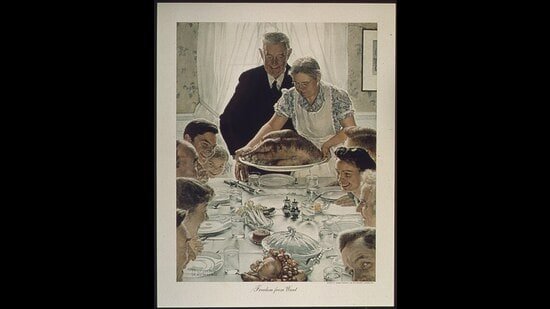
What was the American Dream? The term itself is younger than it sounds.
Historian James Truslow Adams coined it in 1931, in his book The Epic of America, insisting the Dream was not merely about “motor cars and high wages” but a “better and richer and fuller life for everyone”, a life not hostage to the “fortuitous circumstances of birth or position.”
The raw materials of the Dream are older still. They live in the US Declaration of Independence, with its ideas of equality and unalienable rights, its republican ideas of ownership and its conviction that America was a new world in the most literal sense: a clean page upon which effort and providence would write a better story.
In 250 years since that declaration was adopted, in 1776, the Dream has cycled through at least four avatars.
1) In the colonial and early-republic era, it meant land: actual acres, the frontier as a permanent reset button for anyone willing to move west.
2) In the industrial age, it became wages and self-betterment: the immigrant who worked at the mill, saved and sent their children off to college.
3) After World War 2, it crystallised as homeownership. The middle-class urban family was a unit defined by cheap mortgages, a bedroom for every child, a car for every teenager, one parent caring for the home and a single income that stretched comfortably to cover it all.
4) After the 1980s, it was re-imagined as entrepreneurship and equity: the founder’s garage, the stock option, the IPO.
Beneath the surface variations, one thing remained constant: the Dream was pegged to upward mobility. The hope now is to return to a time when such growth and mobility could be taken for granted. As things stand, a 2026 Gallup poll found that fewer than half of those polled (46%) believe all Americans have a shot at ending up better-off.
AN INCREDIBLE ARC
How much of the Dream was ever true? How much was self-aggrandisement, propaganda, an elaborate screen that hid a very different reality lived by unseen masses?
To unpack this, one must first reckon with the scale of what was, by any measure, a grand experiment.
In 1776, the United States consisted of 13 colonies hugging the Atlantic seaboard, across just over 1 million square km, home to roughly 2.5 million people. Today, the country spans nearly 10 million sq km across 50 states, and is home to 342 million.
Which serves as a reminder that the Dream was, for much of its history, powered by something no other major power has possessed in quite the same form: the frontier.
Not just the romantic frontier of cowboys and open plains, but the economic one: the perpetual availability of new land, new cities, new industries, new migrations, that gave physical form to the promise of reinvention. When the land ran out, the economy generated new frontiers in sequence: steel mills, automobile assembly line, the post-war suburb, Silicon Valley, the internet, and now, artificial intelligence.
The constitutional structure that held all this together is, by any reckoning, a remarkable achievement too. The American state has survived a civil war that would have ended most polities, as well as two world wars, the cold war, a series of economic and democratic crises. And it has done so while — if fitfully, belatedly, and never without a fight — expanding the franchise to include people it originally excluded.
THE WORLD’S BEST STORYTELLER
After Britain (the country we can thank for the absurd idea that Shakespeare is the world’s best storyteller), this is perhaps the nation with the greatest flair for showmanship in the modern era.
America cast itself early on as “leader of the free world” (implying, even in that phrase, that anyone who did not recognise this was part of a losers’ club).
It wooed the world with its films, music, universities, research bodies and foreign aid. It deployed diplomacy and aggression; and the US dollar, which remains the reserve currency of a planet effectively colonised by the American way.
Land of the free, went the slogan, while segregationist policies persisted. Everyone has a shot, was the message, in the era of redlining. The world saw a standard of living like no other, as homelessness numbers rose and healthcare spiralled into crisis.
It was the internet that allowed us look behind the gloss. Read the data ourselves. See the police footage and the medical bills. Listen in on debates about reproductive rights, White fright and school shootings.
WHAT ELSE WERE WE MISSING?
The American Dream was always running a bit in arrears.
In 2001, the journalist Barbara Ehrenreich published Nickel and Dimed: On (Not) Getting By in America. It detailed how low-wage working-class jobs such as that of a waitress in Florida, hotel maid in Maine or department-store attendant in Minnesota simply did not pay enough to cover rent, food, transportation and healthcare in the same month.
Scale this up for a country of expensive higher education, where 62% of adults do not hold a four-year college degree. Precarious and low-paid temporary jobs, gig work and subcontracted labour make up 30% to 50% of all working-class jobs in the country. Debt, of one kind or another, is more or less written into the system.
The average American currently carries about $6,700 in credit-card debt. One in nine card-holders can only pay the minimum due each month.
In the wealthiest country in the history of the planet, tens of millions of people live one car repair or medical co-pay bill away from a genuine financial crisis.
How did this happen? As unions and worker protections weakened from the 1980s on, and personal wealth soared for a tiny minority, over several decades, the massive American economy grew around the working classes rather than for them.
As the gap continues to grow between what the average worker produces and what they get to take home, the country is now home to nearly 1,000 billionaires, and the world’s first trillionaire. (For perspective, China is second on that list, with just over 500 billionaires.)
THE EPISODIC RUG-PULL
What happens in the US when the working-class and middle-class feel economically squeezed is what has always happened, around the world, since the dawn of the city-state: the melting pot is put on hold and the welcome mat is pulled away.
It feels remarkable when this happens in the US because the Idea of America remains so looming: beacon of hope, land of milk and honey, “give me your huddled masses yearning to breathe free”. But it’s been happening there since at least the 1850s.
Back then, key targets were Catholics and the Irish. By the 1880s, it was the Chinese. Southern and Eastern Europeans have made the list; Asians have periodically been on it and off and on again.
MAGA is the latest verse in this old tune.
It is unlikely that a Whiter United States would solve the problem. The real magic trick would be to rewind to the post-war economic boom that stretched from the 1940s through the 1970s. But that boom came from a set of conditions: a destroyed Europe, racial exclusions that suppressed competition, an economy far less skewed in favour of the wealthy.
President Donald Trump can harness the rage, but he cannot change the fact that America’s crises — of wage stagnation, inflation, indebtedness, its opioid epidemic, high cost of living and rising homelessness — are self-goals.
MAGA, BUT HOW?
So, is America simply having a difficult decade or two?
Well, it isn’t just an economic superstorm. There is also the growing shadow of China, and the challenges posed by the dominance of Big Tech and AI. The changing geopolitical map, flux in global markets and trade, and the deep layer of uncertainty introduced by the climate crisis.
In many ways, this is – perhaps since the civil war – the most precarious the Dream has been. Yet, the country flourished in the wake of that war.
It has exhibited, over and over, a capacity to course-correct.
The republic has demonstrated, consistently, that elections count, courts matter, journalism works, and organised protest can actually effect change. This is rarer, globally, than one would think.
It isn’t often that a country this size can bring itself to administer the shocks to the system that such course-correction requires. Yet America does. It abolished slavery. Passed Medicare and Medicaid. Elected a Black president.
What will it take to accommodate new realities, to refresh the Dream, while correcting graphs at home that draw money away from families and redirect it to billionaires?
It will take, in some areas, the willingness to see past the visible horizon and start over somewhere new.
It may take a return to pioneering roots, for America to lead the way again, in a vastly changed world.
If 13 colonies could do it, perhaps 50 states can too.
(Kashyap Kompella is a CFA charterholder, tech industry analyst and author of three books on AI)
