

When reading about the reintroduction of wolves into Yellowstone National Park, I learned that while wolves spend quite a lot of time goofing around, their lives are brutal.
For every meal, they risk bodily harm and court death.
Which makes me truly grateful for the modern food system that lets us eat without risking loss of limb. But in our quest for convenience, we may have gone too far. Food delivery is stripping the choice and consequence out of how we eat — and that is hurting us, as we saw in the last column; and hurting the planet, as we shall see in this one.
Let’s start with wasted food.
A MOUNTAIN OF FRIED RICE
In 2019, researchers in Wuhan, China, weighed leftovers (including by rummaging through garbage cans) from over 800 food-delivery orders. The average order, they found, left behind about 200 gm of food and 85 gm of packaging.
After surveying nearly 900 consumers, the researchers found that minimum-spend thresholds and “spend more, save more” discounts nudged people to order more than they could eat.
Another study using data from China’s delivery platform Meituan confirmed the role of minimum-spend thresholds and offers, but found a lower number of 57.5 gm of wasted food per order.
I recently visited China, ran into the minimum-spend threshold while placing a food order, and ended up wasting half my fried rice. Given the rise of single-person orders, minimum-spend thresholds present a serious sustainability challenge.
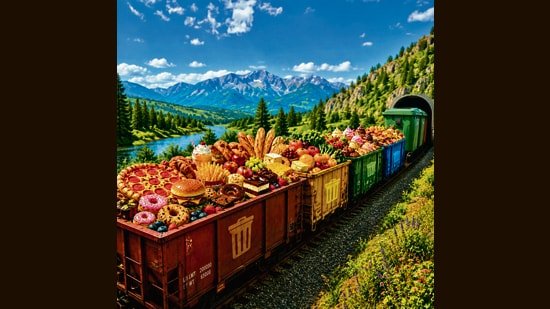
Extrapolated to India, those numbers suggest that online food delivery could generate 100,000 to 300,000 tonnes of food waste a year — roughly what 40 to 120 fully loaded freight trains can carry. This food waste rots in landfills, releasing methane. It pollutes the air when it is burned at street-corner dumps. Because the individual is not directly hurt by such waste — in fact, wolfing down all the food would hurt the person more — each private order adds to public harm.
MEAT AND POTATOES?
Moving on to food choice, one Chinese study found that delivery orders contained more meat and fewer vegetables than meals eaten in restaurants, contributing to a 53% higher carbon footprint.
Part of the reason is that the price on the menu tells only a partial truth. When water and carbon are free or too cheap, it makes a higher-impact dish cheaper than it truly should be, and blunts the power of markets to innovate in order to reduce costs (including by shifting to options that use less water and less carbon).
Rajasthani cuisine is a glorious celebration of what can emerge when landscape limits water availability. Our guts and our palates become poorer by rubbing out this innovation.
Still more food is wasted in the restaurant, and in warehouses of the kind that ensure you get your bananas in minutes. Let’s take just used cooking oil (UCO). Repeated heating changes the oil. It darkens, thickens, turns rancid, and develops trans fats and other breakdown products that make it unsafe to eat. India has rules for used cooking oil, but rules are only as strong as the economics beneath them.
Formal collectors that turn used oil into biodiesel or sustainable aviation fuel are easily outbid by informal scrap dealers, who route the same oil back into street food. Eventually, much of it is poured into drains (which is a waste, and causes problems through the literal pipeline).
Only a small fraction of the 2.5 to 3 million tonnes of UCO generated per year in India are treated for reuse as fuel. This can and should improve.
TRAPPED IN A BOX
Now to packaging. The Wuhan study found that each delivery order generated, on average, 85 gm of packaging waste. A smaller but more oft-quoted study put the number at 64 gm. Either way, the India number is large: online food delivery alone could be producing over 1 lakh tonnes of packaging waste a year.
Going by results from a Sundaram Climate Institute survey of over 2,000 people, many don’t care, a point supported by interviews with senior sources in the industry, waste management experts and start-ups.
What if instead we made the cleaner option align with their self-interest?
Harmful chemicals leach out of plastic and into food, especially when the food is hot and oily. Liquid from heated takeaway containers has been shown to damage the hearts and guts of rats, heavy plastic use is associated with higher rates of heart failure, and microwaving plastic containers can release millions of microscopic particles in minutes.
Some linings and certain types of plastic boxes contain (and release) endocrine disruptors such as phthalates and bisphenol A into food. Black plastic, often made from recycled electronic waste, can carry flame retardants and heavy metals into the tray holding dinner. I’m seeing my delivery box in a new light.
People may not pay more to save the planet. They might pay more to avoid feeding their child hot curry from a suspect box.
DINE, DON’T DASH
Then there is transport. Swiggy and Zomato riders cover millions of kilometres a year, emitting hundreds of thousands of tonnes of CO2 — if they all run on petrol.
Going electric changes the math: each rider saves lakhs of rupees over the life of the bike, and halves his emissions while he’s at it, even powered by India’s coal-heavy grid. Little wonder then that both companies have committed to fully electrifying their fleets over the next five years.
Now, here’s the twist. Swiggy offers an EcoSaver option of slower, greener delivery at a discount: wait a bit longer and the rider will pick up multiple orders to get the most out of his miles. Uptake is low.
The EV approach works because the rider gains; the customer won’t wait 10 more minutes to help the planet. The lesson is clear: Sustainability scales when it is easy, and works when the person bearing the cost also gets a direct reward.
Electric mobility works because the rider may pay more upfront, but saves on fuel and maintenance. It fails when the burden falls on someone else: the restaurant that must spend more time packing, or the hungry customer asked to pause mid-scroll, with dopamine screaming “More!”, and think of the planet.
Virtue is a weak lever at dinner time.
MAGIC, SCALED
We can fix this, but there are three hurdles to overcome.
One is that the green option is too dear. A sustainable box can cost nearly twice its plastic rival. Neither the restaurant, with its razor-thin margins, nor the customer, with enough on their plate, is willing to swallow that difference.
Consider, however, that every innovation looks really expensive at first. LED bulbs were wildly expensive 20 years ago, before policy like the Ujala scheme, procurement and manufacturing scale pushed prices down. Packaging needs the same treatment.
Some action is happening already. Zomato claims it is funding the recycling and processing of plastic packaging used in its deliveries, and has a filter to highlight low-plastic deliveries (though you have to search to find it, which kind of defeats the purpose). Both platforms run marketplaces to highlight sustainable options to vendors.
In my recent deliveries, I have received food packaged in black plastic and food in compostable boxes. Meanwhile, in China, I met an innovator making paper alternatives to Keurig pods, and even paper pans that don’t burn. It seemed like magic. Well, magic scaled is just manufacturing. Solutions exist. They now need help to scale.
The second hurdle is timing. No price signal, label or lecture reaches a customer mid-scroll and hungry. So, stop asking them to make the virtuous choice. Swiggy already has an “Eat Right” filter for protein; point the same machinery at carbon.
Reorder the menu so the lower-impact dish loads first, and let the algorithm accomplish what no sermon can. A British study found that just reshuffling menus by carbon cost cut emissions more effectively than either taxes or labels.
The third (and most important) hurdle is that cost and benefit are currently borne by two different parties. Take food waste. The vendors who turn it into biogas, fertiliser and feed already exist, but the diner bears the effort of segregating, and pays for someone to collect it, while the benefit goes to the world at large and to the vendor. Because cost and reward sit with different groups, nothing moves.
The fix is to put them together. Could the platform that matches hunger and food so well play matchmaker here? After all, study after study has suggested that the algorithm is a driver of over-ordering, which is a driver of the waste. Add a filter for sustainability — with third party verification, and financial, algorithmic and market support (some of which already exists, but needs to become strategically mainstreamed)? In the cut-throat world of restaurant listings on these apps, sustainability could then become a true differentiator.
Wasted food, packaging and transport — the nuts and bolts of convenience — together account for as much carbon as 80,000 Indian households emit in a year. And that’s not counting what reused oil is doing to our arteries or heated black plastic trays are doing to our bodies.
True, online delivery is only a sliver of India’s larger food-waste and emissions problem. But the point is leverage. When a few large platforms sit between millions of restaurants and consumers, they have real power (and the responsibility?) to encourage innovation.
The wolf risks death for dinner. We have built a world where dinner arrives in minutes. Which is a marvel. The waste, plastic and petrol are merely bad design. The challenge is to weed them out. Are we up to it?
(Mridula Ramesh is a climate-tech investor and author of The Climate Solution and Watershed. She can be reached on tradeoffs@climaction.net. The views expressed are personal)
