

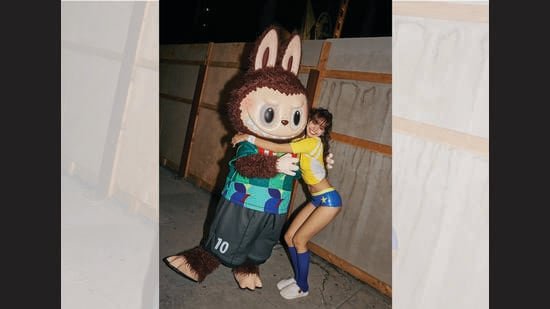
K-pop star Lisa has managed to piss off just about everyone with her official FIFA anthem, Goals. YouTube comments are in full meltdown over the lyrics — My body (Goals), my fit (Goals), my friends (Goals), my whip (Goals) — that have nothing to do with football. At one point in the video, a giant Labubu shows up. Some complain that “we’ve gone from songs about unity, culture and competition to lyrics about being hot, rich and spending money”.
Fair. In Lisa’s defence, she does her best to tie the song to football, with mentions of “ballers” and “champions”. She twerks with this year’s mascots: Maple the Moose, Zayu the Jaguar and Clutch the Bald Eagle. Besides, Goals is obvious Gen Z bait. It’s not trying to be a motivational anthem so much as a football after-party soundtrack.
FIFA’s official album, incidentally, is a buffet of hip-hop, country, electronic music and pop. Shakira, patron saint of World Cup anthems, sings the catchy Dai Dai, which is about sweat, tears and glory — exactly the kind of song you expect from her. She cheers “Let’s Go” in five languages before giving a shoutout to the star players and teams.
It’s the ultimate crowd pleaser. And yet, the video — Shakira dancing with young Black kids somewhere in Africa — has its own subset of haters. People are asking why a tournament hosted across North America is being packaged with African imagery, the kind that flattens an entire continent into poverty-core.
Let’s rewind to four years ago, and to four years before that, and four years more. Every World Cup song seems to follow the same life cycle: It arrives; audiences hate it, but a decade later, the memories are only fond. Pitbull’s We Are One (Ole Ola) was criticised in 2014 for sounding “not Brazilian enough”. Nicky Jam’s Live It Up (2018) was dismissed as overproduced. Nicki Minaj’s Tukoh Taka (2022) was deemed to be grating.
This isn’t exclusively a music problem. Any cultural work tasked with representing millions of people is setting itself up for hate. Because it’s hard to consistently create something that is current, universal but also personal. Think of the logos for the Olympics. When the London 2012 symbol was unveiled, online forums pointed out that the spiky 2 0 1 2 resembled Lisa Simpson performing a sex act. Paris 2024’s logo was compared to everything, from the Tinder icon to a bob-haired Karen who is demanding to speak to the manager. Even mascots aren’t safe. When Bing Dwen Dwen, the cuddly panda of the Beijing Winter Olympics 2022, spoke in the gravelly voice of a middle-aged man, some fans felt personally betrayed.
Humanity is simply too complicated to fit into a single idea. For every person who feels “seen”, there’s someone bound to feel left out. It’s why Oscar winners trigger annual meltdowns. Surely, Sinners deserved Best Picture more than One Battle After Another this year? And Parasite not at all in 2019? Time’s Person of the Year (Taylor Swift (2023); Donald Trump, (2024), “architects of AI” (2025), You, (2006) reflects both the magazine’s breadth and bias. People Magazine can’t name a Sexiest Man Alive without thousands of commenters grumbling that they were “too predictable” (Jonathan Bailey, 2025, we’re not complaining) or “not conventionally attractive” (Blake Shelton, 2017; with Idris Elba, pushed down to #3!). We have collectively wasted energy debating whether the new James Bond theme song is good. But outside of Adele’s Skyfall, can we even name another one without Googling?
So, when you think about it, a World Cup anthem may be the most impossible assignment in pop culture. It has to feel local and global, nostalgic and contemporary, meaningful and catchy enough to blast through stadium speakers. It is supposed to bring together billions of people who don’t share a language, a culture, a politics or even a favourite football team. Yet, in a strange way, the backlash proves that Lisa’s anthem is working. It’s getting the world to argue about the same thing at the same time.
From HT Brunch, July 04, 2026
Follow us on www.instagram.com/htbrunch
