

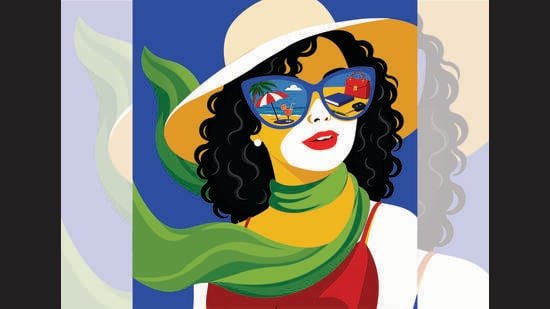
Let’s revise. On the family tree, Aunty simply means a parent’s female sibling. In south Asian culture, Aunty is how you’d respectfully address any older woman. Aunty, in African communities, is the wise OG. Among LGBTQ+ folks, Aunty is another kind of OG – the flamboyant, nurturing, gay man who’s always on your side.
But Aunty, Indian pop culture has long led us to believe, denotes some kind of crotchety neighbourhood crone. The one who hovers over balcony railings, eavesdropping; who presides over kitty parties; dispenses unsolicited advice on the elevator ride; polices young women’s clothes, choices, even how they laugh. The term quickly became shorthand for ageing. “Don’t call me Aunty” has been a recurring punchline to mock women’s anxieties about youth and desirability. The 2012 song from Ek Main Aur Ekk Tu goes “Auntyji, auntyji, get up and dance,” because older women apparently need permission to have fun.

Now, let’s revise again for 2026. On TikTok and Instagram, #RichAunty is a single, child-free older woman with disposable income, impeccable taste and a diverse chosen family. Meera Syal has titled her upcoming memoir Vigilauntie. In fashion, Aunty style indicates high-quality classic pieces, worn by young women who think trends are callow.
And look closely at those neighbourhood crones. Uncle still denotes an old man with an older mindset. Aunty, meanwhile, is a woman who has decentred men and marriage. She’s going on spontaneous vacations (She can’t babysit this weekend, sorry!), she sends the best gifts, she doesn’t tut-tut if you haven’t had your first baby by 30. She’s in control of her own life and isn’t peeking into yours. She’s not giving opinions, she’s giving life goals. Go on. Call her Aunty. She doesn’t mind.
Here’s how the definition has changed.

The big break
At 32, Sana Mishra, a high school teacher in Bengaluru, welcomes being called Aunty. She has nieces and nephews, but she was married at 27 and divorced at 30, which brought with it a strange kind of baggage. “Some men in my circle commented that it would be tough for me to get back to dating because men ‘might not want to date an Aunty’,” she recalls. When she first heard that, she bristled. Then she gave it some thought. “If being emotionally and sexually wiser makes me an Aunty, I am happy to be one. So, I tell the men that as an Aunty, I can game the dating system better than an Uncle like them can.”
Mishra doesn’t want to be a 20-something again. There’s no man to sign off on her everyday decisions, she isn’t obligated to bear children, and is done being deferential. It’s the flip side of the ageing story we’ve grown up hearing: That 20s traditionally were a woman’s prime. It’s when she was at her most attractive. Now, as women in their 20s hustle endlessly to build a career, navigate a messy dating scene, and curse their junior-level single income, it’s the Aunties who seem to live better.

Catch them on Insta. Zeenat Aman, at 74, posts candidly about ageing, love and selfhood. Zarna Garg, 51, uses the Desi Aunty stereotype to celebrate the fun side of arranged marriage, immigrant life in the US and motherhood. Sindhu Vee, 57, makes jokes about ageing, marriage, parenting and female desire, all once taboo subjects.
London-based mythologist Seema Anand, 63, is a sex-educator. But she uses the term “patron saint of pleasure” on her Insta (@SeemaAnandStorytelling), because she has spent much of the last decade convincing women that their desires, or their desirability still matter, even when they reach Auntyhood. “By all means, I am visibly an Aunty,” Anand says, referring to her shock of white hair. When trolls leave “Aunty knows everything”-type comments under her posts about hand techniques and sexuality as a spiritual experience, she doesn’t clap back. Who has the time, when you’re living so large? “I say, ‘Haan. Aunty does’. It’s no longer something that gets me worked up.”

The smart investment
It could be that we’re seeing Aunties in a new light largely because more women have stopped viewing themselves as primarily wives, parents and supporting characters. Many have chosen their partners, married later, had a say in the size of their family, either earned their own money, or have greater control over the family assets. It’s made them less dependent on men, and less interested in upholding any system that does. So, no. They won’t ask, Beta, when are you getting married?
“The average 45-plus woman of today is not the 45-plus woman of a couple of generations ago. They’re building second careers, becoming fit, and refusing to slow down,” says writer Kiran Manral, who co-hosts the lighthearted Not Your Aunty podcast with writer Shunali Khullar Shroff. Their show has picked apart tired Aunty tropes. One episode is about why independent women make some men uncomfortable. Another one covers investing and financial literacy, and how it liberates older women.
Manral imagined that her podcast would be lost on younger listeners. She was wrong. At the Bangalore Literature Festival a year ago, she found teens and women in their 20s telling her that they loved the show, because the hosts were forthright even if they were sometimes politically incorrect. “They quite enjoyed that.” The show has helped younger listeners connect with older women in their families. At a literature festival in Chennai, Manral remembers a man in the audience telling them, “When I listened to your show, it felt like these were my thoughts, but in a woman’s body”.

The new beginning
Pop culture is catching up. We’ve gone from an Auntyji song in 2012 to the 2025 Gujarati film Auntypreneur. Supriya Pathak plays a 65-year-old Mumbai homemaker who, along with other middle-aged women, dives into the stock market to save their housing society from demolition. The women swap kitty parties for market charts, investment tips and strategy sessions, making Aunty the smartest person in the room. The tagline “Why should boys have all the funds?”
Meanwhile, some women are deliberately choosing to be known as Aunties. In Toronto, Canada, Oorbee Roy, 51 is a wife and mother to two children, and a former computer programmer on Wall Street. But her Insta handle is @AuntySkates, and it’s filled with viral videos of her skateboarding in a sari. “Aunties get a bad rap in Indian culture,” she says. “They’re usually judgmental, ill-tempered, and have no filter. I thought it was time to flip the script and make us fun and welcoming.”

Roy is learning to be kinder to the aunties from her childhood too. “I realised that they were once young and hopeful. Maybe societal norms, cultural expectations, or life’s disappointments wore them down,” she says. She took to skateboarding at 43 to spend more time with her kids, not miss out on the fun others in her life were having. That decision is largely built “on the backs of all the Aunties before us who sacrificed their hopes and dreams.”
Meanwhile, India’s family tree is getting a little less crowded. Data from the NCAER and National Family Health Survey suggests that close to 10% of households have only one child, while nearly one in four college-educated women prefer not to have more than one offspring. So, the generation to come may not have enough biological Aunties, anyway. What will remain is the title. Aunty might mean the older neighbour with the spare house key. Or, the gorgeous silver-haired friend who’s vacationing alone in Bali. Or, the menopausal influencer who just bought barrel-leg jeans. Or the woman who’s leaning from the balcony railing not to check on who’s getting home late, but because she felt like some fresh air at 3am, and didn’t need anyone’s permission to get it.
From HT Brunch, July 04, 2026
Follow us on www.instagram.com/htbrunch
