

Would you let your children eat food cooked by the Hare Krishna movement? (Or the International Society for Krishna Consciousness, ISKCON, to give it the full title.) It may sound like a strange question, but the answer touches on a current political controversy. The new government in West Bengal has involved the Hare Krishnas in providing meals to school children in Kolkata, and there has been an uproar about that decision.
But my answer is clear. Not only would I let my kids eat food from the Hare Krishnas, but I would eat it too. For several decades, the Hare Krishnas have run the Govinda restaurant in London, which serves very good vegetarian Indian food, and I have also eaten well at their complex in Mumbai.
So, while I am not overly impressed by their philosophy and the version of Hinduism they have taken to the West, I have no quarrel with their culinary skills.
Why have these skills become controversial now?
Well, because we think of the Hare Krishnas mostly in terms of White people chanting Hindu mantras they cannot pronounce (I once wrote that the movement’s greatest contribution to spreading Hinduism globally is that foreigners who have seen its American followers chanting in the streets now think the Hindu religion has three gods Rama, Krishna and Harry.) But we usually forget the Bengal connection.

The movement was spearheaded by a Bengali called AC De, who based it on the teachings of Sri Chaitanya, a 16th Century mystic/ saint from Bengal, who most Hindus still know very little about. De acquired rich Gujarati and Marwari bania followers in Bombay, one of whom, the shipping magnate Sumati Morarjee, paid for him to go to New York. To his enormous credit, he launched the Hare Krishna movement in America more or less single-handedly and turned it into a global phenomenon.
In today’s West Bengal, the Hare Krishnas are not a very big deal. Most Hindus have more respect for the Ramakrishna Ashram, and its most famous disciple, Vivekananda, is a revered figure in Bengal and outside. But presumably, the BJP in West Bengal remembers De (or Prabhupada, as his followers call him) because it has entrusted school meals to the Hare Krishnas.
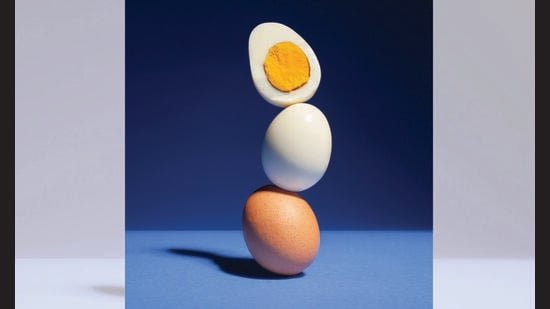
West Bengal is one of India’s most clearly non-vegetarian states. Most Bengalis will eat fish, chicken or meat with every meal if they can afford it (and often even when they can’t afford it). In Bengal, even the Brahmins are non-vegetarian. The Hare Krishnas are vegetarians, so naturally they will not serve meat. But the controversy stems from the decision to stop serving eggs in schools because they regard them as forbidden.

There is one obvious objection to this decision. Free meals are usually provided to poor children whose parents often can’t afford to give them much meat at home. So, the eggs form a valuable source of protein for growing children. Those who support ISKCON have offered two defences of the decision.
The first is that eggs are non-vegetarian. This is a curiously medieval argument. As nearly everyone knows by now, the eggs that are usually eaten in India (and elsewhere) are unfertilised eggs. There is no baby chicken hiding inside them. If you left them alone they would not hatch and no chick would emerge.
Ah yes, say the anti-egg campaigners, but can you deny that they are an animal product? No, of course you can’t. But then milk is also an animal product and most Indian vegetarians have no problem with dahi or ghee. It’s such an old and tired argument that I am surprised that we are still having this debate.
The second argument is that there are many non-animal sources of protein, so removing eggs will make no difference. This argument relies on blurring facts. Yes you can probably make up the protein deficit by adding several other sources of protein, but why remove the one vegetarian food that is already part of the diet and offers the protein a growing child needs?

As the best-selling food author Krish Ashok tweeted: “The egg is one of nature’s most accomplished works. A single, self-contained marvel, packed with every protein the body craves, brimming with vitamins and fats laid down to nourish new life.” Ashok also tweeted: “Soy chunks are great source of cheap protein, and perfect for those that choose not to eat eggs for religious or vegan reasons. But for anyone that eats both, the choice is obvious.”
So, why impose medieval misconceptions about what is vegetarian and what is not on a state where 98% of the population identifies as non-vegetarian anyway? Even if eggs are non-vegetarian (which they are not) why deny them to non-vegetarian children who want them and who need the protein?
This is not the place to discuss politics, but I think all the stuff about a Hindutva agenda is missing the point. West Bengal is the one state (outside the North-East) where most ministers enjoy meat, serve it at their homes and have no desire to give it up.

I don’t think there is any great political agenda lurking behind the decision. The people who entrusted school meals to the Hare Krishnas probably did not think it through or consider the consequences. Because ISKCON offered to share the costs with the state, it probably seemed like a wise move in budgetary terms. But the Hare Krishnas have failed to move with the times. AC De lived in an era when most Indian vegetarians shunned eggs. (He was born in 1896.) He may have genuinely believed that eggs were non-vegetarian or even, that if you left them alone, then they would hatch chickens. We know better now.
And so, to use the misconceptions of an earlier age to deny protein to poor children is to go against all common sense. And certainly, to use government policy to subsidise this obscurantism mitigates against the traditions of Bengal.
Do by all means let the Hare Krishnas do the catering. But when it comes to forbidden food, follow the example of that great son of Bengal, Swami Vivekanand who had no time for medieval misconceptions about what was vegetarian and what was not. As the Swami himself wrote about people who urged him to only eat certain foods, to avoid meat and to follow only the diet they recommended: “This silly bossism without a mite of real help makes me laugh.”
As he nearly always was, Vivekananda was right about this too. The Hare Krishnas have every right to eat what they like. But I think when West Bengal needs real help, what they are offering is what the Swami would call bossism.
From HT Brunch, July 04, 2026
Follow us on www.instagram.com/htbrunch
