

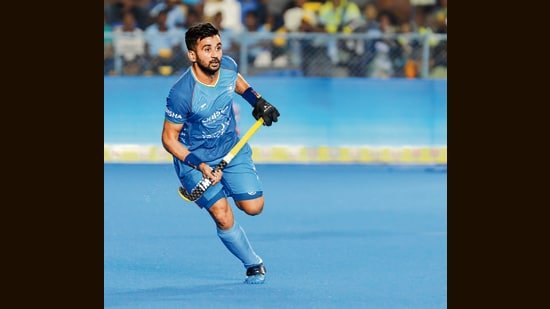
Before he stepped onto the turf to play his 413th international game, breaking Dilip Tirkey’s record to become the most-capped player in the history of Indian hockey, Manpreet Singh did something entirely characteristic: he emptied his mind of the history books.
There was no grand internal monologue. No self-congratulatory reflection on a journey that has spanned four Olympics, delivered two bronze medals at the Games, and involved 15 years of unyielding toil. Instead, the 34-year-old midfielder huddled with his teammates, focused entirely on the tactical nuances of the opponents before them: Germany.
“Before the match, we talked about the journey, but when I reached the ground, I just thought about the game plan and doing what I normally do — giving it 100%,” Singh says.
It is this ability to approach his 413th appearance with the same hunger as his first that has seen the young man from an impoverished farming family in Mithapur, Punjab, transform into the steady heartbeat of contemporary Indian hockey.
Behind the longevity and trademark on-field composure lies an intricate tapestry of sacrifice, including what is essentially a long-distance marriage, and the emotional tax of watching two children grow up via a series of video calls.
To achieve immortality on the field requires a relentless schedule. For the former India skipper that means months spent away from home each year, locked away at national camps or travelling for tournaments.
In December 2020, just months before he would captain India to a historic bronze at the Tokyo Olympics, ending an agonising 41-year podium drought at the Games, Singh married his long-time partner, Illi Saddique of Malaysia. They now have two daughters, four-year-old Jasmine and one-year-old Avelyn.
While the sporting world counts Singh’s milestones in caps, goals and medals, his family measures them in missed moments. “It’s not easy having your husband away for most of the year,” Saddique says. “The distance is difficult and the sacrifices are real.”
“When they started walking, when they started talking… I was not with them,” he adds.
Her uncompromising support keeps him going; she is his most reliable and most honest critic, Singh says, laughing. “She’ll say, ‘You didn’t do well today. You need to improve here or there.’”
***
The composure that defines Singh’s time on the field didn’t come naturally to him. It was forged, he says, by early career devastation.
As a youngster bursting into the national setup, he was part of the squad that travelled to the 2012 London Olympics, during a period now described as the nadir of Indian hockey. The most successful hockey nation in Olympic history, with eight gold medals at the Games, India had failed to qualify for the 2008 Games in Beijing. In London, they ended the tournament 12th and last, losing all six matches.
“I went to the Olympics with dreams and a lot of hope,” Singh says.
But instead of breaking him, London became the ultimate classroom. It revealed the vast, unforgiving gap between domestic talent and world-class international hockey. He noted the clinical efficiency with which powerhouses such as Australia, Germany and the Netherlands operated.
A year later, the inception of the Hockey India League (HIL) allowed him to spend time in close quarters with international icons such as Germany’s Moritz Furste and England’s Barry Middleton, on the Ranchi Rhinos team. He soaked in their tactics for mental preparation and observed how they handled the shifting tides of a high-pressure match.
By the time of the Tokyo Games in 2021, Singh was the captain and the nucleus of his team. The bronze there was followed by another at Paris 2024.
With Singh at the helm, Indian hockey saw a psychological shift.
The fact that India was the only hockey team to medal at both Tokyo and Paris provided a huge boost. The days of entering matches against elite teams with an inferiority complex were gone.
“A lot of things have changed. Indian hockey has improved a lot. Now everyone has the confidence that if we do our best, we can beat any team,” Singh says.
There have been other dramatic improvements. When he debuted in 2011, aged 19, professional hockey offered little financial security. That changed with HIL. Hockey India has also since introduced cash awards, individual incentives and match fees. “There has been a lot of financial improvement,” Singh says.
Away from the turf, the rewards come in small, emotional packages. Her recently found Jasmine watching him on TV, for instance, and trying to talk to him and help him through the screen. “She cheers for me. She says that she is proud of me,” he says.
As for the game, he has no plans of stepping away. Now the seniormost player in the dressing room, his role has evolved from tactical enforcer to team mentor, and he has his sights set on the 2028 LA Olympics.
He’s driven by a dream that remains unfulfilled: a World Cup podium. Since India’s last such win was in 1975, this would neatly cap off a career of great goals.
“I want to win as many medals as there are for India. I want to inspire the next generation,” he says. “I want to be the role model others have been to me.”
