

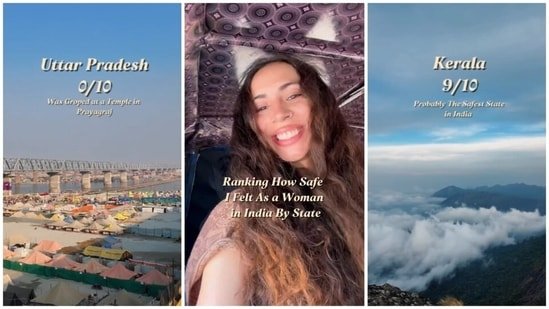
In an era where travel content often fluctuates between romanticised escapism and cautionary tales, content creator Kenna Kala has opted for a middle ground: raw transparency. A trans woman who relocated from New York to India, Kala has spent the last year documenting her solo travels across the country. Also read | Singapore woman says ‘India gets so much bad publicity online’, documents ‘honest experience travelling in north India’
Her May 19 Instagram video, titled ‘Ranking how safe I felt as a woman in India by state’, has struck a nerve, garnering millions of views and igniting a debate about regional safety disparities. Kenna’s argument is that a single experience cannot help you judge India. “I definitely feel safer in many parts of India than I do in my own country, but there are also places where I feel significantly less safe,” she shared in her caption.
By breaking down her journey state by state, she provided a nuanced roadmap for solo travellers who often view the country through a singular, often negative, lens.
The rankings: state-by-state breakdown
Kenna’s safety scores range from total failure to near-perfect security, with her specific experiences providing the context for each number:
⦿ Uttar Pradesh (0/10): Kenna gave the state her lowest possible rating, citing a traumatic incident where she was ‘groped at a temple in Prayagraj’.
⦿ Delhi (1/10): The capital fared only slightly better, with Kenna rhetorically asking, “Do I have to explain?” — alluding to the city’s long-standing reputation for being difficult for women and solo-travellers.
⦿ Rajasthan (5/10): Despite admitting she ‘loves it here anyways’, she remained firm that the state is ‘definitely not safe’.
⦿ West Bengal (6/10): A moderate score, though Kenna noted a personal curfew, stating she ‘wouldn’t go out alone at night’ in the east Indian state.
⦿ Goa (6/10): Interestingly, Kenna identified the authorities as the primary source of discomfort here, remarking that ‘the police are the scary ones here’.
⦿ Tamil Nadu (7/10): Her experience in Pondicherry was marred by a man showing her ‘p***’ content on his phone, yet she rated the south Indian state highly, suggesting it feels safe ‘if you’re modest’.
⦿ Karnataka (8/10): Moving into the top-tier rankings, Kenna expressed deep affection for the state, simply saying, “I love it here so much.”
⦿ Kerala (9/10): Taking the top spot, Kerala was hailed by Kenna as ‘probably the safest state in India’ for women.
‘Again south India saved the whole country’
The response to Kenna’s video was multifaceted, reflecting the complex relationship Indians have with international perceptions of their country. Many Instagram users celebrated the high scores for south India, with comments like, “Again south India saved the whole country.” Highlighting a growing sense of regional identity regarding social safety, another person wrote, “Let’s go south India!!!”
Some Instagram users took the low ratings for the north as a call to action. One person asked for specific details on Delhi as ‘the administration needs to work on what they can’.
However, not everyone agreed with Kenna’s selection of states. One Instagram user questioned why foreigners often skip the ‘safest’ regions: “Why do they always pick places like UP and Delhi… but they never rate states like Himachal Pradesh or Uttarakhand, which are among the safest and most peaceful parts of the country?”
Kenna Kala’s journey is significant because it challenges the ‘safe/unsafe’ binary that dominates western travel discourse about India. As a solo traveller and a trans woman, her perspective offers a unique stress test for social tolerance and physical security. By distinguishing between the harrowing experience in Prayagraj and the relative peace of Kerala, she provided a more sophisticated narrative than the typical travel advisory.
Her experience suggested that for foreigners, ‘India’ is not one experience, but a collection of vastly different cultural and social environments. Ultimately, her transparency highlights a shift in how the world views India: no longer as a monolithic entity to be feared or idolised, but as a diverse country where safety is deeply tied to geography, local administration, and regional culture.
Note to readers: This report is based on user-generated content from social media. HT.com has not independently verified the claims and does not endorse them.
This article is for informational purposes only.
