

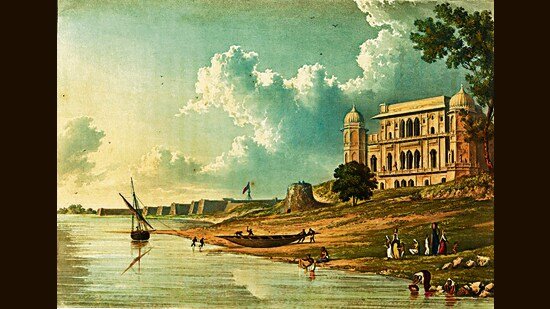
How does one remember a city? How does one pay homage to a place that was part of one’s being; its sights, sounds and smells, its very air, embedded in the bones?
I just finished reading Hindi writer Mamta Kalia’s memoir, Jeete Jee Allahabad (Living in Allahabad; for which she won a 2025 Sahitya Akademi Award), and I think she may have the answer. As the title suggests, the book is about Allahabad, a city where she and her husband, the Hindi writer Ravindra Kalia, lived from the 1970s to the turn of the millennium.
In her memoir, Kalia writes of its storied literary history, as the home of authors, poets, and numerous publishing houses. Some, such as Lokbharti Prakashan, were the favoured addas of Hindi writers. One might visit the offices and bump into Sumitranandan Pant one day and Amrit Rai the next. It wasn’t unusual for someone to pop in to enquire about the whereabouts of some writer or the other. “Was Doodhnath [Singh] here,” they might ask; only to be told, “He was here an hour ago, but he left in search of Markandeya.”
Many writers started their own publishing outfits. It was each one’s dream to bring out a magazine of their own, despite the high mortality rates and there being no money in the enterprise. It was a nasha, an intoxication. Many of these efforts have since been quietly shuttered.
With few avenues for employment, meanwhile, writers taught at the Allahabad university; if they were lucky enough to get a job there. Most lived frantically unstable lives as freelancers. A radio programme was like hitting the jackpot. For the rest, even as they slaved over novels and short stories, they sometimes found the going so tough that they took on that most exhausting and tedious of day jobs: proofreading books for publishers.
Still, the city provided that undefinable literary climate that allowed writers to create their best works here. Doodhnath Singh was from Ballia but Allahabad shaped his intellect and thoughts. His most memorable short stories were written here. It was the same with Gyanranjan, and too many others to name.
There was a leisurely ease to the city that could be hard for outsiders to understand. When writer Bhisham Sahni and his wife Sheela Sahni visited Allahabad, they stayed with the Kalias. As they were leaving, Bhisham said their hosts ought to visit them in Delhi. Sheela, who was working at the Russian embassy, added, “But remember, apart from Saturdays and Sundays, the house is always locked. So call before you come.” The Kalias immediately decided they would not visit their home. They were pukka Allahabadis by then and this was not the style of the city. It did not stand on formality, nor could it endure formality of any kind.
The duo lived for most of their time in the city in a house in Rani Mandi, originally a neighbourhood of tawaifs or courtesans. All the houses were built in a similar fashion, recalls Mamta, with enormous doors, two or three courtyards, and large windows. The house reminded her of Kamal Amrohi’s 1972 film Pakeezah, she writes.
Their own haveli looked impressive from the outside, she adds, but was dilapidated within. Even so, they loved it. So much so that in 1992, when her husband suggested they move to a newer home in a newer part of town, she and her two sons protested vociferously.
They eventually did move. But a bigger wrench would come in 2003, when the family shifted to Delhi. Her heart and mind are still lodged in a city more than 650 km away, Mamta Kalia writes.
In her memory, the Allahabad of the past has transformed into a kind of utopia. She remembers roaming around Zero Road in the heart of the city, with its bookshops, sweetshops, cloth shops and narrow lanes snaking out from the main street. She recalls stories of Allahabad’s tallest literary figures, from the Urdu scholar Shamsur Rahman Faruqi to the poet Suryakant Tripathi Nirala. Recalls Kaifi Azmi visiting in the early 1970s for a mushaira, and she and many others going to the railway station to see him off. At the station, she asked if he might recite another poem. He asked for a pen and paper. She found a pen. Her husband pulled out his platform ticket. Azmi scrawled a sher on it in Urdu, right there: Ghaas pe gumsum baitha hai Kaifi / Yaad kisi ki aayi hui hai.
The ticket became a precious artefact treasured by the Kalias and their friends, until it was lost one day. Just like she lost Allahabad.
She can’t go back. The city she knew no longer exists. It lives on now only in memory.
(Email Poonam Saxena on poonamsaxena3555@ gmail.com. The views expressed are personal)
