

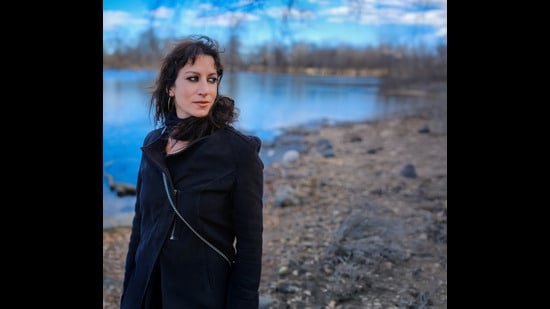
As a half-Palestinian-half-Jewish American, Hannah Lillith Assadi grew up amid intense love and a persistent sense of loss. Her parents’ love for each other and their family seemed to suture a gaping historical wound. Religion did not play a large role in the home, and that rift did not come into play.
But she was the daughter of a man who was evicted from his home, with his family, when he was five years old. He had told her stories of how he wandered the world, for decades, looking for and never really finding another place to belong; or, if he did, finding it in people rather than places. So she knew what the wound between her two halves had cost him.
What she didn’t realise was the sense of failure he carried. Despite all the struggles, and the joy, when she asked him on his deathbed how he felt about his life, he said it was “wasted”. He had never made it home, as his father and mother had dreamed he would; the war had raged on, and the world had continued to care little or not at all.
Hearing him use that word “broke my heart. I wanted to prove him wrong,” says Assadi, 39. So she decided to tell the story of Sami Abdul Fattah Assadi (1943-2022).
That story became her third novel, Paradiso 17, longlisted for this year’s Women’s Prize for Fiction.
It traces the journey of a five-year-old Palestinian boy named Sufien from his ancestral home on a hilltop in Safad (now part of Israel) — a place where the family had lived for so many centuries, they had no memory of ever being anywhere else — to a refugee camp in Syria, a tiny flat in Kuwait, then life as a student in Italy, and as an undocumented immigrant who overstayed his visas in both Italy and the US.
Eventually, in America, he meets Sarah, a Jewish woman whose love brings both refuge and pain. What has it been like to reckon with this legacy? Excerpts from an interview.
* It took you a year to write this book.
I wrote this novel in the year after my father passed away in October 2022. The opening scene is a man on his deathbed looking back, because that’s how it began. That first scene was written before his passing.
After he passed, I wrote, scene by scene, everything I could remember him telling me about his life. I tried to capture the pulse of a life in exile.
The younger of my two children was three months old back then. My only time to be with my grief was when everybody was asleep. So I wrote every night, from 10 pm to midnight. In the end, this character I created, which is certainly a reflection of my father, is also a reflection of me.
* Growing up the daughter of a Palestinian man and a Jewish woman, how do you view the idea of such exile?
I was born in New York City, grew up in Arizona, and have lived in New York for the last 20 years. So I can only answer that question from being my father’s daughter. At times, he suffered from his position. In certain moods, he would introduce himself as “the man without a country” or “the man whose country was stolen from him”.
But he also lived in Italy as a very young man, and was happy. I try to capture the joy of that period. Like the character Sufien, my father had to drop out of university because his father could no longer afford it. Afterwards, he worked in a market, where he made friends. He loved Italian culture and loved to speak Italian. When you saw him in that mode, there was this sense that not all was lost in his Palestinian story.
I feel his loss defined him and would continue to define him all his life. He eventually became a citizen, in America; but that doesn’t always mean you’re accepted as an American with a capital A in this country.
* How have your different identities shaped you?
I do feel like a New Yorker, as much as one can, given that this is a city that sits inside a very problematic nation; but then New York is also a city of exiles. There are so many different people here, and often they’re from somewhere else. And New York is more of an idea that people gather around versus a nationality. This concept of home is very liberating to me.
* How did you come to writing?
It became the only way I could tackle my background, and tackle the biggest questions of mortality and love, which are the same for everybody.
Even in Paradiso 17, the afterlife is a huge theme, and so is the persistence of the dead in our lives. There are questions of mortality and love in the novel that are universal. There are earthly questions in the novel too, but the biggest questions are spiritual ones.
* There’s a fair bit of magic realism in the book: dreams, prophecies, curses and premonitions.
Magic realism is an incredibly important literary device to me as a writer because it lifts one out of real-world logic and adds a little bit of dream or spiritual logic. It’s my absolute favourite thing to consume aesthetically and it moves me when I read it or when I watch it in film.
Dreams, and the life of the mind and of imagination, are extraordinarily important to me too. My most persistent writing practice is noting down my dreams every morning. Other people meditate or have religious practices. For me, it’s dreams that are my access point to the land beyond. So, it was going to show up in the work.
* How did you settle on the title, drawn from Canto 17 of Dante’s Paradiso?
The original title was Frank Leone, which was my father’s nickname and pen name. If he wrote something angry in the comments of a newspaper article, that was how he signed. If he didn’t feel comfortable saying he was an Arab, he would say his name was Franco because he spoke Italian fluently.
My American editor rightfully told me, and it broke my heart but in a good way, that the title made it sound a bit like a mafia novel.
Canto 17 of Dante’s Paradiso was always the epigraph of the book, because that is the canto in which Dante’s exile is prophesied. Ostensibly, he goes to heaven and meets this ancestor who has been dead for a hundred years or more, and the ancestor prophesies that Dante will be exiled from his beloved Florence.
When I sent my editor the new title, there was some debate about it being just Paradiso rather than Paradiso 17. And I said, no, it has to be Paradiso 17. The number figures quite largely in the novel as well. Sufien leaves his displaced family’s new home in Kuwait at 17 and 17 figures in the addresses he has across the course of his life.
* Your journey is very different from your father’s, and yet one can assume that echoes remain. What does the idea of Palestine mean to you?
That’s a big question. I don’t know that it’s so important what it means to me, because there are people living under occupation, people who have been victims of a genocide, who never had justice restored to them.
That’s the much bigger and more important meaning of Palestine. And that I do carry within me: that my father’s ancestral home was taken, and the property in it. In that way, I do belong very slimly inside of that category of people to whom Palestine is the greatest injustice of their lives. And then there is a larger metaphorical meaning we can attach to it: Many of us believe that if Palestine were free — and there are various ways to define what that would look like — the rest of us would be free too.
