

High in the forest canopy, long before we built cities or roads, life clung to branches.Our ancestors ate mangosteens and black junipers, crunched on nuts, and dug up tubers and roots. On an ill-fated day, one of them slipped and fell to her death from the same 40-foot-high canopy that nurtured her.
Three million years later, in what is now Ethiopia, her remarkably complete fossilised remains galvanised the world’s interest in human origins. By 2016, Lucy, the bipedal hominin, had become an icon, her story pieced together by scientists who reimagined how she might have lived and died among the trees.
“Our ability to bounce along branches standing upright, our desire to build nests and smell cedarwood—all the adaptations of primates—are adaptations to trees,” writes British biochemist and tree science consultant Harriet Rix, in her 2025 book, The Genius of Trees (2025; Vintage Digital).
The most striking are our coarse fingertips, with fat and fluid-filled pads that deflate like a tyre for more friction, and fingerprints that evolved to channel away water or moss films, for better grip. Hefty shoulders, too developed to help with quick movement as we swung by the branches. Trees are planetary engineers, omnipresent witnesses, and a living record of climate history and human evolution. How did they shape the world? And how has the world shaped them?
ROOT AWAKENING

It began with a fragile act of survival, almost 500 million years ago. First, colonies of green, sheet-like algae washed ashore on barren land battered by harsh UV light. They learned to adapt, developing sturdy vascular systems to withstand this transition.
Alongside ankle-length plants, giant spires that today fall into a distinct branch of life emerged. They were branchless, reaching up to 26 feet, resembling smooth-skinned, dark, woody logs called Prototaxites.
Within the next 100 million years, trees had spread across the planet, locking away so much carbon that they altered the atmosphere completely. During this period, few bacteria or fungi could break down lignin, the compound that gives trees their sturdy structure. When the trees died, they did not decay. The carbon piled up in swampy forests, driving a surge in photosynthesis, which would change the world.
Oxygen levels shot up from 15 % to 35 %, and soon Earth was home to giants. Dragonflies as big as birds darted through the skies, mammoth cockroaches scurried on land, while early tetrapods or crocodile-like predators dominated swamps.
And rather ironically, all that readily available oxygen made forest fires unstoppable, wiping out huge swathes of trees.“Repeatedly in deep history, millions of years ago, trees seem to have wiped themselves out by producing so much oxygen that they change the climate and often then burn themselves to death,” Rix tells Wknd.
Out of the ashes of the Carboniferous forests new types of trees evolved.The first modern or true tree, the now-extinct Archaeopteris, with its fern-like leaves, emerged from this period around 380-360 million years ago.
As the climate became drier and hotter because of volcanic eruptions and Pangea split into Gondwana and Laurasia, ancient gymnosperms (seed-bearing, non-flowering vascular plants) such as conifers, ginkgos, and cycads appeared. These plants developed waxy needles and tough cones to survive harsh conditions.
About 66 million years ago, the gymnosperms gave way to angiosperms or flowering trees, but it was only after the Chicxulub (an asteroid that crashed into the earth) that they spread rapidly, covering over 90 % of the world.
Fire again became an important ecological force, 20 million years ago.Trees evolved thicker bark and fire-resistant traits, while some clever pines learned to use this heat to their advantage. The heat helped burst open cones and release their seeds.
A lot of the modern genera of trees we know today evolved during this period.
STICKING TOGETHER

When modern humans evolved about 40,000 years ago, there were an estimated 6 trillion trees already on the planet. They had already undergone amazing transformations, not just in leaf size and shape but in bark texture, trunk structure, pollination and dispersal methods, Rix says.
Relict trees from an earlier geological age that survive in the Mediterranean,south of the Caspian Sea in Iran, and in China and Japan, evolved over the many “hot and wet” cycles. Yet three million years ago, when the world became cooler and drier, many species died out.
Later, humans stepped in to help too.
The ginkgo, for instance, was reportedly saved from near-extinction by being nurtured and cultivated by Buddhist monks in China and later in Japan and Korea in the 11th century. “The liquidamber trees which survive in a small patch of the humid south coast of Turkey likely owe their survival to the sweet-smelling sap, which was once extremely valuable for perfume,” says Rix.
It was our forerunners’ ability to sleep safely in nests atop trees that improved sleep quality and aided brain development, alongside, of course, the fat-filled fruit of trees that fueled this rapid progression.
“The need to find that fruit and keep moving to find more of it added the “quest” element to our psyches,” Rix explains.
Romanticised as they are, trees have also left destruction in their wake. The eucalyptus can pull so much water from the water table that its neighbours die parched. Pine trees are notorious for starting a fire cycle that destroys everything around almost every 20 years. Allelopathic trees release poisonous biochemicals into the soil to wipe out their competitors for local resources.
Walnuts are resistant to fire, partly because they poison plants around their roots, which die and act as ladder fuel, preventing flames from reaching the crown.
BRANCHING OUT
Interestingly, India is still home to a descendant of the ancient Archaeopteris. The queen sago or Cycas circinalis, which resembles a palm tree and is a frequent centrepiece in garden landscapes across India, traces its ancestry to a region of the erstwhile Gondwana. Today, it is found in the drier tracts of peninsular India, spanning the interior Deccan plateau, says scientist and ecologist TR Shankar Raman at the Nature Conservation Foundation.
The ornamental plant is slow-growing and naturally resilient to drought and fire, but currently stands the risk of overharvesting. “Their prehistoric appeal makes it sought-after by collectors for plant trade,” he adds.

The country ranks ninth in the total forest area it holds, at an estimated 72.7 million hectares, which is roughly 2% of the world’s total cover, according to the FAO Global Forest Resources Assessment 2025. Our forests have a fascinating diversity of trees that have undergone dramatic adaptations: deep-rooted banyans, water-conserving and fire-resistant crocodile-bark trees, stretches of salt-tolerant mangroves and high-altitude species such as deodar cedars, walnuts, and chir pines.
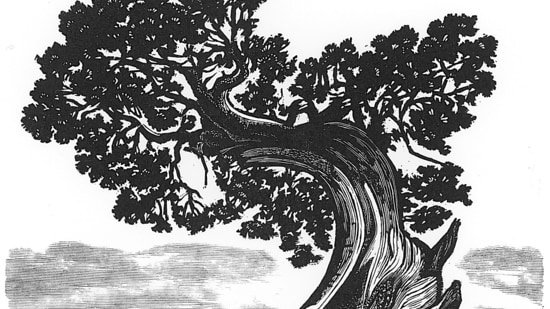
Among the most ancient are the junipers (Juniperus genus), dating back 56 to 33 million years, including the oldest at 2,032 years in the Lahaul-Spiti valley, sustained by resinous glands, self-pruning abilities and a dual-root system that can extend over 100 ft. During drought, it turns off water flow to certain branches, lending them their gnarly, twisted shape.
Most remarkably, trees also barricade parts of the country’s 11,000-km coastline. The ancient mangroves—whose ancestors appeared about 75 million years ago—use aerial roots to survive anaerobic, tidal soils and cover vast stretches such as the 1,40,000 hectare Sundarbans, the world’s largest continuous mangrove forests.
WEATHERING HEIGHTS

The larger story is one of perseverance. “When times get rough, trees conserve their energy and put it in their roots, saving for the good times and surviving the bad,” says dendroclimatologist Valerie Trouet, at the Laboratory of Tree-Ring Research, University of Arizona. Unlike animal cells, which can limit how long they divide – a safeguard against cancer – tree cells don’t age the same way.
“This means that most trees die only because of external factors such as pests, diseases, drought or flood.”
While humans may not be wiping them out in a single strike like the Chicxulub, our actions aren’t any kinder. We are still shrinking the space they have to survive.
“After a big prehistoric extinction event, those trees which survived would change dramatically but the survivors then had the space to radiate out into the unoccupied space,” says Rix.
According to the Food and Agriculture Organisation of the United Nations’ Global Forest Resources Assessment 2025, the total forest cover today stands at 4.14 billion hectares, covering 31-32 % of Earth’s total land area. 10.9 million hectares of land were deforested annually between 2015 and 2025.
Today, 38% of the world’s trees are at risk of extinction. Out of the 73,000 known tree species, only 25 can live for up to 1,000 years.
At this rate, the ancient giants won’t be around much longer to impart their centuries of wisdom.
We evolved into a world where trees had stabilised everything around us – wind, rain, soil – and we promptly started destroying the very stabilisers. “We can and must learn that if we don’t work with the other components of the natural world and give them space, then we will have to do all that stabilising ourselves, and we just don’t know how,” adds Rix.
