

The game Doom has, over time, turned up everywhere. It’s been retrofitted, by fans, for iPods and digital cameras, ATM machines and calculators; within Excel spreadsheets and even in the display screen of a pregnancy test.
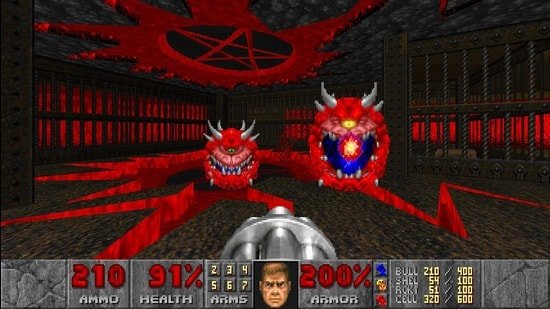
So it isn’t surprising that there’s a kind of CAPTCHA in which the user plays Doom to prove they are human. The premise is simple: kill three enemies.
But it isn’t as easy as it looks. Move forward, and you may be destroyed by fireball-throwing imps. Far better to camp at starting position and wait for the enemies to approach. I did this, and it took me two tries to clear the test.
The game, devised in 2021 by programmer Miquel Camps Orteza as a way to showcase his skill, is the simplest in a small but intriguing sub-genre.
CAPTCHA, that annoying genre of online tests that screens for bots by demanding that all users type out letters, or click on all the images of bicycle wheels, has spawned a host of online games, some of which play out over hours.
I’m Not a Robot unfolds, with rising intensity, over 48 levels and takes roughly two hours to finish. Fewer than 1% of players have passed. It begins with regular visual captcha tests: crosswalks, traffic lights, vegetables and so on. Suddenly, you’re playing whack-a-mole, hunting for words in a grid, searching for Waldo. There’s even a simulated parallel-parking level.
By Level 28, you’re a day trader monitoring a live stocks chart, trying to make $2,500. Success depends on reading trends, timing decisions and tolerating uncertainty — skills associated less with ordinary people than with the posturing of a LinkedIn lunatic.
Losing gives one time to mull over what makes this a test of being human. Is it simply the willingness to perform a task with no clear benefit? The stock-trading level, after all, doesn’t test human traits such as observation, empathy or creativity. It tests culturally specific digital literacy. Someone who couldn’t read graphs would fail.
What does it mean that the system simply isn’t made for them?
By the time one gets to the sliding tiles puzzle at Level 30, the whole thing has started to feel like an exercise in masochism too. It takes mulishness, not personhood, to make it to the end.
To be fair, CAPTCHA games present themselves as jokes or art projects. The difficulty is the point. The low pass rate is a feature, not a bug; a satire on the web’s escalating demands.
Proof of humanity becomes just another performance online. (Meanwhile, the internet, our twisty version of the Matrix, fills with agents trying to convince other agents of their humanity.)
Could these games also be proof of concept? Could real Completely Automated Public Turing tests to tell Computers and Humans Apart someday have users fight non-player characters to enter a site? Engage in a battle of wits; answer a riddle; play the stock market?
Do these experiments hint at a future in which proof of humanity becomes less about who one is and more about what one is willing to endure?
That isn’t as unlikely as it sounds. With so many AI-led algorithms already surpassing humans at discrete cognitive tasks, systems may increasingly rely on metrics of cost, in the form of time spent.
Humanity is already defined, in new CAPTCHA models, by inefficiency. We click randomly, scroll erratically, move much slower than the bots.
Could we eventually have to prove we are not robots by being a very particular kind of human: patient, adaptable, willing to play, no matter how long the game lasts? Would that be the first task the machines give us?
