

Do the names Marit Bjorgen, Ingemar Stenmark, Alberto Tomba, Kjetil Andre Aamodt and Katarina Witt evoke the same feeling of awe and wonder in you that Emil Zatopek, Nadia Comaneci, Usain Bolt, Michael Phelps and Katie Ledecky do?
Do they quicken the pulse and stir the soul? Invoke images of grit, glory and gold, across eras and geographies?
If the answer to these questions is in the affirmative, let us hurtle down this slope together. If you have no idea what we’re talking about, put on your snow goggles and stick around.
As the 25th edition of the Winter Olympics — or Milano Cortina 2026 — comes to a close today, it’s a good time to tune into sport’s ultimate song of ice and fire.
FULL CIRCLE
First, an event from this fortnight that defines the Olympic dream.
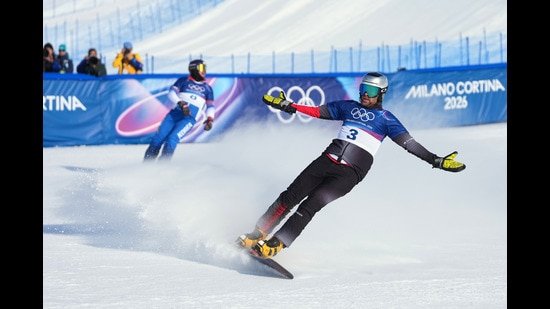
Benjamin Karl, 40, stood at the top of the hill in the final of the men’s parallel giant slalom. In front of the Austrian lay a 635-metre track littered with 32 gates through which he would need to make 30 turns while hurtling down on his snowboard at over 70 km per hour.
The reigning Olympic gold medallist from Beijing 2022, Karl’s challenger in the final, was 37-year-old South Korean Kim Sang-kyum, one of the surprise packages of the 2026 Games. Kim first stunned the world champion and local hero Roland Fischnaller of Italy in the quarterfinals and then got the measure of one of the favourites, Bulgarian Tervel Zamfirov, in the semis. The stage was set for an upset.
But Karl, likely to retire after the Games, had something special planned for his last hurrah.
As the lights turned from red to green, it was Kim who got off the blocks faster, dashing through the first few gates a tenth of a second ahead. That’s when Karl made his move. Instead of large horizontal loops on the snow, he stuck to a dramatic racing line that appeared to convert curves into straights. Suddenly, he started picking off Kim at every gate; building a comfortable gap by the time they entered the final 100 metres; even finding time to spread his arms wide as he crossed the finish line.
Karl sealed the historic back-to-back gold with a poster image for Milano Cortina 2026: he stripped off his shirt, did a massive weightlifter flex, and fell bare-chested onto the snow. It was a tribute to Austrian alpine skiing legend Hermann Maier, who celebrated victories in a similar manner.
“The Herminator” won two gold medals at the Winter Olympics in Nagano in 1998. A 13-year-old Karl, watching Maier’s heroics on TV, caught a spark that would forge a bond across generations in a way that only the Olympics can.
LEGACY CAST IN ICE
When French educator Pierre de Coubertin planned the first modern Olympics in April 1896, at Athens, winter sports were a casualty of scheduling.
The Scandinavian countries that excelled in winter sports were unhappy, of course, but there was little to be done. So, in 1901, inspired by Swedish sports administrator Viktor Black, these nations decided to start their own Nordic Games involving Sweden, Norway, Denmark, Finland and Iceland. These Games, which featured skiing, snowboarding, skating and curling as the main draws, were held between 1901 and 1926.
Meanwhile, the clamour for winter sports was growing within the International Olympic Committee. Figure skating was introduced at the 1908 London Olympics, though the competition was held in October, three months after the rest of the Games. Sweden refused to include winter sports at Stockholm 2012, and though Germany was open to the idea, World World 1 led to the cancellation of what would have been Berlin 1916.
The 1920 Olympics in Antwerp featured figure skating and ice hockey, but the issue was mired in a mishmash of logistics and politics. Finally, a landmark agreement was reached two years before Paris 1924 that the host country would hold a separate event — the International Winter Sports Week — in the shadow of Mont Blanc in Chamoix that January, roughly five months before the Summer Games.
This event was such a success that IOC pushed to have it rechristened, and eventually persuaded the Scandinavian countries that Chamoix 1924 was in fact not the International Winter Sports Week but, retrospectively, the first Winter Olympics.
The rings, flame, torch and motto arrived for the first time at St Moritz, 1928. The Winter Olympics, its medals at par with the Summer Games, were finally born.
The Winter Games were held alongside the Summer Olympics until 1992, when Lillehammer 1994, hosted by Norway, started a new four-year cycle in which the two Olympic competitions would fall in alternating even-numbered years.
FASTER, HIGHER, STRONGER
The true power of the Winter Olympics comes from the range of competition: the daredevilry of alpine skiing, the artistry of figure skating, the precision of curling, the pace of the ice hockey puck, and the speedy synchronicity of sleds darting through an icy pit.
It comes from the rivalries and camaraderie these sports inspire, the bevy of multiple gold-medal-winning champions mentioned at the top of this piece, and the stories of countless others who relentlessly chase the Olympic dream.
The Jamaican bobsled team, celebrated in the 1993 film Cool Runnings, were cheered on by frenzied fans at Calgary 1988 for making it to the Olympics though they came from a tropical island paradise where there were neither sleds nor snow.
And never forget Indian luger Shiva Keshavan, who not only introduced a new sport to the national consciousness but qualified against all odds for six Olympic Games, from Nagano 1998 as a 16-year-old to PyeongChang 2018 as the shining beacon of winter sports in the country.
For summer or winter, the Olympic spirit endures.
(The views expressed are personal)
